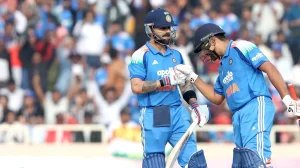
Samson followed up three games where he didn’t do well with one of the best hundreds of the season, leading Chennai Super Kings to a 23-run win over Delhi Capitals in Chennai. The opening batsman hit an amazing 115 from 56 balls; this performance showed everyone CSK’s season was starting again, and it showed how important straightforward, focused batting is in Twenty20 cricket.
Returning to basics after a lean run
Before Saturday, Samson had only made 6, 7 and 9 runs in his IPL 2026 games. He was annoyed by these low scores, but they actually helped him concentrate more. He said he was going to get back to the most basic parts of his game, with both his body and his thinking, because he hadn’t been scoring many runs.
“I’ve failed a lot. And failing a lot shows you how to get back into form,” Samson explained. “You start to wonder if you should be playing more aggressively or change your whole plan. You need to get your body and your mind back to basics.”
The mental reset behind the timing
For Samson, going back to basics didn’t mean playing very carefully. It meant really watching the ball, having confidence in his ability to hit it, and letting good timing do the work. He said he wanted to be in a different state of mind, seeing the ball earlier, and keeping still when he was at the wicket.
Because of this, he played brilliantly but with control. He hit fifteen fours and four sixes, not by swinging wildly, but by judging where the ball would bounce, hitting it later, and getting runs from any ball that wasn’t quite right. This is the usual risk and reward situation in the IPL, and he did it with a clear understanding.
A new shirt, same class: settling at CSK
This was Samson’s first season playing in yellow (CSK’s colour) after many years with Rajasthan. It can make even experienced players a little uncertain to join a new team, but he said the atmosphere in the CSK team made it easy to settle in. He said he felt that they trusted him, and that made him feel responsible to do well.
“It means a lot to me. The trust they showed in me made me feel a strong sense of responsibility,” he said. “It isn’t easy to start at a new team, but it didn’t feel like it. It was like a second home. We had a meeting today that lasted 50 seconds – and that’s something I appreciate.”
A hundred dedicated to Stephen Fleming
Samson’s way of celebrating was a thank you to Stephen Fleming, the head coach who has been with CSK for a long time and is known for being calm. “That was for Fleming,” Samson said. “I know how difficult it can be to lead a team for many years.” This fitted with the theme of the day: showing respect, being clear about what you’re doing, and the team being the most important thing.
Partnership that changed the innings
The point at which the game really turned around was when Samson and Ayush Mhatre scored 113 runs together; Mhatre scored 59 runs under pressure, which was surprising for someone so young. They played the middle part of the innings in a clever way, increasing their speed without getting anxious, and looking for opportunities to attack the bowlers.
Mhatre was confident, found gaps in the field and swapped places with Samson so Samson could set the speed of the innings. Samson said how well Mhatre thought things through and how he behaved, which suggests CSK might have found a flexible player for the middle of the batting lineup for the whole of the season.
Bowlers finish the job, DC rue fielding errors
Samson started the win, but CSK's bowlers finished it off with their consistency. The captain, Ruturaj Gaikwad, explained their plan: to take wickets by bowling the ball at a fast pace, and not just to try to stop the other team from scoring. Because they didn’t have a bowler who was outstanding in a special way, they relied on being clear, getting it right, and changing the speed of the ball at the right time.
“With the bowling, we did what we wanted,” Gaikwad said. “We were put under pressure in the first few overs but we recovered after that.” This recovery was the key part of the chase. Once CSK’s bowlers had got some of the Delhi middle-order batsmen out, the number of runs Delhi needed to win kept going up, the ball got softer, and they had fewer options.
Axar Patel from Delhi said that Delhi’s fielding had made things even worse. They dropped catches and made small errors, which turned singles into twos and allowed CSK’s batsmen who were already scoring runs to continue to dominate. "The fielding was what made the difference,” he said. “Losing wickets quickly made it difficult to get back into the game.”
The weather didn’t give Delhi a good excuse. Although it got damp in the second innings (called dew), CSK’s bowlers were good enough with the ball to reduce the effect of this. They bowled at the batsman’s hips and at the top of the stumps, forced them to make mistakes when trying to hit the ball to the side, and aimed for the longest part of the boundary later in the innings.
Looking at the way the game was played, CSK have now found a way to win. They should have batsmen who can score runs at the end of the innings, work well together in the middle of the innings, and the bowlers should work together with a clear plan and do more than you’d expect from their speed. Against Delhi, all of these things came together.
For Samson, the hundred was a chance to start again and a reminder of what he is capable of. He can play aggressively at the beginning of the innings, stay in to bat during overs 7 to 15, and score quickly at the end. When he concentrates on keeping things simple, his timing is so good that even good balls from the bowler seem easy to hit.
For CSK, this is their first win after losing three games. But how they won is more important than the fact that they won. One of their main players is now in good form, a young player did well, and the bowlers did what they intended. This is how you change a season around in the IPL.