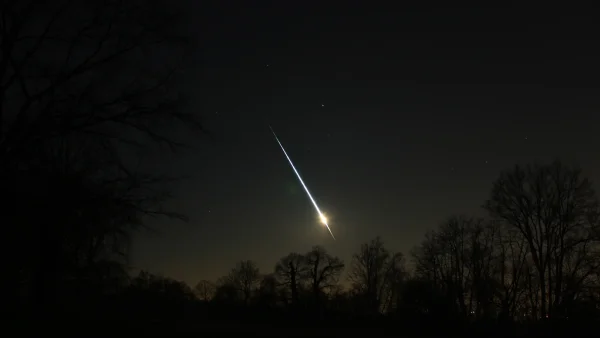
NASA says that asteroid 2023 HB4 is about the size of a house and will come no closer than roughly 4,000,000 miles on April 12, 2026. This close pass isn’t a danger and provides a good opportunity for science and for improving our ability to track things.
Asteroid 2023 HB4: key facts
Being a “near-Earth object” means 2023 HB4’s orbit brings it fairly close to where Earth goes around the sun. Astronomers think it’s about 48 feet in diameter, about as big as a small house or a large bus, and they’ve figured this out by how much light it reflects and from their observations.
Since it was found in 2023, astronomers have been keeping track of it and it’s now on the regular list of things to watch. They’ve worked out where it will be on April 12, 2026, and know for sure it won’t cross Earth’s path when it gets closest.
Distance and risk assessment
It will pass by at approximately 4,000,000 miles, which is a lot further than the moon (the moon averages 238,000 miles away). This is a very safe distance in astronomy and experts don’t think it will collide with Earth during this particular pass; the risk assessments are always careful.
Space agencies use a score to show how likely an asteroid is to hit Earth and they are constantly updating the asteroid’s path as they get new information. With 2023 HB4, lots of observations have confirmed it won’t be considered dangerous when it goes by on April 12.
Scientific value of the flyby
Even when asteroids are millions of miles away, when they come close, scientists can get better at predicting their orbits and learn how asteroids act. Every time they watch it, they can improve their predictions of how small pulls of gravity and heat changes affect where it goes.
If possible, they can also learn about what it’s made of and what its surface is like using spectroscopy and radar. Knowing these details helps us understand the history of our solar system and helps with planning for future trips to similar objects.
Monitoring and planetary defense efforts
NASA and other space organizations around the world have a network of telescopes and radar that are used to find and track near-Earth objects. These systems find, follow, and learn about things like 2023 HB4 so that people in charge have the most recent and accurate data in case of a real threat.
They continue to observe, and this often involves both professional astronomers and amateur ones. Space agencies share what they learn through official sources and public alerts to be open and share new information quickly.
How to follow the event and what to expect
You won’t be able to see this asteroid just by looking at the sky, and you’ll probably need a telescope or a live feed to watch it. Amateur astronomy groups and observatories might have online events to show the asteroid’s path and explain the data as it comes in.
If you are interested in following this event, look for updates from space agencies and science organizations that publish where the asteroid will be and when it’s best to observe it. The pass on April 12 shows how important it is to keep watching and how much better we’re getting at protecting the planet.