The first lunar eclipse of 2026 is on Holi, which is a pretty important time for astronomy and the festival itself. Chandra Grahan March 2026 is a complete lunar eclipse, and quite a lot of people in India – and other countries – will be able to see the Moon go into the Earth’s shadow. Here are the important details, when it will happen, and what people generally do.
Date and what the Chandra Grahan March 2026 is about
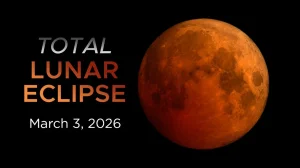
Chandra Grahan March 2026 is on Tuesday, March 3, 2026, and it’s at the same time as the Holika Dahan. The eclipse has the Moon in Leo, and in the Purva Phalguni nakshatra. It’s a complete lunar eclipse in astronomy, and for a lot of people it’s a really important Chandra Grahan.
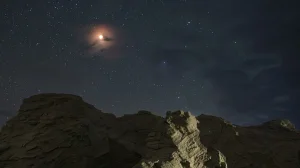
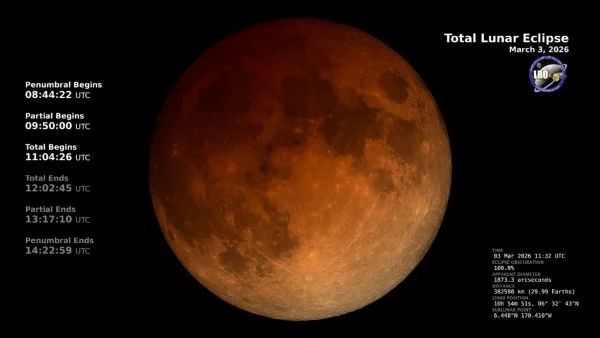
The entire eclipse period isn’t very long, but it is striking. Traditional calculations say the complete part lasts around 20 minutes and 31 seconds, which makes the dramatic sight of a red, or 'Blood Moon‘, when the eclipse is at its biggest.
When the eclipse phases happen
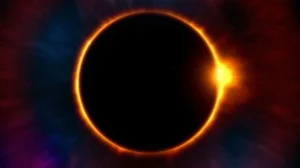
The eclipse starts with the penumbral and umbral stages, then moves to totality, and finishes with the penumbral stage. The main times in universal time are: first penumbral contact around 2:16 PM, first umbral contact around 3:21 PM, the total phase starts around 4:35 PM, at its highest point at 5:04 PM, the total phase ends at 5:33 PM, last umbral contact at 6:46 PM, and last penumbral contact near 7:52 PM.
The most visually interesting part – for most people – is the total phase between approximately 4:35 PM and 5:33 PM universal time. Local times in India will differ depending on where you are, and the Moon will often be coming up as the eclipse phases are already happening for many.
What times the eclipse can be seen in cities in India
Some local times for the best part to see it are: Delhi 6:33 PM to 6:47 PM, Mumbai 6:33 PM to 6:47 PM, Chennai 6:28 PM to 6:47 PM, Kolkata 5:39 PM to 6:48 PM, Hyderabad 6:26 PM to 6:47 PM, Ahmedabad 6:32 PM to 6:47 PM. These show the time around the biggest point of the eclipse, and when it ends in each place.
Remember that the east and northeast of India may have different times for the Moon to rise, and some places in the far west may miss some of the eclipse. People who want to watch it should check a good local panchang or astronomy timetable for the right times for their town.
When Sutak Kaal is, and what people do traditionally
Sutak Kaal – the time that isn’t good luck, and is observed before eclipses – will be in effect on March 3rd. One time often given in panchang places the start of Sutak at about 9:39 AM, and it ends at 6:46 PM on the day of the eclipse. Other traditional calculations put the start earlier, around 6:20 AM, depending on local practice and rules.
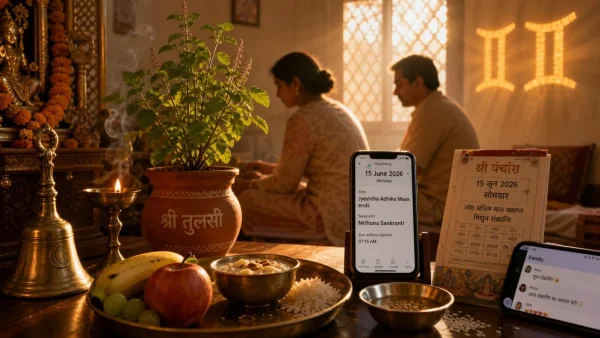
During Sutak, a lot of families and temples do what is usual: not doing religious worship, closing temple doors, and stopping some things. After the eclipse ends, people usually do cleaning, like washing with holy water, and cleaning places of worship, then normal prayers and activities start again.
Where the Chandra Grahan can be seen in India and the world
The Chandra Grahan will be visible across most of India, though it will be different in each area. Most of the country will be able to see at least some of it at moonrise, while some areas in the northeast and island areas may see later parts of it, or not much at all. The furthest west may miss some of the event.
Outside India, the eclipse will also be visible in parts of East Asia, Australia, the Pacific, and the Americas. How good the view is will depend on the weather and what the horizon is like locally, so clear skies and an open eastern horizon will give you the best chance of a good view.
What the Blood Moon means in astrology and the scientific reason for it
In astrology, the Moon is very important as a key sign of feelings and everyday life. A lunar eclipse is often seen as a time when things are made stronger or changed. A lot of people who follow this do extra religious things, think about things, or restrain themselves during and after it.
In science, the 'Blood Moon‘ happens because the Earth stops direct sunlight from getting to the Moon, and scatters the shorter wavelengths in the air around the Earth. Red and orange wavelengths shine onto the Moon, giving the eclipsed Moon a dark, copper colour that people often find really impressive.