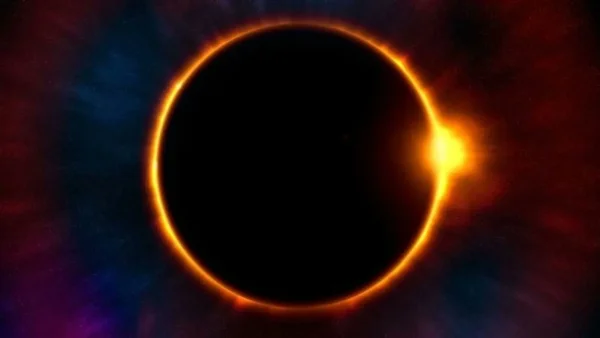
An annular solar eclipse – a ‘ring of fire’ – will happen on February 17, 2026, when the Moon goes between the Earth and the Sun, but it won’t quite cover the Sun. Because the Moon will seem a little smaller in the sky, a bright ring of sunlight will be left around the Moon’s shape.
What the annular eclipse will look like
During an annular eclipse, the Sun will not get completely dark. A strong ring of sunlight will be around the Moon, and will stay visible when the eclipse is at its greatest. This is a striking sight, although it is not the same as a total solar eclipse, as some sunlight still gets to the Earth around the Moon. At the places where the eclipse is fullest, the ring of fire will last for nearly two minutes and twenty seconds. In other places, people will see a partial eclipse, with the Sun looking as though a piece has been taken out of it. The colour of the sky and shadows will change, but it won’t become night.
Where the full ring will be visible
The small area of the eclipse where it is fully annular goes almost entirely over Antarctica. No large towns are directly in that area. Just a few research stations at the South Pole will see the full ring as the Moon’s antumbral shadow goes over the frozen land. The teams at Concordia Research Station and Mirny Station are set to experience the full phase for about two minutes and twenty seconds. These isolated groups will study the air and the Sun while giving their findings to scientists and the general public.
Cities that will see a partial eclipse
A lot of cities in the Southern Hemisphere will see a partial eclipse on February 17. How much of the Sun is covered varies a lot: Cape Town will see about five percent covered, Durban about sixteen percent, Port Louis in Mauritius around thirty-one percent, and Antananarivo in Madagascar almost twenty percent. Other places that will see a partial eclipse are Punta Arenas, Marambio Base, Orcadas, King Edward Point, Bouvet Island, Casey, Marion Island, Port-aux-Francais, Port Elizabeth, Amsterdam Island, Mafeteng, Maseru, Teyateyaneng, Johannesburg, Pretoria, Gaborone, Mbabane, Maputo, Harare, Diego Garcia, Saint-Denis, Toamasina, Lilongwe, Mamoudzou, Moroni, and Victoria. Partial coverage means the Moon blocks only part of the Sun. With the right eye protection, the Sun will look as if it has a curved cut in it. The change is not very obvious when little of the Sun is covered, but is clearer when more is.
Why many regions, including India and the UAE, will miss the eclipse
The Moon’s shadow for this eclipse is far to the south of most areas where people live. The Indian subcontinent and the UAE are well to the north of the path, so people living there will not see any change in the Sun that day. The way the planets line up controls whether you can see it, more than how much people want to. Around the world, the time for the event is roughly from 3:26 pm IST to 7:57 pm IST, but these times do not mean there will be eclipse phases in areas outside the southern track. People who want to watch should check local times and maps showing where it can be seen.
How to watch safely and where to stream
Never look directly at the Sun without eclipse glasses which have been officially tested, or solar filters made for looking at the Sun directly. Normal sunglasses do not give enough protection. If you want to watch with binoculars or a telescope, put a proper solar filter over the front lens. As the path is over remote Antarctica, many space agencies and research stations will show the event live on the internet. Watching a live broadcast lets people enjoy the ring of fire without special eye covering. Follow official scientific and research channels for reliable live feeds.
Viewing tips for photographers
Use a strong tripod and a solar filter on any camera lens to protect your equipment and get pictures of the Sun safely. Set the exposure for the bright ring, not for the sky around it; take a series of exposures, and try short bursts at the time of greatest annularity. If you want to photograph a screen or livestream, do not point a camera without a filter at the Sun. Practice what you will do and when, beforehand, and put safety before getting a single picture, so that you can enjoy the eclipse responsibly.