You may be seeing a lot of chatter about this on your feed. There’s a reason for that. Tonight, Venus, Mercury and Jupiter are making their way into the same low-lying part of the west, but in the U.S. you won’t have much time for it. Make a point of going out as soon as the sun goes down or you’ll be too late.
When and where to make the most of it
Forget about a midnight stargaze; this is a twilight affair. The ideal time is 30 to 60 minutes after sunset, once the light has died down enough for the planets to stand out but before they’re gone.
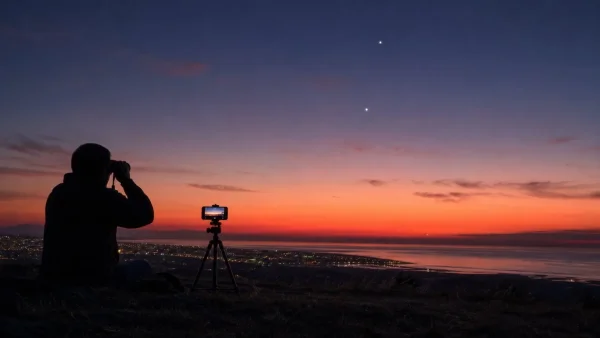
Turn to the west or west-northwest and find an open vantage point. A beach, a field, a roof or a hilltop is far better than a city block. Any obstruction like a tree or a mountain will put an end to your view of Mercury in a hurry. You have maybe 30-45 minutes before he and Jupiter set.
What to expect
They will be in a soft diagonal over the horizon. Venus is the one you can’t miss – the brightest and the one you will fixate on. Jupiter is there too, but the haze near the horizon will wash some of it out.
Look a little to the right of Venus and you will spot the rest. Mercury is the one hugging the ground, the dimmest and the first to go. As for the details: Venus is an 80%-illuminated gibbous, Mercury is half-lit and Jupiter is a bit of a larger disk.
A few things to do for a good look
Here is a simple way to make the most of the short time you have:
– Be there and get your bearings before the sun is under the line
– Make sure you have a clear run at the western horizon
– Begin looking 30 minutes in
– Rely on binoculars for a better fix on Mercury
– Get some wide-angle shots while the light is right
– Don’t count on more than 30-45 minutes of good viewing
Don’t have a scope? Fine
You don’t need one for this. Once the sky is dark, Venus and Jupiter are plain to see. Binoculars will do the trick for Mercury. And a phone with a wide lens is all it takes to put the three of them in a nice frame with the twilight behind them.
How we got here
It’s what the pros refer to as a planet parade when you have a bunch of them in one area. They are, of course, millions of miles from each other, but since they all follow the ecliptic, they can look like they are in on the same thing from where we are standing.
This week is the payoff to some earlier activity. On June 9, Venus and Jupiter were in a tight conjunction. Now, from the 11th to the 15th, Mercury is in the mix, and you have your mini parade in the west as the day ends.
Some pro advice for less than ideal circumstances
It comes down to timing and where you are. If you dally, Mercury will be under the horizon and the light pollution will make up for it. Haze on the horizon? Go higher where the air is better and you have a flatter view.
Have a look at the weather. A wisp of cloud can put a stop to the show. In town, you can use binoculars to cut through the glare for a peek at Mercury, then put them away and take in the whole picture.
What’s in store
But the parade is only the beginning. On the 17th, a sliver of a Moon will come in for a lunar occultation of Venus. For those in certain parts of the U.S., Canada, Brazil and Venezuela, Venus will be hidden for a moment and then come back out from behind the Moon.
One word of caution: keep your optics, whether binoculars, a telescope or a camera, well away from the Sun unless you have the right gear for it. You can do some damage to your eyes in a hurry.
In a nutshell
An unassuming kind of sky-watching with a lot of impact. Go out a bit after the sun, zero in on Venus and you will have Jupiter and Mercury in your sights before they are done. If the skies are with you, it will be well worth the 30-45 minutes.