With this $60 billion acquisition of Anysphere, the rocket maker is wading in to the business of software development infrastructure. They want to make their workflows sturdier and faster, and in the process, ruffle some feathers in the market for AI coding tools.
What they are putting down for
Cursor is an editor made for AI from the ground up, with large language models at its heart. Having that in-house means SpaceX can be a bit more hands-on with the source code, the dependencies, and what the models put out for systems they can’t afford to have fail.
Don’t think of it as just another app to get work done. It’s about having your finger on the pulse of the whole stack. When you control the tools, you can cut down on build time, sidestep some third-party headaches, and build up some know-how that carries over from one program to the next.
The numbers and the when
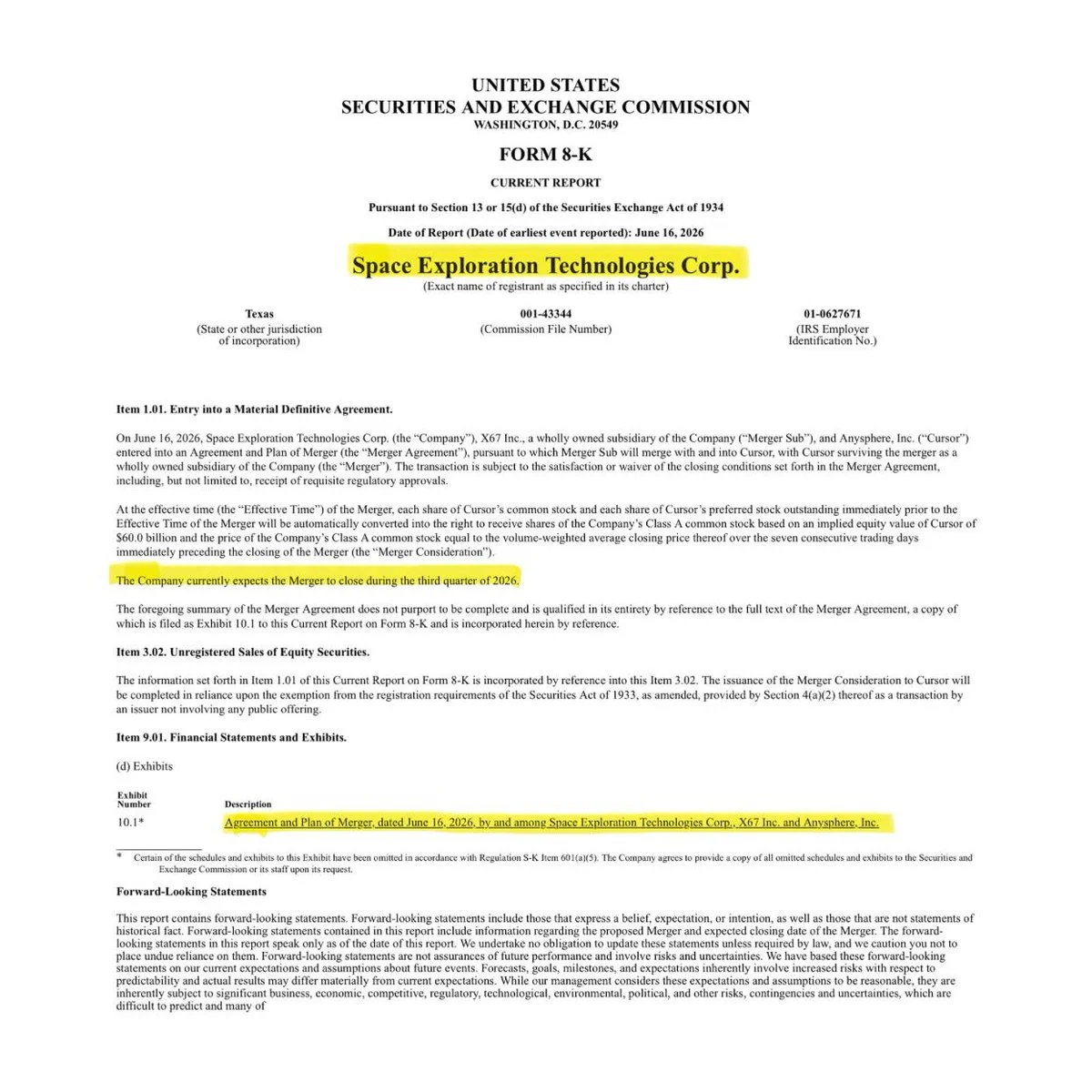
According to a filing, Anysphere, Inc. will be bought by SpaceX and made a subsidiary. They plan to have the merger in the books by Q3 2026, which gives them a hard date to work with for integration and talking to customers.
$60 billion is a lot to put on a developer tool. But for SpaceX, it’s not a side thing; it’s as much of a strategic piece of the puzzle as a cloud platform or a steady supply of chips would be.
You can read the room like this:
– Tooling has become the front line of infrastructure
– There’s no better way to be on the offense (and defense) than to integrate vertically
– The enterprise is going to want options that are secure from the start
How the rest of the field will react
There is no shortage of players in AI-assisted dev right now; the big cloud providers and model labs have their copilots in every IDE. But what SpaceX is doing is a bit of a departure: they are latching an AI editor onto one of the most high-strung engineering outfits you’ll find.
It puts a slant on the market. On one hand, Cursor has a testbed the size of an aerospace programme to see if features hold up under pressure. On the other, SpaceX can nudge the product in the direction of being reliable and compliant, not just chatty.
So why should a dev or an enterprise care?
For the people writing the code, you might see a shift toward tools where you can trace what’s happening, run things in a sandbox, and have builds you can count on. If that makes its way out there, we may see AI move from being a helper to something you can put in an audit report.
Big companies want to know who has the keys to the code and where the data is living. An editor that has been put through its paces at SpaceX and is built for speed and safety could be the go-to for any sector where you can’t have a vendor holding all the cards but still need to move fast.
The upside, and where it could get tricky
SpaceX is of the mind that if you own the place where the code is written, you can close the gap between an idea and a deployment. That means quicker turnarounds on everything from avionics to the back-end of Starlink.
Then again, you have to be careful. There is a whole community of users for Cursor who want an unbiased, no-nonsense product. Keeping up with innovation while also satisfying SpaceX’s internal standards for reliability is going to be a test of their product management.
Some of the nitty-gritty comes down to this:
– Is Cursor going to let you be private and flexible with your models?
– How do you put in the security without making it a pain to use?
– Will the price be right for both the enterprise and the masses?
Looking ahead
Before they wrap up in 2026, you can bet SpaceX and Anysphere will lay out how they plan to put this together. Customers will be watching for some straight talk on data, service levels, and whether everyone gets a fair shot at the new stuff.
Do it right and this could be a wake-up call for the industry. We’re not just talking about a clever tool anymore, but one that is secure, has output you can measure, and is made for heavy lifting. The AI coding space has a new kind of player in it now.