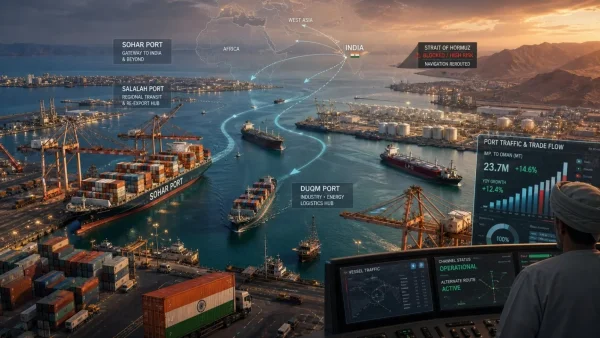
The war in Iran and the pressure on energy routes have forced us to draw new lines on the map, and Oman is right in the middle of it. If you look at the Commerce ministry’s figures, there has been a quick about-face in who we are trading with. We are making hard calls on energy security and moving logistics around so the goods don’t stop.
Oman: the new energy pivot
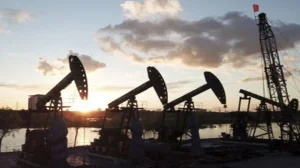
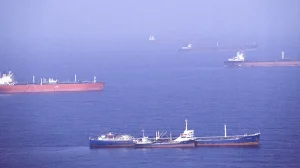
With the Strait of Hormuz under a blockade, what was once a side note in our relations with Oman has become a strategic opening. The free trade deal we put in place this month has put Sohar, Salalah and Duqm in play for Indian cargo heading into West Asia and the UAE.
The stats don’t lie. In the first two months of the financial year, we’ve seen imports from Oman go up 3.8-fold to $3.4 billion. That has them in the top 10 now, up from 30th in April-May 2025. For May alone, official data puts the value change at 305.66%.
Rajesh Agrawal, the commerce secretary, will tell you that Oman’s part in the transit game has let our exports to West Asia get back to where they were last year. But he is also the first to point out that we are still seeing some headwinds on the way in. Imports in the region are down some 18% because of the supply hiccups.
A reshuffling of the import deck
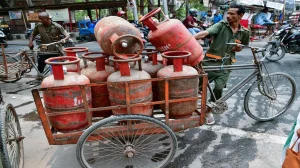
It’s not just Oman. The pecking order has changed. The UAE has had to make way for fourth, with Russia back in second and the US in its wake. We have been after more LPG and it has meant more tonnage from the US, which is part of a larger, energy-driven reordering.
We are also looking to South America for fuel. Brazil has come on strong with a 2.8 times increase in imports, to $2.7 billion. Peru is no exception; with over $2 billion in shipments, it has moved up to be our 20th largest source, from 35th a year ago.
Here is what the changes look like:
– $3.4 billion in from Oman, putting them at 10th
– The UAE at number four for April-May
– Russia and the US in the top three, thanks to LPG
– $2.7 billion from Brazil, and more than $2 billion from Peru
When it comes to exports, we are following the arbitrage
On the way out, Singapore has made a run for it. In April-May it passed both China and the Netherlands to be our third biggest market, only $180 million behind the UAE. You have to put that down to oil products being sent another way since the trouble in West Asia clogged up the old paths.
We’ve seen a 2.2 times growth in exports to Singapore, to $5.1 billion. Even with the barriers, we still put over 25% more goods to China. And we are making inroads in Africa, too, for a bit of variety beyond the energy sector.
Take Tanzania. They are now our eighth-largest destination, a far cry from 25th last year, with oil and gems and jewellery leading the way. ‘In April-May last year we did $800 million with them, this year we are at $2.2 billion,’ says Agrawal. Then you have Sri Lanka at 12 with $1.8 billion in exports, and South Africa at 10.
‘For May, we were a little down in West Asia at $5.30 billion versus $5.38 billion in 2025,’ he adds. It is a small thing, but it shows the supply line is still not as smooth as we would like.
The big picture and what lies ahead
Trade is growing, but it is running up the bill. Exports in May were up 18 per cent to $45.2 billion, but we put in 20.62 per cent more in imports, at $73.41 billion. The deficit is $28.21 billion, and it is the cost of the energy we have to bring in.
All told, we have $88.91 billion in exports for April-May 2026-27, a 16.09 per cent gain. What you have is a situation where Oman is doing some of the heavy lifting for West Asia, and our need for LPG is re-writing the list of who we do business with.
But it is more than just finding a detour. Having a way in through Oman means we are not as exposed to what is happening at Hormuz. And with partners in places like South America and Africa, we can take a hit without it breaking us. The question is how to make sure these new lanes hold up while the conflict drags on.