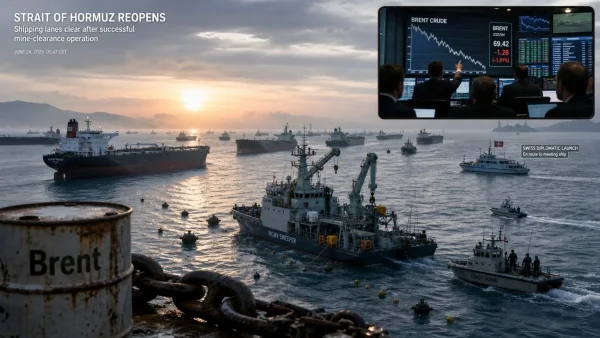
You could say the oil call from Wall Street has done a 180 after the move to unblock the Strait. Both Goldman and Morgan have trimmed their crude projections, on the hunch that we’ll see Persian Gulf output come back before the rest of the trading desk can worry about it. The change of tune, put out on June 16, 2026, is a sign of ebbing risk premiums and a fresh set of expectations for Brent.
Why Wall Street is recalibrating
There’s an interim understanding between the US and Iran that has put some life into the idea of normal shipping in this vital artery. You can see it in the prices: they’ve given up ground to the softest point since the start of March, even as people in the market are still asking for hard numbers on the when and how of it all.
Formalities are to be put in ink in Switzerland this Friday. We don’t have the fine print yet, but Morgan Stanley is viewing the pact as a way to cool things down and let more product through the strait.
Diverging timelines, similar destination
Goldman is the one with the most optimism on the timing side. Daan Struyven and his team are now of the mind that by late July, we’ll be where we were before the war. They’re making a play that once the accord is done, the old constraints will just fall away.
Morgan Stanley is a bit more conservative. They figure it will be a few weeks to get the tankers moving again, not just to clear the mines but to win back the trust of shipowners and underwriters. Some of those vessels have to make the trip back to the area, too.
They put a lot of weight on the order of operations. You have to empty the export tanks before you can build up production. An empty tanker coming in is as important as a full one going out. By their count, half of what was lost should be back in September, 80% by year-end, and the remainder in early 2027.
New price decks for Q3 and Q4
The numbers have changed in a big way. Goldman is looking at $80 for a barrel of Brent in the last quarter, no longer the $90 they had before. If the flow of goods holds up, the conflict premium is all but gone.
Morgan has made its own adjustments to the physical benchmark. They are calling for Dated Brent to run $90 in the third quarter – a step down from $100 – and $80 in the final three months. It’s a reflection of supply from the Gulf coming back sooner than was thought.
Market implications beyond the headlines
Open up Hormuz and you get more barrels and less of a rollercoaster. You might also see refinery margins and freight rates come to terms with the return of tonnage and the insurance to go with it.
But don’t forget the risks of putting it into practice. Producers, traders and ship operators are still waiting for the last word on the deal. How fast the mines are dealt with and idle capacity is put to work will be what makes or breaks the new price targets.
What to watch next
All eyes are on the signing in Switzerland and the first round of shipping figures. A hiccup in the clearing, or with the insurers, or in where the tankers end up, and you won’t be hitting Goldman’s July mark so easily.
Here is what the investors are keeping tabs on:
– $80 for Brent in Q4, says Goldman
– Was $90 before
– $90 for Dated in the third quarter (Morgan Stanley)
– $100 was the old number
– $80 in the fourth (Morgan Stanley)
– Normalized exports by July’s end (Goldman)
– 50% of output by September (Morgan Stanley)
– 80% in December, the rest in 2027
The strategic picture
The word from the street is plain: a working Hormuz means less in the way of supply risk and lower price decks. Should the flows come in on this new schedule, a $80 Brent in Q4 is a fair bet. But if the logistics side of things lags, you can expect Morgan Stanley’s more gradual view to hold sway.
One way or another, we’re moving from a place of fear to one of results. The water over the next few weeks will tell us who’s right.