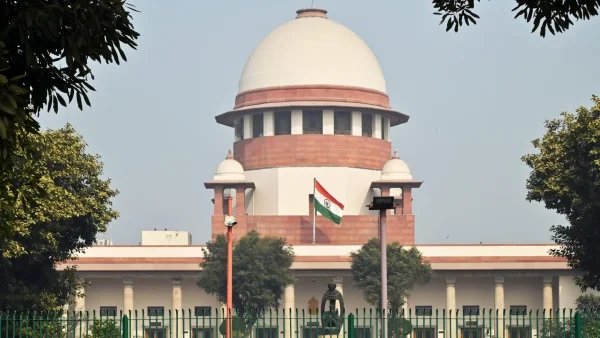
By staying the Delhi High Court’s decision to free Khan, the top court has put a finer point on the country’s debate: do you reform or do you see to justice for the 69 who perished in the 1993 Bowbazar case? For the time being, the stay means Khan, after 33 years in, is not going anywhere.
Why the stay matters
You have to ask if 33 years of good behaviour can make up for a terror conviction. West Bengal took its case to the Supreme Court after the Delhi High Court, back on June 5, made the call to release him early based on his record and the length of his time in custody.
The state’s position was that you can’t just let a life convict in a terror case go and expect it to be right by the ones left behind. The Supreme Court has agreed to look into it and has put the brakes on the release for now.
What the Supreme Court ordered
Justices PK Mishra and Sanjeev Sachdeva of a bench at the top court have stayed the Delhi High Court’s order and sent out notices to both Khan and the Union in response to West Bengal’s petition. They will be back to this on July 28th.
In a short hearing, the bench made note of the fact that Khan has been called the mastermind here. There can be only one of those in any given crime, and the court seems to be mulling over that.
Here is what the court has put on the table today:
– The Delhi High Court’s order to release is no more
– Notices are with Khan and the Centre
– We’ll hear from them on July 28th
State’s objections and the defence’s stand
For West Bengal, Additional Solicitor General SV Raju had some hard questions for the High Court about its use of reformative theory in a case of this magnitude. He also made reference to the State Sentence Review Board, which the state says was not in favour of an early exit for Khan.
Khan’s side has asked for the court to stay out of it. He is 77, in poor health and has been in for 33 odd years. They also pointed to Pannalal, a co-convict, who was let out in 2014 as a matter of record.
How the High Court viewed the case
When the Delhi High Court went along with Khan’s plea on June 5, it was because of his long time in and his conduct. The thinking was that the point of punishment is to put a man back in society.
There was also a recommendation for his release from the State Sentence Review Board in 2015, though they did a U-turn and nixed it in September of that year.
Conviction and legal backdrop
Khan was found guilty on August 31, 2001, under the IPC, the Explosives Act and TADA for what he did in the Bowbazar affair. TADA is the old guard of the Unlawful Activities (Prevention) Act we have today.
He was set to be out after 33 years until the Supreme Court stepped in. With the stay, he is in custody while the top court puts the High Court’s logic to the test.
The 1993 Bowbazar blast
It all goes back to the night of March 16, 1993 in Kolkata’s Bowbazar. A bomb went off, 69 were dead, buildings were in pieces and many more were hurt. One of the worst the city has seen.
The story is that a stockpile of explosives in a thickly populated area was the cause. That kind of damage is why any talk of remission is so charged.
What comes next
After we get the word from Khan and the Centre, the Supreme Court will have another look at it on the 28th. What they say will be a telling moment for how India handles the line between reformation and safety in these kinds of cases.
For now, Khan isn’t leaving. And the families in Bowbazar are left to wonder if they will find any closure in a system that is still deciding whether to put a premium on rehabilitation or on keeping him in.