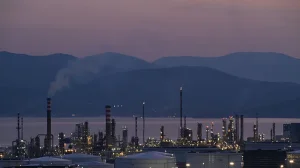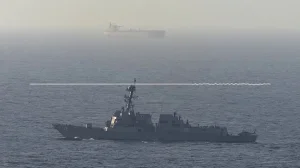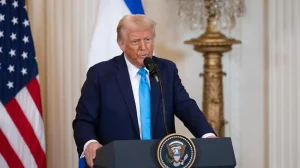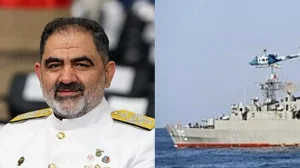
The situation around the Strait of Hormuz has become much more dangerous. Trump says Iran’s armed forces have been defeated, and the US and its allies are tightening a naval blockade. On May 5th, 2026, the White House said Project Freedom is absolutely necessary to protect shipping and to keep oil flowing.
A chokepoint and a global bill
Military leaders in the US are saying this isn’t just a theoretical problem. General Dan Caine says that Iran’s Islamic Revolutionary Guard Corps has been using trade as a weapon for the last seven weeks by going after merchant ships in the Strait of Hormuz.
Twenty percent of all the oil used in the world goes through this narrow waterway. Caine says Iran’s actions are against the Law of the Sea, which gives rights to ships to sail through, and it’s like holding the world’s economy hostage.
Trump’s sweeping claims of Iranian collapse
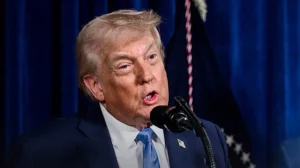
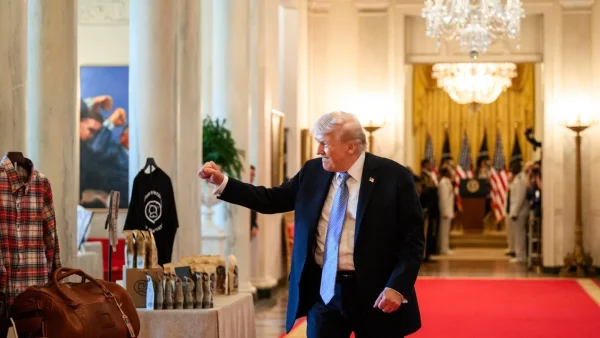
Trump, speaking from the Oval Office, said Iran’s military structures and leaders have been completely broken down. He says the Iranian government pretends to be strong on television, but privately admits to being weak, though he didn’t show any proof of this.
Trump stated ‘Iran doesn’t have a chance, they never did, and they know this’ and explained that US pressure has completely destroyed Iran’s ability to defend itself.
Trump mentioned ships they’ve stopped and complimented the US Navy for doing a fantastic job with the naval blockade in the area. He also said ‘We are the most powerful country in the world’, and claimed that Iran’s navy, air force, defense systems, radar and top leaders have all been ‘totally destroyed’.
What officials are saying, at a glance
Here are the core statements shaping policy and perception today:
– Trump says Iran’s military and leadership are ‘wiped out’
– Caine calls the strait disruption economic hostage-taking
– The strait moves 20% of global oil consumption
– Hegseth brands Project Freedom ‘locked and loaded’
Project Freedom and the stated mission
Secretary of War Pete Hegseth, at a press conference with others, described Project Freedom. He said it is a short-term, protective action to end Iran’s interference with ships in international waters and to bring back security to the seas.
Hegseth made it clear that the goal is limited: to keep commercial ships safe and stop further attacks, and not to make the conflict larger. Officials have repeatedly said the operation is about enforcing the right of ships to use the waterway.
Why it matters now
The rules of the sea and how stable the market is come together at Hormuz. If something blocks 20% of the world’s oil supply for any length of time, it could cause the cost of shipping and the price of energy to go up and up. US officials say Iran is using this as a way to get something, and Project Freedom is meant to weaken that power.
The way Trump is talking is also a tactic. By saying Iran’s military is already ‘destroyed’, Trump is trying to discourage Iran from doing anything, and is attempting to control what people think will happen and for how long any fighting at sea might last.
What comes next
US officials say the most important thing is that commercial ships can continue to go through without being stopped, and that the harassment at this important point in the sea is stopped. Trump says the success of the blockade will be shown if oil tankers and cargo ships go back to their normal routes in the next few days.
Right now, the Pentagon (the US military headquarters) is taking a protective and limited-time approach. The government says Project Freedom is a response to seven weeks of threats and attacks on ships, and is specifically meant to bring back safety to the seas and enforce the established right of ships to sail through.
With this in mind, what Iran says and does publicly and any incidents that actually happen at sea will decide whether the operation stays under control or if it will face new problems. Shippers, insurance companies, and the energy market are all at risk from even a short-term interruption.