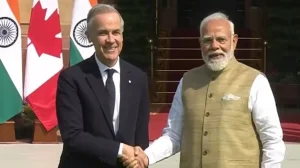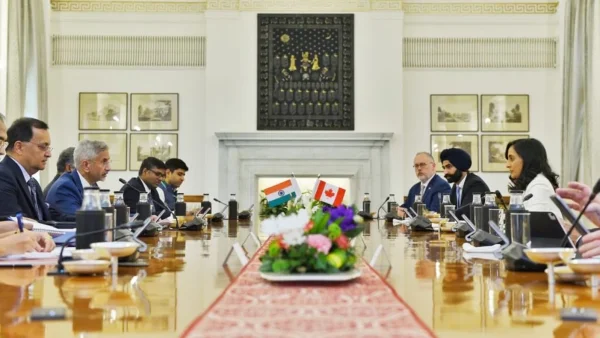
Prime Minister Mark Carney of Canada said that Canada and India are working on this comprehensive economic partnership agreement, with the aim of doubling trade in both directions by 2030. He told people at a meeting that the deal is likely to be signed before the end of the year, while he is visiting India for four days – a part of efforts to make the relationship between the two countries stronger, and to create new economic opportunities.
How talks are going, and the political support for them
Carney presented the agreement as the result of a planned move to improve relations after he became prime minister. He said that reaching out to India early on – like inviting it to the G7 Summit, and working with it at the G20 – had made it possible to move more quickly on trade, security, and technology.
Government people are working on a comprehensive economic partnership agreement which would cover goods, services, investment and how regulations work. The Canadian government wants to finish the talks this year, to show that both sides are politically willing to act fast and put a trade framework in place which is important for the long term.
What trade will focus on: food, energy and critical minerals
Canada wants to be a supplier that India can rely on, to meet its increasing needs for food and energy. Carney stressed that Canada is a major power in food and energy, and said that at first, cooperation would be about increasing exports of farm products, trade in energy, and investment in infrastructure.
Critical minerals and metals are very important to the partnership. Canada wants to supply minerals for India’s manufacturing and clean technology industries, and India’s demand will help with larger investment in mining, turning minerals into useful products, and building up supply chains on both sides.
Working together on nuclear power and plans for clean energy
Another main part of the agreement is working together on nuclear power – from a long-term supply of uranium, to jointly developing both large reactors and small modular reactors. Carney said Canada is a reliable partner for nuclear fuel and technology which can help India increase its amount of low-carbon power that is always available.
He also said that India could help Canada reach its goal of doubling the size of its clean power grid by 2040. Joint projects in renewable energy, technology for sending power over long distances, and modernizing the grid could create jobs and cut emissions in both countries.
Cooperation in technology: AI, quantum computing and new ideas in defense
Carney stressed that India’s strengths in artificial intelligence and the digital economy fit well with Canada’s goals of making things commercial and improving defense innovation. He suggested working together on AI, quantum technology and research which could be used for both civilian and military purposes, to speed up the use of new ideas in industry, and make security partnerships stronger.
It will be important for policy to be the same on data control, intellectual property and funding for innovation, so that links in research can be turned into commercial results. Working together on this could help companies grow faster and reach wider markets in North America and Asia.
What the agreement would mean for the economy, and the next steps for businesses
If the agreement is successful, businesses in both countries could see trade barriers lowered, clearer rules for investment, and better access to government buying and service markets. Canadian companies which export agri-food, energy and critical minerals could get new positions in the market, while Indian technology and manufacturing firms could grow into North American supply chains.
People who are negotiating still need to deal with questions about regulations, labour and the environment, and the private sector will have a key part to play in putting the agreement into practice. For now, the agreement shows a move towards Canada and India becoming more closely linked economically, with goals that can be measured – like doubling trade by 2030.