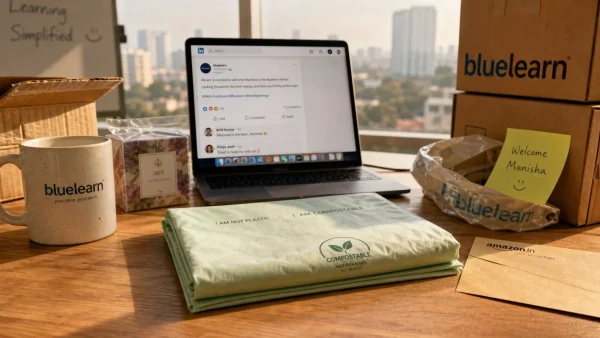
She was in for a surprise on day one. In place of the standard onboarding trinkets, there was a lone compostable bag on her desk. She put it out there on LinkedIn and now people are talking: is it time for offices to let go of the plastic and get down to business with some no-nonsense, low-waste items?
A welcome that did something useful
Manisha Dubey, a brand strategist, put it this way: her company, Bambrew, left the mugs and vouchers alone and gave her what she needed. Fresh in a new city, without any house help and in the middle of unpacking, a good trash bag was better than yet another scented candle.
She called it the ‘warmest, most compostable welcome’ of her life. Then with a wink, she said a monthly restock would be fine since ‘you can never have enough of those’.
From slogans to everyday behaviour
It was a far cry from the typical onboarding show. ‘No gift card. No wellness coupon. Not even a “welcome to the team” mug I’ll put to use twice and then lose. Just a garbage bag. On my desk. For me,’ she wrote.
Dubey sees a lot of firms touting a ‘green future’ while their freebies come in plastic. Bambrew, in her view, took a different approach: ‘They gave me a bag and told me to make of it what I will.’
Why this small shift matters
The bag is an example of what she means by putting the planet first. ‘No plastic, no leaks, no rips. And I don’t feel like a bad person when I’m throwing it out.’ It’s not the novelty of it, but the nudge. You want sustainability to be a habit, not just a headline.
You can see that in the comments. People are giving HR credit for not going with the easy option. As one put it, ‘I like that it makes sustainability a way of doing things, not a marketing line. A little practicality goes further than a big speech.’
Social media reactions capture the mood
There’s been a mix of kudos and a bit of fun in the replies. ‘Taking notes here. Well done, HR,’ one user said. Another had a laugh: ‘So you’ve found a new planet, Manisha? Congrats.’
Then there’s the matter of common sense. ‘This is the kind of kit that doesn’t need a TED Talk to explain why it’s good… I like it!’ someone wrote. ‘Haha, sometimes the best welcome is the one you put to work.’
Others saw the value in keeping it simple. ‘What a profound lesson from such a straightforward move,’ one wrote. And a quip from another: ‘Funny. And you got 15 to boot.’
What companies can learn now
There’s a chasm between what we say about being green and what we do. The welcome kit is an easy place to close it without making a fuss. One compostable thing can do the job of a plastic one and you won’t end up with a mug in the back of a cupboard.
If you’re in HR and want to onboard with some conscience, here’s what to keep in mind:
– Ditch the plastic for something you can put in the ground
– Make it part of the routine, not the tagline
– Be more useful than you are branded
Beyond the buzz: consequences and next steps
It’s obvious when you think about it. A gift you can use right away and has no waste to it is going to be more of a hit than something with a logo on it. Some folks even said they’d be happy to give up a coffee mug for the real deal.
Not hard for an organisation to follow. Give them what they need, cut the plastic, and let them see your values from the off. Or as Dubey put it, with some irony, ‘My era of being environmentally responsible is upon me. Whether I like it or not.’
All the talk this has stirred up isn’t over a bag. It’s about whether a company is willing to make sustainability something you can get your hands on and use again and again, as opposed to just another point made at orientation.