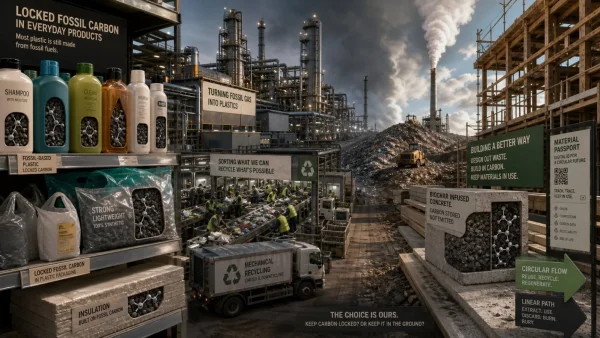
In fact, making “decarbonise everything” your goal is a mistake. The danger is in overlooking the carbon in the things we use every day. If your net zero strategy is all about clean power, you’re going to let a good portion of emissions go by without a second thought.
Go to a supermarket and you can see it. There’s carbon in the plastic of a shampoo bottle, in the fibres of a bag, in the insulation up in the ceiling. These aren’t just by-products of living in a fossil-fuel world; they are its more enduring mark. And when those items are put in the bin, or worse, incinerated, that carbon is back in the air.
For some time now we’ve been talking about fossil fuels as something to be combusted. But a lot of it doesn’t get burned. Some 15 to 20 per cent of what we consume is made into polymers, adhesives, synthetic fabrics and the like.
And that number is on the up, even though you won’t find it in most net zero tallies. The chemical industry is where this starts. They are responsible for 14% of the world’s oil and 8% of its gas, but they are using it as raw material, not to make fire.
Take ammonia, which is the basis for the fertiliser that puts food on half the planet’s table. Or ethylene from crude oil, which is the starting point for a host of coatings and solvents. In their line of work, handling carbon is what they do.
Plastics and the waste-led carbon loop
Plastic is a case in point. We churn out 400 million tonnes a year, nearly all of it from fossils. Maybe 9% gets a second life through recycling. The remainder is put in a landfill, torched or otherwise makes its way back to the atmosphere.
It is a kind of seepage that undercuts what has been achieved in the energy sector. You can’t just write off these as a waste management issue and be done with it. Without a plan for materials, the story of the fossil era is far from over.
Construction can lock carbon, if we let it
But there is one area where we have some room to manoeuvre: buildings. A structure can be around for a century, so you can have it hold onto carbon for the long term instead of letting it off quickly.
Wood is a good example. A tree takes in CO2 and then you have that in the timber of a house. You can do the same with engineered products, or mix in biochar from farm and forest waste to keep carbon in your concrete.
You can even take CO2 and make it into something like insulation. Here, carbon is a part of the build, not something to be put in a hole in the ground or the sky.
From fossil default to circular carbon
What we should be after is not to rid ourselves of carbon, but to put an end to the habit of reaching for the fossil kind. You can’t make chemicals, plastics or building materials without carbon. But it doesn’t have to be the kind you get from oil, gas or coal.
There are other ways to put it in your product: plant matter, by-products of farming and forestry, even CO2 you’ve siphoned off from an industrial process before it can get out. If you do it right, these can stand in for fossil carbon in everything from polymers to insulation.
But “right” is doing the hard work. Any alternative has to show its numbers over a full life cycle. You have to be able to point to where the carbon was, what it took to get it, if any land was harmed, how long it’s in the item, and what you do with it when you’re done.
Bury or circulate: the tough call
Then there’s the question of what to do with captured carbon: put it in the ground or let it keep moving? Burying it in rock or the deep sea is permanent, sure, but it also takes those atoms out of the running for good and chews into the surface carbon pool that the rest of us need.
For a system that isn’t so wasteful, you want to keep carbon in play and recoup it at the end of the line. Only when there’s no sensible way to do that should you consider burial.
It’s not a trivial call. Bury too much and you could leave future industry with no feedstock but fossils. Talk up circularity without the means to back it up and you’re just greenwashing. You have to be straight about it, with data to show for it.
If the new stuff doesn’t perform as well, the whole transition is for naught. And you can’t ignore supply constraints. Biogenic carbon is a limited resource, as is the land and energy to work with it.
In the end, it comes down to trust. The people on the buying side are going to want to know the story of the carbon in what they’re using. You can’t make that up; you can’t see where it’s been. That’s where you need solid certification and maybe a digital passport to put some transparency in the market.
The bottom line: decarbonise combustion, recarbonise materials differently
Chasing carbon out of every corner of industry is a losing game. Better to decarbonise your power and put non-fossil carbon into your materials. Do it properly and you have construction that sequesters, and plastics that don’t end up in the sky.
Put it off and you’ll just be adding to the backlog of products that will be a problem down the road. Left to their own devices, recycled claims will outstrip what’s actually happening and someone will have to pay for the mess later.
What must change now
Now it’s a matter of making it happen. Policymakers can set the tone with the right kind of standards and pricing. Industry can put its money where its mouth is on design and disclosure. Cities can call for materials that hold up.
To make the shift stick, experts point to near-term actions:
– New materials must match or exceed fossil performance.
– Map sustainable carbon supplies with transparent limits.
– Reward circular carbon via procurement, pricing and rules.
– Use rigorous life-cycle assessments to verify real cuts.
– Build sorting, repair, recycling and safe disposal first.
– Prove origin and handling with labels and digital passports.
We can’t decarbonise the world. But we can change where our carbon is coming from and what we do with it. We have the time to put energy and material in order, if we have the honesty to face our limits and the discipline to build something that works.