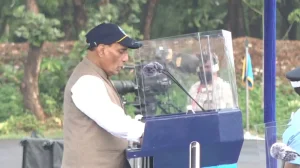
Rajnath Singh made it official on Friday with the Bhoomi Pujan for the press at the Ordnance Factory Ambajhari in Nagpur. It’s another step towards a more robust defence supply line, and one that is being put forward as a way to guard against over-reliance on what we can’t make here and the occasional shock from abroad.
Why this press is in the news
For the Defence Minister, this is about making a hard turn away from foreign vendors and putting our own capabilities to work. He pointed out that when you have a conflict, the flow of essential materials can be cut off. To have forces that are ready for tomorrow and to keep projects on track, you have to be able to provide for your own security needs.
According to Singh, the press will be churning out some of the larger, high-strength, precision aluminium alloy extrusions. You’ll find these in everything from defence and aerospace to missiles, and even in the railways and other key sectors.
Strategic positioning and competition
There is a well-known bottleneck when it comes to metals that are light but hard to beat, and this is meant to be a direct answer to that. Singh was clear that today’s fighters, space systems and missiles are only as good as the metal they are made of.
This was no ordinary project unveiling. He put it down as one of the most sophisticated of its type in the country, a sign that we are ready to go head-to-head with overseas players on matters of both size and intricacy.
Cutting import risk, building depth
You won’t hear officials put it any other way: the press is to be a national asset. It’s there to shore up local manufacturing and let us produce the kind of strategic profiles we used to have to buy in, in keeping with the Aatmanirbhar Bharat agenda.
Singh also made a point of tying in some of our recent field successes to Indian hardware. A weapon system is only as reliable as the thousands of parts in it, and with this press we can make the more involved ones right here to spec.
Numbers that tell the story
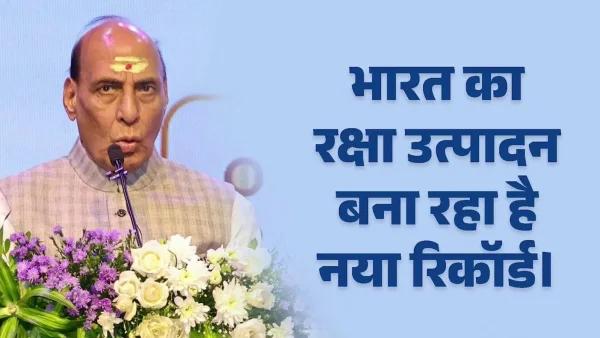
The minister put the press in the context of a much bigger upswing in manufacturing. We’ve gone from Rs 46,000 crore in domestic defence production in 2014 to an all-time high of Rs 1.78 lakh crore in FY 2025-26. On the export side, we are at Rs 38,424 crore, up from under Rs 1,000 crore a decade ago.
He says we are likely to hit some of our more far-reaching targets ahead of time. The plan for the next couple of years is to see Rs 3 lakh crore in production and Rs 50,000 crore in exports.
To put it in Singh’s words, the priorities are:
– Get to a higher level of scale and complexity in what we make at home
– Do without imports for the extrusions we need
– Keep the aerospace and missile programmes on their timetable
– Be in a position to weather any supply-side shocks
What corporatisation has done
The unit in Nagpur is part of Yantra India Limited, which is what you get after the Ordnance Factory Board was corporatised. Singh said the idea was to have DPSUs that are nimbler and have more say in how they operate.
The figures back it up. OFB’s production was Rs 12,755 crore in 2019-20; now in 2025-26 it is Rs 26,282 crore. As for defence exports, before the change we were at Rs 81 crore. Today that number is Rs 4,561 crore, with YIL alone bringing in Rs 397 crore.
Making industry war-ready
War may be changing, but as Singh put it, conventional power is still a must, 1947 or 2047. So the new press is about the long haul of building up capacity, not just a minor tech fix.
He sees the government pushing Aatmanirbhar Bharat on four levels: technology, the people, knowledge and trust in the country. This press is a piece of that, offering our engineers a way to work with critical alloys on their own terms.
What comes next
We’ll judge the project on whether it can put out a steady stream of the complex, strong profiles we need. If it does, it will firm up our supply lines, take some of the risk out of our frontline work and leave less room for imports where it counts.
Maharashtra CM Devendra Fadnavis, Sanjeev Kumar, the Secretary (Defence Production), and others were on hand for the ceremony, showing the kind of co-operation between the centre, the state and the industry that makes this happen.