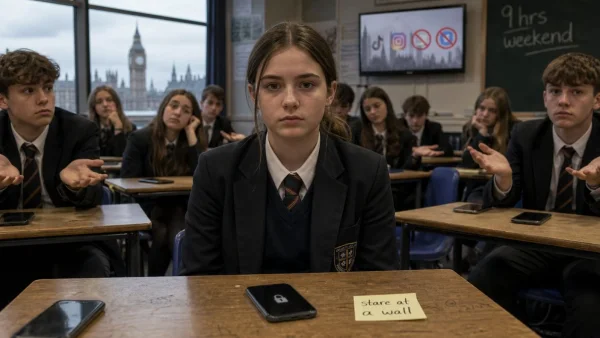
Then there was a schoolgirl in Britain with a one-liner that has come to define this whole policy turn. When asked by Prime Minister Keir Starmer what her weekend would be like without her apps, she put it in four words: ‘stare at a wall’. In a way, she put a finger on the chasm between what teens do and what the government wants them to do.
A viral quip that put a name to teenage unease
We spoke to Isabella in her classroom in Tarleton not long after the news broke. She didn’t think it was going to come to pass, but then allowed the PM ‘seems pretty sure of it’. What did have her worried was being cut off from parents, family and the like.
You could tell her friends weren’t on board either. Put the question to the room and no hands went up. A clip of the interview made its rounds online, with one broadcaster pointing out that Isabella had put in nine hours of screen time over the weekend, which only added to the story’s appeal.
It struck a nerve because it’s a simple fact: kids use these platforms to get in touch as much as to be put on. Remove them, as Isabella was hinting, and you have a void where a social life used to be.
What is in store under the new rules
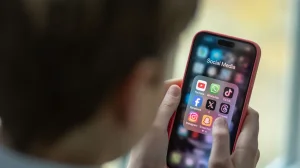
According to ministers, the major sites will be off limits to under-16s from the spring of 2027. We’re talking Snapchat, TikTok, YouTube, Instagram, Facebook and X. But you won’t see the same for WhatsApp or Signal.
They are touting an ‘Australia-plus’ way of doing things, so it’s not just a matter of blocking an account. There are ideas in the works for some wider rein-in of the digital world, even in gaming.
Some of what is on the table:
– No more livestreaming for the under 16s
– You can’t chat with strangers in games
– And possibly a curfew on social media
The government’s line is they will fine-tune the verification to keep kids out without getting in the way of proper communication.
The case for action
Starmer has been making the point that we have to step in, and he’s not alone. A consultation with over 116,000 people showed 90 per cent in favour of a legal age limit. He says too much of this is leaving young people down in the dumps and it is the state’s job to do something about it.
Even Prince Harry and Meghan have given it their seal of approval, calling it a good move and telling the big tech to put wellbeing before the bottom line. They don’t want the onus to be on families alone.
And the numbers to back it up
JAMA Psychiatry has a paper showing that three hours or more a day on social media comes with a higher chance of anxiety and other issues. The WHO put out a report in 2024 on the uptick in all that, from less sleep to more stress in Europe.
There’s a UN report that makes the case that the algorithms and the hours in front of a screen can wear down your focus and your ability to get on with others. For those in favour, it’s reason enough to put some guardrails in place.
But there are questions left to answer
Tech firms will tell you a sledgehammer approach will just send young people to parts of the web with fewer rules. The teenagers have a similar take – that you are nipping in the bud the kind of day-to-day contact they have now.
And how do you police it? Across all the different devices and app stores? Ministers say we’ll have the specifics in July.
You have to look at the rest of the world for context. Britain is the fourth to go down this road, in the wake of Australia, Indonesia and Malaysia. Down in Australia they made history with a total ban for under-16s in December 2025.
Here, the ‘plus’ in the Australia model means a bit more than just an age check. There are controls on features and time as well. That will make the difference between a policy that does some good and one that is just in the way.
Online, the response has been mixed. Some are happy to see it, thinking it will get kids back to the real world. Others feel it’s a bit much, and would rather see some of the filtering done in other places.
For a kid like Isabella, it’s a no-brainer: those nine hours of the weekend are gone and have to be filled in. For the people in charge, it’s a balancing act between the evidence, what parents are asking for, and making sure you don’t drive young people into the dark corners of the internet.
Don’t expect the row to die down until the July details are in. It will all come down to the small print: how you prove you’re old enough, what leeway there is for school and family, and if you can make the rules for gaming and streaming work without ending up with the very people you are trying to help on the outside looking in.