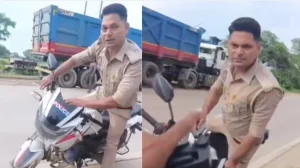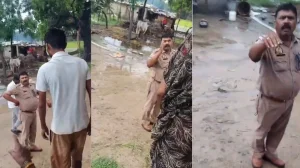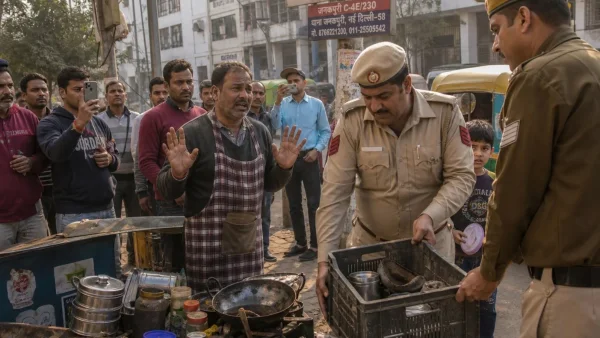
A video from Delhi’s Janakpuri has gone viral on social media, showing a roadside food vendor pleading with police officers as they remove his stall during an enforcement drive.
In the video, the visibly distressed vendor can be heard saying, “Sir, I come here to earn a living for just two hours,” appealing to the officers not to seize his goods. As the incident unfolds, local residents gather around the scene, with some questioning the police action and arguing in support of the vendor.
The video has reignited a long-standing debate: Where should authorities draw the line between enforcing the law and protecting the livelihoods of small street vendors?
What Does the Viral Video Show?
The footage shows police personnel removing items from a roadside food stall while the vendor repeatedly requests them to stop.
Several bystanders can be seen confronting the officers, arguing that the vendor was merely trying to earn a livelihood. The atmosphere quickly turns tense as the crowd questions the necessity and manner of the action.
The complete circumstances leading to the enforcement action, including whether the vendor had the required permissions or whether prior notices had been issued, have not been independently verified.
The Controversy: Enforcement or Excess?
The incident has divided opinion.
One section believes the police were carrying out their legal duty if the stall was operating without authorization or obstructing public space.
Another section argues that enforcement should be carried out with sensitivity, especially when dealing with people whose daily earnings depend on a few hours of business.
The controversy is not new. Across Indian cities, roadside vendors often find themselves caught between municipal regulations and the need to earn a living.
Street Vendors: Protected by Law, But Challenges Remain
India enacted the Street Vendors (Protection of Livelihood and Regulation of Street Vending) Act, 2014, with the objective of protecting vendors from arbitrary eviction while regulating vending activities.
The law provides for:
Identification and registration of eligible street vendors.
Designation of vending zones.
Protection from arbitrary removal, subject to the provisions of the Act.
Regulation through local Town Vending Committees.
However, implementation varies across cities, and disputes over encroachments, licensing, and public spaces continue to arise.
Why Do Such Clashes Keep Happening?
Urban planners say the conflict is rooted in competing priorities.
Authorities are expected to:
Keep roads and footpaths free from obstruction.
Maintain public order.
Ensure pedestrian safety.
Enforce municipal rules.
At the same time, thousands of families depend on street vending as their primary source of income.
When clear vending zones are unavailable or licensing processes are delayed, confrontations between vendors and enforcement agencies become more frequent.
What Is the Delhi Government Doing?
The Delhi government and municipal authorities have, over the years, taken steps to regulate street vending through surveys, identification of vendors, and the formation of Town Vending Committees under the 2014 law.
However, vendor associations have often argued that implementation has been uneven and that many eligible vendors are still waiting for formal recognition or designated vending spaces.
Authorities, on the other hand, maintain that action is necessary against unauthorized encroachments that obstruct roads, footpaths, or public movement.
Can Enforcement Be More Humane?
The viral video has also raised questions about how enforcement is carried out.
Legal experts note that enforcing municipal laws and maintaining public spaces are legitimate responsibilities of authorities. However, they also emphasize that interactions with citizens—especially those from economically vulnerable backgrounds—should be conducted with dignity and proportionality.
A person’s livelihood and the rule of law need not be viewed as opposing principles. Effective governance requires balancing both.
The Bigger Question
The Janakpuri incident is about more than one roadside stall.
It reflects a broader challenge facing India’s rapidly growing cities: How can governments ensure orderly public spaces without pushing informal workers further into economic insecurity?
For the vendor in the video, the issue was immediate—saving a day’s earnings.
For policymakers, the larger challenge remains unresolved: creating cities where laws are enforced fairly while ensuring that those who earn an honest living are treated with respect and provided lawful opportunities to work.
As the video continues to circulate online, many are calling not just for answers about this particular incident, but for a more balanced approach that protects both public order and the dignity of work.