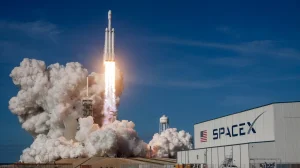
SpaceX is landing in the Nasdaq 100 on Tuesday, and Wall Street is wasting no time planting bullish flags. The twin forces of index inclusion and fresh buy ratings have set up a pivotal moment for the rocket, satellite and AI player, with passive flows and sentiment poised to test the stock’s post-IPO narrative.
Index entry sets up near-term demand
Rapid inclusion usually means automatic buying. Analyst Rob Du Boff estimated that the Nasdaq 100 and FTSE Russell additions together could trigger at least $5.4 billion from index-tracking funds, a mechanical tailwind that few newly listed companies enjoy.
The company, officially Space Exploration Technologies Corp., joined the Russell 1000 Index late last month, just two weeks after its IPO. The timing of the Nasdaq move should help minimize volatility, said David Trainer of New Constructs, even as he warned the valuation looks detached from fundamentals.
The stock, about 29% below its all-time intraday high, was 1.8% lower in premarket trading on Tuesday in a broader technology selloff. Those declines set a lower base, but index-related buying can be price insensitive, adding an unpredictable layer to early trading.
Brokerages open coverage with a clear bias
At least six brokers, including Morgan Stanley and Goldman Sachs Group Inc., began coverage with buy-equivalent ratings after the quiet period for banks that underwrote the $86 billion initial public offering expired. Early research is converging on the same message: lean into multi-year growth.
The buy wave also reflects how the sell side works for market leaders. Across the 3,000 biggest US companies, buy recommendations account for 63% of all analyst ratings, and only 4.2% are sells. Even after a sharp pullback, about 30% from its high, Microsoft still carries roughly 95% buy-equivalent ratings.
That backdrop matters because it sets expectations. Coverage helps investors frame SpaceX as more than a founder story, but it also raises the bar on execution, profitability and valuation, issues analysts themselves still flag.
Price targets reveal the debate’s boundaries
Morgan Stanley, among the most optimistic, argues SpaceX can capitalise on demand for AI services from fast-growing new entrants. ‘While neocloud deals are the bulk of the business near term, we see end-to-end AI services as the longer-term business model,’ analysts including Adam Jonas wrote.
Morgan Stanley set a $300 per share target, an 87% gain from Monday’s close of $160.42. The range is wide: Arete Research sits at a Street High of $401, while New Street Research initiated at $165, the lowest among tracked firms.
Targets this far apart usually signal uncertainty over margin structure and valuation baselines. They also create trading fuel as investors pick sides on growth speed and capital intensity.
AI as the strategic differentiator
SpaceX’s near-term book, described as ‘neocloud deals,’ gives the company a revenue bridge while it builds towards end-to-end AI services. If that shift takes hold, the business mix could look less like a pure space venture and more like a connectivity-plus-compute platform.
That strategy pits SpaceX for wallet share where infrastructure, latency and data transport intersect. It also explains why coverage emphasises AI demand even more than rockets or satellites.
Here are the main investor implications to watch next:
– Near-term flows versus broader tech sentiment
– Margin visibility as AI services scale
– Pace of enterprise neocloud deal wins
Nasdaq’s rule shift, and the S&P 500 gap
Speed is part of this story. Rule changes at Nasdaq Inc. now allow newly listed, large-cap firms to enter the Nasdaq 100 in as little as 15 trading days, down from the previous three-month minimum. SpaceX benefited from that faster on-ramp.
S&P Dow Jones Indices, by contrast, kept existing eligibility requirements in early June, closing the door on a similar fast track to the S&P 500. That matters because the S&P 500 anchors more passive assets.
‘The Nasdaq 100 does not have nearly as much assets benchmarked to it as the S&P 500, but it also has some factors that juice demand for SpaceX,’ said Du Boff. For now, the Nasdaq 100 badge brings visibility, liquidity and a near-term test of conviction.
The next phase will hinge on execution. Index buys can spark a rally, but sustaining it will require clarity on profitability levers and proof that the AI-led roadmap delivers beyond bold targets.