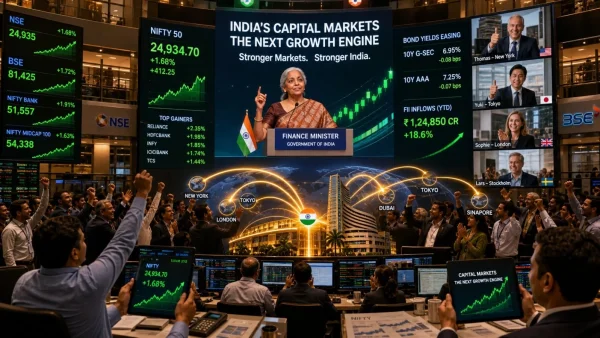
On Monday, a firm word from the finance minister set the whole of India’s capital-markets world in motion, with stocks in the asset management and brokerage space moving up in a hurry. You could see it in the way HDFC AMC, Motilal Oswal and Nippon Life India AMC were all in the red as traders made their play on a new round of overseas money.
There was no mistaking the intent: the moves by the government and the RBI to pull in some foreign cash are just the start. If you’re following the momentum for Google Discover, the ones to watch in the near term are the names along the capital formation chain, not the usual index stalwarts.
Policy signal turns spotlight on market intermediaries
When she spoke at an event on June 15, 2026, Sitharaman put a new spin on the case for investing in India’s market intermediaries. As we expect to see more from the outside, the firms that are in the business of channelling flows, settling and managing will be the first to feel the effects of the extra activity and liquidity.
The minister made it plain that while the first effort is in the bond market, it won’t be limited to it. That makes asset managers and brokers the kind of early-adopter you want to be in if these reforms are to spread to other asset classes.
Winners on the screen
You could tell by the numbers. The Nifty Capital Markets index put in a good day, 3.2 percent in the plus to 5,519.90, with every one of its 17 members in the black. HDFC Asset Management was at the top of the list, 6.9 percent higher at Rs 2,627, with Motilal Oswal Financial Services not far behind at 5.7 percent.
Nippon Life India Asset Management was up 4.7 percent; Nuvama Wealth 4.3; and Groww put on a little over 4. The brokerages and infrastructure types firmed up too. Angel One was 3.7 percent better, CDSL over 3, and 360 One Wam 3.
Even the transfer agents and exchanges were part of it. CAMS, KFin and the BSE were in the 2 to 3 percent range. Then you had the rest of the pack – UTI, Anand Rathi, ICICI, IEX, MCX – all trading up as the breadth of the move became hard to argue with.
Flows and liquidity expectations
It was your typical pro-liquidity call. Put in some foreign money and you can count on AUM revenues at the AMCs and the fees at depositories to pick up, which gives you some operating room even if the core markets don’t reprice right away.
What the government and RBI have moved already
They’ve been at work on a few changes to make things easier for the overseas investor.
On the government side, we’ve seen a wider array of securities put on the table for foreign investors through the Fully Accessible Route, and they’ve made it known that interest and capital gains from government paper will be tax-free.
The RBI has been in step with this, putting in place some measures to make foreign currency deposits and outside borrowings more attractive, all to give capital inflows a lift. “It’s an opening,” is how Sitharaman put it. “Right now you might say it’s only in the bond market, but don’t let it be the end of the story. We have more to come.” She was clear about the need to see more foreign money in the country.
You can read it as a plan to open up over time, which is good news for any firm that straddles the line between home-grown and international capital.
To put a fine point on it, here is what has been put in motion:
– A bigger FAR list for those investing from abroad
– No tax on G-sec interest or the gains from them
– Some prodding from the RBI on FCDs and external debt
Some global tailwinds
There was already a bit of a risk-on mood out there. With word of a possible peace deal between the U.S. and Iran, worries over energy and inflation have subsided, and crude has given back some ground. The rest of the world’s equities have been better for it.
Our own indices have been no different. The Sensex was 756 points in the green at 3:01 pm, sitting at 76,284; the Nifty was 232 up at 23,855. By the close, the Sensex had put in 736 points to 76,264 and the Nifty, after a quick foray past 24,000, settled in a little lower at 23,854.
The advance was underpinned by some broad-based buying. Both the Midcap and Smallcap 100s were up over a percent, and with the India VIX down three or so, the nerves have been taken out of the market.
What it means for positioning
The way the market has responded is telling. You’re seeing a rotation into the kinds of firms that stand to gain from some behind-the-scenes reform, not just the ones in the headlines. If the foreign money keeps coming, asset managers with room to grow and brokers with a digital edge are in a strong spot.
Exchanges and depositories can put more in their pocket from the extra activity without the costs to match, which is a nice setup in a volume-driven environment. And if we see a wider set of reforms than just in bonds, the case for equities and derivatives makes even more sense.
Looking ahead
How this plays out is a matter of when and how. The minister has given us her word, but the devil is in the details of how the flows get channeled beyond sovereign debt.
If you’re following this, here are a few things to have your eye on:
– Any word on access to non-bond instruments
– FPI numbers
– How the cash and derivative books are trading
– AUM figures for the big names
For now, the message is plain: policy and a lull in global risk made for a potent mix, and the enablers in India’s market were first in line. Should the government keep its course, what we saw on Monday could well be the overture, not the last word.