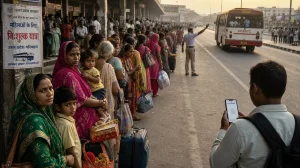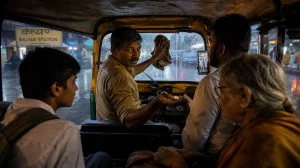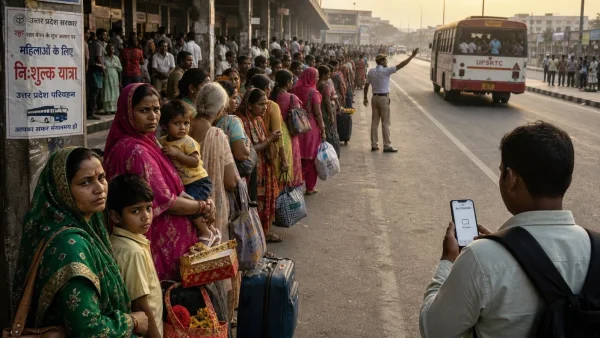
The Uttar Pradesh government’s decision to provide free bus travel to women during Raksha Bandhan is certainly a welcome step. Offering women relief on public transport, particularly during a major festival when thousands of people travel, can provide meaningful assistance to families.
But alongside the appreciation comes another question:
If the government can spend heavily on large infrastructure projects, why are ordinary citizens still struggling with basic public facilities?
The condition and functioning of public transport facilities around Civil Lines in Prayagraj have once again brought that question into focus.
Maha Kumbh 2025 brought massive infrastructure investment
Prayagraj underwent a major transformation ahead of Maha Kumbh 2025, with large-scale expenditure on roads, transport, sanitation, railway infrastructure and other public facilities.
Transport was one of the major components of the preparations. During the Maha Kumbh, additional buses and other transport services were deployed to handle the enormous number of visitors arriving in the city.
The Civil Lines bus station was also earmarked for redevelopment. A proposal announced earlier estimated the redevelopment cost at approximately ₹149 crore, with plans for a modern passenger facility including improved platforms, parking, sanitation, seating, security and other amenities.
The question being asked now is simple:
How much of that infrastructure investment is translating into a better everyday experience for residents and passengers?
One year later, basic questions remain
The Maha Kumbh concluded more than a year ago, but concerns over public transport arrangements in Prayagraj continue.
Recent reports indicate that redevelopment work at the Civil Lines bus station has affected bus operations, with services being shifted to alternative locations. This has reportedly created additional inconvenience for passengers who previously depended on the Civil Lines facility.
For the average commuter, a bus station is not merely an infrastructure project.
It is a place where people wait every day to travel to work, college, hospitals, markets and their hometowns.
For ordinary people, infrastructure means basic facilities
Large projects and headline-making investments may look impressive on paper. But for ordinary citizens, the quality of governance is often judged by much simpler questions:
Is the bus available when needed?
Is there a proper place to sit and wait?
Are the toilets clean and functional?
Is there shelter during rain and extreme heat?
Is the area adequately lit and safe at night?
Can elderly passengers, women and children access the facility comfortably?
Are routes and departure times clearly displayed?
Are alternative bus facilities properly equipped when the main terminal is unavailable?
These are the things that affect people’s lives every single day.
What is the legacy of Maha Kumbh 2025?
Maha Kumbh 2025 was presented as a major opportunity to upgrade Prayagraj’s infrastructure and transform the city’s public facilities.
But the true test of such investment begins after the event is over.
A city cannot be judged only by how it performs during a massive international-scale gathering.
The more important question is whether the infrastructure created or upgraded for the event continues to serve residents effectively for years afterward.
If public money has been invested in improving transport infrastructure, citizens are entitled to expect those improvements to remain visible in their everyday lives.
Free travel is welcome—but availability matters too
The government’s decision to provide free bus travel to women during Raksha Bandhan deserves recognition as a measure aimed at making travel more affordable.
But a free ticket alone cannot solve the problems of public transportation.
Passengers need buses. They need functioning bus stations. They need safe and clean facilities. And they need reliable services.
Free travel becomes meaningful only when the public transport system itself is accessible and dependable.
The government now faces some basic questions
The concerns surrounding Civil Lines raise several questions that the authorities should answer transparently:
What is the current status of the Civil Lines bus station redevelopment project?
What is the project’s actual expenditure, revised cost and expected completion date?
Are passengers receiving adequate facilities at the alternative locations being used for bus operations?
What long-term improvements from the Maha Kumbh infrastructure investment are currently benefiting ordinary residents?
These are not unreasonable political questions. They are questions about public money and public services.
The real measure of development
Whether one supports or opposes the government is ultimately secondary to the everyday experience of citizens.
For the person waiting at a bus stand, the question is not how impressive a project looked during its inauguration.
The question is whether the facility works.
For women, free travel on Raksha Bandhan is a welcome benefit.
But the larger expectation is equally simple:
Give people affordable travel—but also give them buses, clean facilities, safe terminals and infrastructure that continues to work long after the cameras have gone.
Because ultimately, the success of Maha Kumbh’s infrastructure investment should not be measured only by what was built for a few weeks in 2025.
It should be measured by what an ordinary resident of Prayagraj experiences every day in 2026.