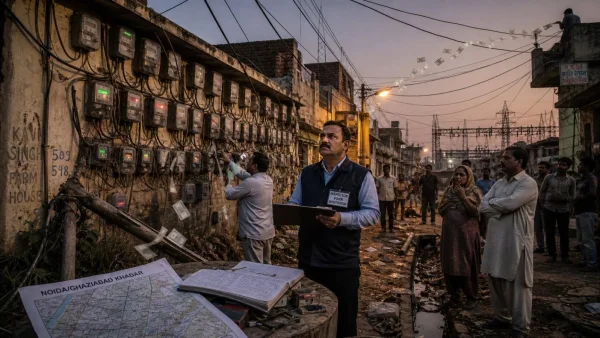
A reported network of thousands of unauthorised electricity connections in Chijarsi village in Noida has raised serious questions about the functioning of the state’s power distribution system and the alleged loss of public revenue.
According to allegations presented before Uttar Pradesh Chief Minister Yogi Adityanath, around 13,000 illegal electricity connections are operating in the area. Despite the connections reportedly being unauthorised, electricity meters have allegedly been installed outside homes and other properties.
The revelations have prompted questions about how such a large number of connections could operate without detection and where the money collected from consumers is ultimately going.
A Parallel Electricity Network?
The allegations suggest that electricity is being supplied to properties through a system outside the authorised billing and revenue framework.
If thousands of consumers are paying money for electricity but the corresponding revenue is not reaching the government treasury or the authorised power utility, the potential financial implications could be substantial.
The allegation is particularly significant because the reported number—13,000 connections—would represent a sizeable network rather than a handful of isolated cases.
However, the exact financial loss, the identity of those allegedly collecting the money and the legal status of individual connections would need to be established through an official investigation.
Issue Raised Before Chief Minister
The matter reportedly came to the attention of Chief Minister Yogi Adityanath after Manoj Kumar Singh, identified as the CEO of the State Transformation Commission, raised concerns about the alleged electricity network during a meeting with the Chief Minister.
Following the discussion, the Chief Minister reportedly reprimanded Power Corporation Chairman Ashish Goel and sought an explanation over the situation.
The development has brought renewed attention to the question of accountability within the state’s electricity distribution system.
The central issue is straightforward:
How can thousands of allegedly unauthorised electricity connections exist in an area with visible meters and electricity consumption without the responsible authorities detecting the problem?
The Larger Question: Ghaziabad-Noida Khadar
The controversy extends beyond Chijarsi.
Along the Yamuna in parts of Ghaziabad and Noida, large stretches of the khadar—low-lying areas vulnerable to flooding—have witnessed extensive construction, including large buildings and farmhouses.
Many of these properties are alleged to have been constructed in areas where development may be restricted or unauthorised.
Yet numerous structures reportedly have electricity supply.
That raises another fundamental question:
If a construction is illegal, how does it obtain an electricity connection?
Electricity supply and building legality are technically separate regulatory matters, and the presence of electricity does not by itself establish that a building is legally authorised.
Nevertheless, when large numbers of properties in disputed or restricted areas have functioning power connections, it raises questions about whether electricity infrastructure is being used without adequate verification of the properties being served.
Where Does the Money Go?
Perhaps the most serious allegation concerns the money reportedly collected from consumers.
If electricity is being supplied through unauthorised connections and payments are being collected outside the official billing system, investigators would need to determine:
Who issued or facilitated the connections?
Who installed the meters?
Who collects payments from consumers?
Are consumers receiving official electricity bills?
How much revenue is being collected every month?
How much, if any, reaches the authorised power distribution company?
Which officials or intermediaries authorised the connections?
How long has the alleged network been operating?
These questions cannot be answered merely through political statements. They require documentary evidence, meter records, billing data, payment trails and an independent investigation.
A Systemic Failure if Proven
If the allegations are substantiated, the issue would go far beyond individual illegal connections.
It could indicate a serious breakdown in the monitoring and enforcement mechanisms of the electricity distribution system.
A network involving thousands of connections would potentially require coordination or prolonged inaction at multiple levels.
That is why accountability should not stop with removing individual connections.
The investigation should establish how the network was created, who benefited financially and why regulatory mechanisms failed to detect it earlier.
Illegal Construction and Public Infrastructure
The controversy also highlights a broader challenge facing rapidly expanding areas around Noida and Ghaziabad.
Unauthorised development can create complex problems involving electricity, water, roads, drainage, sewage, fire safety and environmental regulations.
Once permanent infrastructure reaches such properties, it can become increasingly difficult for authorities to prevent further development.
This creates a cycle:
unauthorised construction → infrastructure demand → unofficial or questionable connections → further construction → greater enforcement difficulties.
Breaking that cycle requires coordination between electricity authorities, development authorities, municipal bodies and district administration.
The Need for Transparency
The reported action by the Chief Minister has put the issue under the spotlight.
But public concern will ultimately be addressed only if authorities provide clear answers.
A transparent investigation should establish the number of unauthorised connections, the amount of revenue involved, the officials or private individuals responsible and the action taken against those found guilty.
Consumers who may have unknowingly obtained unauthorised connections also need clarity about their legal position and future electricity supply.
Most importantly, the investigation should follow the money.
The key question is no longer simply who received illegal electricity connections.
It is:
Who created the system, who collected the money, who allowed it to continue—and why did the authorities fail to stop it?
If thousands of unauthorised connections were indeed operating openly for years, the issue represents more than electricity theft.
It would raise serious questions about governance, regulatory oversight and the protection of public revenue in one of Uttar Pradesh’s fastest-growing regions.