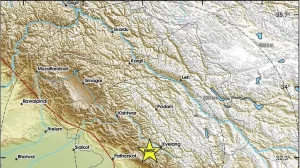
The state has been rattled by these 29 small quakes in little more than two weeks, with a concentration around Nashik and Palghar that has some asking about the risk to Mumbai. Scientists would call it an earthquake swarm: a cluster of shallow activity that is more of a seasonal indicator than a precursor to something large.
Friday was a case in point, with five tremors logged in and around Nashik. The frequency is unusual, but specialists do not see a tectonic crisis; they see a trigger tied to the monsoon and the depth of the quakes. Their counsel is to build smarter and monitor the situation without panicking.
What is behind the sudden streak of tremors?
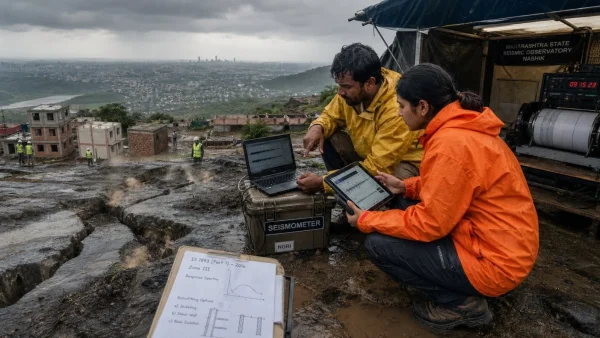
Beneath Nashik, the Deccan Plateau is all basaltic rock with its share of fractures and pores. With the monsoon comes water that works its way into those cracks, raising pore pressure until it has to let go in the form of a small tremor.
“We term it hydro-seismicity,” says Professor Deepankar Choudhury of IIT Bombay, an earthquake specialist and civil engineering professor. He would have you know that such swarms are a common enough occurrence here during or after the rains, so there is nothing out of the ordinary in the current run of events.
By definition, a swarm is a series of small quakes in a confined area over a short time, usually lacking any one dominant event and its aftershocks. These are shallow affairs, running from 3.5 km to 5 km underfoot, and can go on for anything from a few days to months.
Where and how often the ground has moved
The numbers tell the story: 29 tremors in Maharashtra between July 30 and August 14. Twenty four were in or near Nashik, four in Palghar and a single one in Nagpur, with magnitudes of 2 to 4.3 and depths of 5 to 8 km.
There were days when the activity was particularly intense. On August 6, for instance, Nashik had six tremors from 5.41 am to late afternoon. Four more came on the 8th and another four on the 10th. It is the kind of bursty pattern you expect from a swarm, as opposed to a single event building in scale.
Largest of the bunch
A magnitude 4.3 quake in Nashik on August 8 at 5 km deep was the most to date. By the standards of the region it is moderate and fits right in with the rest of the swarm.
Is Mumbai in the line of fire? The expert view
Choudhury and others will tell you that the energy in a shallow swarm does not travel far. What happens in Nashik is unlikely to be felt in Mumbai. That said, the character of the swarm should be watched.
Under IS 1893, Part 1, both Nashik and Palghar are in Seismic Zone III, denoting a moderate risk. Earthquakes here may be linked to crustal faults or plate motion, though the Deccan Plateau is removed from a major boundary and is fairly stable.
A monsoon pattern repeated
The state is no stranger to this. You could make the same case for the swarms Palghar saw in February 2019 or September 2023. The wet weather is the key to the hydro-seismicity at work in the Deccan basalt belt.
It is simple physics, according to Choudhury. Water gets into the cracked basalt and builds up pressure, accounting for the shallow, clustered bursts we see in and after the monsoon.
For now, what requires attention
Even a small tremor puts construction to the test. The thinking is to be preventive and design for your zone rather than wait for an event to force your hand. Experts stress the need to abide by the provisions of IS 1893 so that infrastructure can hold up to moderate shaking.
From the present pattern, officials and researchers draw a few practical conclusions:
– A close watch on the depth and trajectory of the swarm
– New builds must be in line with IS 1893, Part 1
– Any vulnerable assets should be retrofitted to Zone III levels
– Bear in mind that shallow swarms tend to attenuate quickly
Reading the trendline
One cannot rely on a swarm as a sure sign of a big quake coming. This sequence is consistent with what has been documented in the region. The job is to keep the instruments running and the public informed without causing alarm fatigue.
Put simply, the two-week run of tremors in Maharashtra is explainable and measurable. With 24 events in the Nashik area, four in Palghar and one in Nagpur – the 4.3 on August 8 being the peak at 5 km – it is hydro-seismicity at play, not tectonics. Stay informed and follow the code.