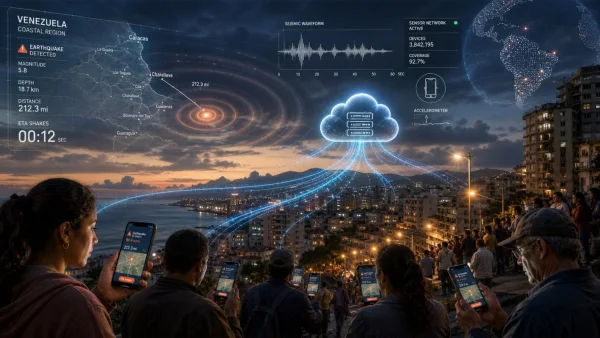
To be clear, Google didn’t see those quakes coming. They were faster. With twin quakes tearing up the country, some with an Android in hand got a nudge before the ground moved. You could call it an ad hoc warning network, and one that is now in use by millions in parts of the world without a proper system in place.
What actually happened in Venezuela
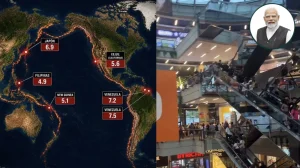
On Wednesday, the north of the country was hit hard by two. First came a 7.2 at 6:04 p.m. ET, and about 39 seconds after that, a 7.5. Early reports say the one-two punch left a lot of buildings in ruins and caused all manner of damage.
Before the tremors even registered for some, you could see the notifications on X. One screenshot had a 6.2 magnitude readout for a quake 212.3 miles or so off. It was only an estimate, but when you are in the middle of it, the timing is what you care about.
Those come from Google’s detection side of things. They give you a few seconds to put in a brace, get out of the way, or make sure someone you’re with is safe, before the really bad part of the waves gets there.
How Android phones beat the shaking
An earthquake isn’t one single event; it comes in waves. You have the P-waves first – they are quick and not as much of a force. Then the S-waves and surface waves come in, and that is where the trouble is, both for structures and for nerves.
Since data can move at close to light speed over a network, you can put a warning in front of the wave for people some distance from the epicentre. In a way, Google’s servers are in a race against the quake itself, with 299,792 km per second on their side.
Once the system has an earthquake down near its source, it will fan out the alerts. If you are a good number of kilometres out, you might have a few to ten seconds of a head start. It is not a prediction, it is just being first to know.
Your phone as a pocket seismometer
You won’t find a federal early warning grid with sensors in the ground in Venezuela. In the U.S., some states have ShakeAlert. Elsewhere, Google is the one making up for it. And they do it with a piece of hardware you already have: the accelerometer.
It’s what orients your screen when you turn the phone. But it also picks up on certain kinds of vibration. When a phone feels something like a quake, it pings Google with a general idea of where it is. The servers then look to see if other phones in the area are saying the same thing. If they are, the system calls it an earthquake.
Put it all together and you have over 2 billion devices that Google says make up the biggest network of its kind. It is active in 97 countries, a lot of them with fault lines and no public infrastructure to speak of.
So in Venezuela, the warnings were put together by the very people who felt the first jolt, not by some state apparatus. For those few seconds, a private tool was all the early warning they had.
What the alerts look like and when you get them
There are two types of notice you can expect from Android, depending on how hard it is going to shake. A Be Aware is your heads-up for something on the lighter side. Take Action is the more pressing of the two, for when you’re in for some moderate to heavy shaking and need to put on your guard right away.
If you tap on one, you’ll be taken to some basic earthquake safety info with a few things to do to keep out of harm’s way. You’ll also see a map giving you a rough idea of where the quake was and how big it was. Don’t be surprised if those numbers don’t line up with the seismograph later on; that 6.2 figure some in Venezuela saw is a case in point.
We’ve had the Android Earthquake Alerts System in India since 2023, so long as you have an Android 5 or newer and are on Wi‑Fi or cellular. Of course, if you don’t want to be pestered by them, you can just switch them off in your settings.
What to bear in mind
When the next one comes along, here are four things to remember:
– We’re talking detection and speed, not a crystal ball.
– The first read may not be the last.
– You need a network to get the word.
– A few seconds’ notice can keep you from getting hurt.
Why it’s not just about Venezuela
To a lot of people, this isn’t some nifty app. It’s a safety net in places that didn’t have one. In countries without a thick web of seismometers and a public warning system, a phone can still give you a head start that might save you.
But it does come with a catch. You used to have the USGS or a civil protection agency calling the shots on emergency alerts. Now a private company’s algorithm has the power to rouse a whole city in the middle of the night. That puts some old questions on the table: who’s in charge, what are they doing with the data, and how do you handle a mistake?
The situation in Venezuela makes for a hot topic. In a humanitarian crisis, any edge you can get is important. But when you let a corporation do the government’s job, you have to ask why, particularly as this kind of thing is rolling out in more and more places.
How a head start works in the real world
It all comes down to how far you are from the epicentre and the state of the network. If you’re right on top of it, you might not get a warning at all before the ground gives way. Out in the periphery, though, you can have ten or more seconds to put yourself in a better position, step back from a window, or put the car in neutral.
The data moves fast enough over the internet to beat the tremors over a couple of hundred kilometres. In Venezuela, an alert for something 212.3 miles off is proof of that.
You may have seen a notification that wasn’t spot on with the final tally. The system is built to be quick first and precise second. We want you to move before the hard part of the shake, not to put out a perfect statistic.
The numbers behind it
Here’s what you can expect to see:
– 97 countries are covered
– Over 2 billion Androids are in the mix
– Two tiers of alert to tell you what to do
– And in India, it’s been around since 2023 for Android 5+
Looking ahead
There will be some hard talks with policymakers. As these private tools take on a public role, you can bet governments will want some rules on accuracy and how to set things right. And users are going to want to know how a false alarm is weeded out and what’s being kept on file.
For now, the takeaway from Venezuela is plain. When a big one hits, a well-timed detection can put you a few seconds ahead of the chaos. It’s not fortune-telling. It’s just good engineering, put in the hands of billions, and it can be the line between being ready and being in a panic.