Contrary to what some might think, Bhuj was not the country’s worst. That title goes to the 8.7-magnitude tremor in Assam-Tibet in 1950. It’s a humbling reminder of the kind of threat we face, even if it’s not top of mind. And with the danger so focused on the Himalayas, the cities you’d count on for safety aren’t always the ones you might guess.
Which Indian cities are generally safer
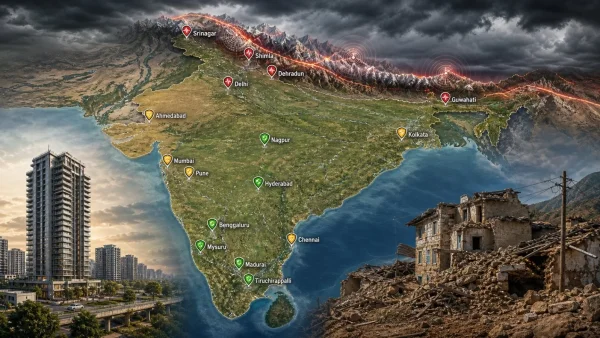
The seismic hazard in India is not spread out evenly. If you’re in a city on the firm ground of the peninsular shield, you have an edge when the big ones hit.
From a risk standpoint, these are seen as the more secure options:
– Hyderabad
– Bengaluru
– Mysuru
– Nagpur
– Madurai
– Tiruchirappalli
They are far enough from the Indian-Eurasian collision to be spared the kind of violent shaking that happens along the Himalayan arc.
Cities in the middle
There are a number of metros in no man’s land between low and high risk. You have Mumbai, Chennai, Pune and Kolkata – not as exposed as those in the north or northeast, but by no means invulnerable. Ahmedabad is in this category too, with its risk profile put on the upswing in recent hazard maps.
Even a moderate tremor can be made worse by local geology, old buildings and how packed things are.
Highest-risk urban centres
The big cities with the most to lose are the ones hugging the Himalayan front and the Northeast. In Delhi, Dehradun, Shimla, Srinagar and Guwahati, you are in close quarters with active faults and mounting tectonic pressure. Experts will tell you the region is capable of putting on a show that could impact millions.
Why buildings can outweigh geography
Where you are is one thing, but how you build is what makes the difference. A well-put-together edifice in a risky part of town will do better than a shoddy one in a calmer area.
Latur in 1993 was a lesson in that. The ground there is fairly stable, but the shallow nature of the quake and the way the villages were built led to some hard times.
India’s biggest earthquakes, retold through impact
If you want to know where the bar is set, look at two. Take the 1950 Assam-Tibet earthquake: an 8.7 on the scale that left 4,800 dead and put the region to rights in the worst way possible.
The 8.1-magnitude Bihar-Nepal earthquake of 1934 was a catastrophe, with the final count of lives lost coming in at 10,700 to 12,000, 7,253 of them in Bihar. It was one of the biggest continental quakes on record, born from the tectonic collision of the Indian and Eurasian plates. The hard-hit areas were Rajnagar, Madhubani, Darbhanga, Bhagalpur and Patna; in Sitamarhi, you could hardly find a house that wasn’t in some state of ruin.
India has been no stranger to cross-border tremors. Take the 2015 Nepal quake, for instance. Centred in Gorkha, the 7.8-magnitude shock was felt well into northern and eastern India, as well as in Bangladesh, Tibet and China. It left nearly 9,000 dead and over 22,000 with injuries, not to mention $7.8 billion in damages.
Then there was the 2005 Kashmir earthquake. At 7.6, it did inordinate damage in Pakistan-administered Kashmir, Khyber Pakhtunkhwa and parts of Jammu and Kashmir. With a death toll put at 79,000 to 86,000, it is up there with the worst in South Asia.
But for many, the 2001 Bhuj disaster is the one that defines India’s experience with earthquakes. On 26 January, a 7.6 magnitude event took 20,023 lives and wounded 166,000. Some 400,000 structures were wiped out in Gujarat and Sindh. In Kutch alone, 90 per cent of the homes bore the brunt of it.
You don’t have to go to the extremes of the Himalayas to see the devastation. A 6.9 in Sikkim in 2011, near the Kanchenjunga Conservation Area, sent ripples through five countries and cost 111 lives. And in 1975, the 6.8 in Kinnaur, Himachal Pradesh, was violent enough to claim 47 and leave a trail of broken roads and buildings in its wake.
Even in the west and peninsular India, the ground has given way. The 1967 Koyna quake, thought to be tied to the dam there, was a 6.6 that left 177 dead. Latur in 1993 was shallower, but in those thickly settled villages it was a 6.2 or 6.4 that was nothing short of an apocalypse for 10,000 people. Anjar in 1956, with its 115 fatalities, was an early warning of the seismic trouble in Kutch.
What this means for you
Here is the bottom line:
– 1950, not Bhuj, holds the record for the most powerful
– You can build a safer city, but there is no such thing as a quake-proof one
– Good construction is what will keep you alive, not where you are
Whether you are in Delhi or Guwahati, Hyderabad or Mysuru, having the right codes and being ready is what counts.