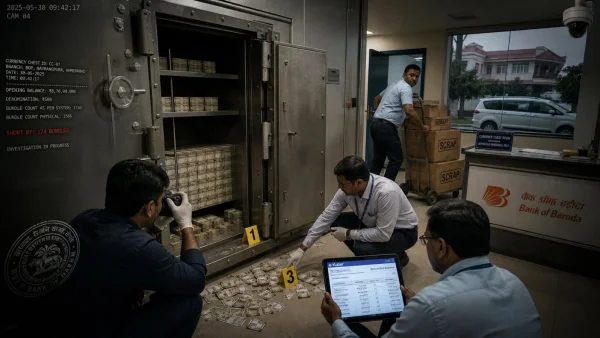
A startling financial-security case has emerged from Ahmedabad, but there is one important correction to the viral claim making the rounds:
Reports do not indicate that ₹8.70 crore was stolen directly from an RBI-owned treasury. The alleged theft took place at an RBI currency chest housed inside a Bank of Baroda branch in Ahmedabad’s Kalupur/Gandhi Road area. A Bank of Baroda joint custodian was arrested in connection with the alleged embezzlement.
And yes, the amount is staggering.
₹8.70 Crore. 174 Bundles. 500-Rupee Notes.
According to police and media reports, 174 bundles of ₹500 notes—worth approximately ₹8.70 crore—were allegedly removed from the currency chest. The chest was jointly managed by custodians, including the accused bank employee, Harsiddh Kadiyar.
The case reportedly came to light when a subsequent audit and physical verification revealed that the cash recorded in the system did not match the actual money in the chest.
That immediately raises the uncomfortable question:
How can ₹8.70 crore disappear from a highly controlled currency facility without the shortage being detected immediately?
The Alleged “Scrap Box” Trick
The investigation reportedly uncovered an extraordinary detail.
CCTV footage allegedly showed Kadiyar leaving the premises with boxes on January 13. According to investigators, the boxes were presented as scrap material that was supposedly being taken out for disposal.
If the allegations are proved, this was not simply someone sneaking a bundle of notes into a pocket.
It involved moving a large quantity of cash out of a secured banking environment.
And that’s where the story becomes less about one alleged thief and more about internal controls.
Was the System Also Tricked?
Reports say investigators are examining allegations that records and balance information were manipulated to conceal the shortage.
One report says false balance certificates were allegedly uploaded through the RBI’s e-Kuber currency-chest system, while other reporting describes discrepancies in internal records used for reconciliation.
If established, that would be a major concern.
Because a currency chest isn’t supposed to operate on:
“Don’t worry, the spreadsheet says the money is there.”
Physical cash reconciliation exists precisely because computers can record whatever humans enter.
The Investigation Has Already Produced Arrests
Ahmedabad Police arrested Kadiyar in May 2026. Reports also say two other people were arrested/allegedly involved, with investigators examining their role in moving the cash.
A subsequent court proceeding demonstrates that the case is being treated seriously. The Ahmedabad sessions court reportedly denied bail to one accused, noting the seriousness of the allegations and that the investigation remained pending. The court also referred to the alleged misappropriation of public money and recorded that some recovery had been made.
So the claim that “nothing will be found” is already contradicted by the fact that arrests, investigation and recoveries have taken place.
Where Did the Alleged Money Go?
This may be the most interesting part of the investigation.
Police reports say investigators traced some of the alleged proceeds toward:
a bungalow worth more than ₹2 crore;
a commercial property;
a vehicle;
cryptocurrency investments; and
cash allegedly concealed in a vehicle.
Police reportedly recovered ₹2.20 crore in cash from an Ertiga and seized other assets.
That means the investigation isn’t simply about finding missing notes.
It is also about following the money trail.
The Bigger Question: Where Were the Controls?
This is where criticism of the system is justified—without prematurely blaming the RBI itself.
An RBI currency chest is part of India’s cash-distribution infrastructure. Such facilities handle currency on behalf of the banking system.
Therefore, the real questions include:
How frequently was physical cash reconciled?
Who verified the records?
How many people had access to the cash?
Were CCTV procedures followed properly?
How was material allowed to leave the premises?
Why wasn’t the shortage detected immediately?
How were alleged false entries accepted by the system?
These questions matter regardless of who ultimately gets convicted.
But Calling It “RBI’s Treasury Was Robbed” Is Misleading
This distinction deserves emphasis.
The RBI owns and manages India’s monetary system, but an RBI currency chest can be maintained at a commercial bank branch under RBI arrangements.
In this case, reports identify the location as a Bank of Baroda branch housing an RBI currency chest.
So a more accurate headline is:
“₹8.70 Crore Allegedly Stolen From RBI Currency Chest Housed at Bank of Baroda Branch in Ahmedabad.”
That’s very different from claiming that someone walked into the RBI’s central treasury and emptied its vault.
And Here’s the Sarcasm
Security system:
“Everything is under control.”
Cash:
₹8.70 crore allegedly disappears.
Records:
“₹8.70 crore is right here.”
Auditor:
“Then where is it?”
Records:
“Umm…”
And apparently the alleged explanation for some boxes leaving the premises was essentially:
“It’s just scrap.”
If the allegations are proved, that’s one piece of “scrap” that cost ₹8.70 crore.
Is This a Modi Government Failure?
Political criticism is inevitable, but the facts need to be kept separate from political rhetoric.
The case concerns an alleged theft by employees/associates at a Bank of Baroda branch housing an RBI currency chest, and the police investigation is ongoing.
It would therefore be inaccurate to say that the Prime Minister personally or the Union government has been shown to have caused the theft.
At the same time, the government, RBI and banking regulators do have a legitimate responsibility to ensure that systems handling public money are secure.
That means asking uncomfortable questions about controls is entirely fair.
What Should Happen Now?
The authorities should go beyond simply arresting the alleged perpetrators.
They should determine:
Exactly how the cash was removed.
Who had authorised access to the chest.
Whether internal records were manipulated.
Whether anyone else helped conceal the shortage.
Why routine reconciliation did not detect the discrepancy earlier.
How much of the alleged ₹8.70 crore has been recovered.
Whether assets purchased from alleged proceeds can be identified and recovered.
Whether security protocols need to be strengthened across other currency chests.
And if officials or employees are found to have deliberately ignored warning signs, accountability should extend beyond the person accused of physically taking the money.
The Real Scandal May Be Bigger Than the Missing Cash
The alleged theft is shocking.
But the bigger institutional question is potentially more uncomfortable:
If ₹8.70 crore can allegedly leave a currency chest while official records continue to show the money as present, how robust are the controls protecting India’s cash infrastructure? That’s the question worth answering.
The investigation should establish the facts, identify everyone responsible, recover as much of the alleged loss as possible and explain how the security architecture failed.
Because in a banking system, trust is itself a currency.
And when ₹8.70 crore allegedly walks out of a currency chest, the public deserves to know not only who took it—but how the system failed to notice.