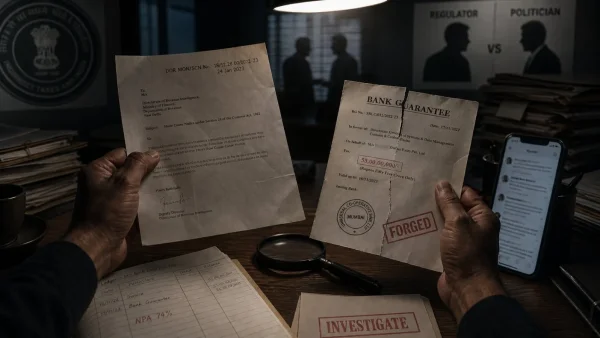
A serious allegation involving M/s Viraj Constructions Pvt. Ltd. and Creative Thermolite is being circulated on social media, with questions directed at the Reserve Bank of India and Union Finance Minister Nirmala Sitharaman over alleged financial irregularities involving ₹55 crore, a purported fake bank guarantee, high NPAs and alleged embezzlement of ₹15 crore.
The central question being raised is not merely “Was there a financial irregularity?”
It is:
“If regulators had already noticed serious issues, what action followed—and why was a criminal complaint allegedly not filed?” However, there is an important caveat: I could not independently locate the referenced RBI notice, DOR MON/SCN No. 18/12.28 00/0022-23 dated 24 January 2023, in publicly searchable RBI records. Therefore, the specific allegations should be treated as claims requiring documentary verification, rather than established facts.
What Is Being Alleged?
The claims circulating online refer to alleged financial wrongdoing involving:
an alleged fake bank guarantee
approximately 74% NPA
alleged ₹15 crore embezzlement
companies identified as Viraj Constructions Pvt. Ltd. and Creative Thermolite
individuals named in the allegation as Viraj Sagar, Alka Das and Sanjay Govil
These are serious accusations.
But there is a crucial distinction between a regulatory finding, an allegation, an investigation and a criminal conviction.
A company being subject to regulatory action does not automatically establish that every individual named in a complaint committed a criminal offence.
The RBI Notice Is the Key Piece of the Puzzle
The post specifically points to an RBI document carrying the reference:
DOR MON/SCN No. 18/12.28 00/0022-23
and dated 24 January 2023.
If an authentic copy of that notice establishes the alleged irregularities, it could provide an important timeline:
Irregularity detected → regulatory notice → response by concerned parties → RBI decision → possible referral to investigative agencies → recovery/prosecution.
The public deserves clarity on each step.
The most important question therefore isn’t simply:
“Why wasn’t an FIR filed?”It is:
“What exactly did the RBI establish, what jurisdiction did it have, and what action did the competent authorities take afterwards?”
RBI Cannot Be Treated as a Police Station
This is an important point often lost in social-media debates.
The RBI is India’s central banking regulator, but not every regulatory violation automatically results in an FIR by the RBI itself.
Depending on the facts, potential criminal conduct can involve other agencies and authorities, including the police or specialised investigative agencies.
So saying “RBI found something, therefore RBI itself must file an FIR” may oversimplify the legal process.
But that does not eliminate the accountability question.
If a regulator uncovers evidence suggesting possible criminal misconduct, citizens are entitled to ask:
Was the matter referred to the appropriate investigative authority?
Was a complaint made?
Was an investigation initiated?
What happened to the alleged financial loss?
And Then Comes the ₹55-Crore Question
If ₹55 crore was genuinely lost through fraudulent transactions, the public interest goes beyond punishment.
Where did the money go? Was it:
diverted?
transferred to related entities?
withdrawn?
invested elsewhere?
recovered partially?
written off?
converted into an NPA?
Following the money is often more important than simply identifying the paperwork irregularity.
What About the Alleged 74% NPA?
The claim of a 74% NPA also requires careful examination.
“NPA” generally refers to a loan or advance classified as a non-performing asset under applicable banking rules.
But an NPA percentage by itself does not prove fraud.
A loan can become an NPA because of business failure, inability to repay or other circumstances.
Fraud requires additional evidence.
Therefore, the public discussion needs to separate:
bad loan ≠ automatically fraud
and
fraudulent borrowing ≠ ordinary business failure.
The Fake Bank Guarantee Allegation Is Particularly Serious
A bank guarantee is a financial instrument through which a bank undertakes to make payment to a beneficiary if specified obligations are not met by its customer.
If a document presented as a bank guarantee is actually fabricated, that can have serious consequences for banks, lenders and borrowers.
But again, the specific allegation needs to be established through the original documents and investigation.
The obvious questions would be:
Was the guarantee actually fake?
Which bank supposedly issued it?
Did the bank deny issuing it?
Who submitted the document?
Who relied upon it?
Was money released because of it?
These questions could potentially turn a confusing financial allegation into a clear evidence trail.
Why No FIR? The Question That Needs an Answer
If the allegations are substantiated, authorities should explain what happened after the regulatory a1ction.
Possible explanations could include:1
The matter may have been handled through regulatory proceedings.
It may have been referred to another agency.
A criminal investigation may have occurred separately.
The alleged facts may not have met the threshold for an FIR at that stage.
Proceedings may have taken place but remain outside the public information available online.
Without the underlying RBI notice and subsequent records, it would be irresponsible to claim that “no action was taken.”
But if no criminal or recovery action followed despite evidence of possible criminal misconduct, that absolutely deserves scrutiny.
And Here’s the Sarcasm
Citizen:
“₹55 crore fraud happened?”
System:
“Please submit the complaint.”
Citizen:
“But the regulator already knew?”
System:
“Please submit the complaint in triplicate.”
Citizen:
“What happened to the ₹55 crore?”
System:
“The file is under consideration.”
Of course, that’s satire—not a claim about what actually happened in this case.
But it captures the frustration behind the controversy:
Financial wrongdoing means very little if accountability gets trapped in paperwork.
Questions for RBI, Banking Authorities and the Government
If the allegations are based on an authentic regulatory record, several questions deserve clear answers:
1. Is the January 24, 2023 RBI notice authentic?
The document should be publicly verifiable.
2. What exactly did the notice allege or establish?
The public should see the relevant findings rather than social-media summaries.
3. Was the alleged ₹55-crore exposure recovered?
If not, what is the current status?
4. Was the alleged fake bank guarantee investigated?
And if so, by whom?
5. Was any criminal complaint filed?
If yes, what is its status?
6. Were the named individuals formally accused?
If so, under which proceedings?
7. What happened to the alleged ₹15 crore?
Was it recovered, written off or still outstanding?
8. Were banks or officials found responsible for lapses?
If a fraudulent guarantee was accepted, the institutional failure also deserves examination.
The Bigger Issue: Regulatory Action Must Have a Visible Endgame
A notice is not the end of accountability.
Neither is a penalty.
Neither is an NPA classification.
The real question is what happens afterward.
Money recovered?
Wrongdoers prosecuted?
Banking controls strengthened?
Officials held accountable?
Victims compensated?
That is what the public ultimately wants to know.
Bottom Line
The allegations surrounding Viraj Constructions Pvt. Ltd., Creative Thermolite and the individuals named in the circulating claim are serious enough to warrant documentary scrutiny.
But the viral post should not be treated as proof of criminal guilt without verifying the underlying RBI notice, subsequent orders, investigative records and court proceedings.
The strongest journalism here is not simply:
“₹55 crore scam! Why did the government do nothing?”
It is a more precise question:
“What did the RBI actually find in January 2023, what action followed, and where does the alleged money stand today?” If the answer is already documented, authorities should publish it clearly.
If it isn’t, that transparency gap is itself a legitimate public-interest question.
And when allegations involve tens of crores of public or banking-sector exposure, citizens shouldn’t have to solve the mystery through social-media posts.