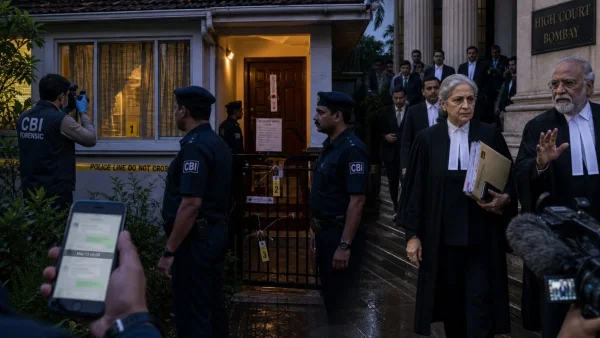
It was 27 May 2026 and the MP High Court was no place for quiet. Retired judge Giribala Singh’s lawyers made it clear they would not let an effort to cancel her bail in the Twisha Sharma case stand, pointing out that the home was under seal and the police were there, making any charge of uncooperative behaviour baseless.
Defense counters non-cooperation narrative
“It is contrary to the record,” said Senior Advocate Nitya Ramakrishnan for Singh, when it came to the allegations of tampering or running from the law. She told the court that the Bhopal residence had been in the hands of the police since the following morning, so there was no way for evidence to be disturbed.
What the case file and timeline show
The defense laid out what happened in the hours after the 33-year-old was found hanging at 10:30 on the night of 12 May; she was at AIIMS Bhopal in 20 minutes. From 13 May, Ramakrishnan said, the property was put under seal, save for a room and a bathroom, with the police in the house by then.
Singh was there for the investigators on 13 May, too, Ramakrishnan said. The records will show officers on the scene from early on, as well as Singh and her son. What’s more, while the deceased’s father was at the post-mortem, she was not even put in the loop about the inquest.
Then there is the matter of the accused putting in some verifiable work to be part of the process. Ramakrishnan noted that the 63-year-old retired judicial officer didn’t just hide behind her counsel; at 6 in the morning she put in a WhatsApp of her own to ask for some time.
The prosecution seems to have overlooked the fact that the officers did come back on 24 May and take things from the sealed rooms, Ramakrishnan argued. And as for Singh, you can’t make her walk into a station on your say-so; she has not been ignoring anyone.
With a few key points and the times they were made, the defense made its case:
– A phone taken from the home, with a signed memo to prove it
– A return on 24 May to make another seizure from the sealed-off parts
– The family being turned away from those same areas
– Notices of one kind or another, when the house was already in the police’s eye
When it comes to the relief they are after, it is a right to apply for anticipatory bail, period. It is wrong to say it can’t be done in a dowry death case, and you have to put forward a demand for dowry – which has been put forward, but is in dispute.
Chats, money transfers, and family interventions
As for the digital trail, the defense is of the view that some normal family talk is being read into. The trial court looked at the whole of the chat, not just a line here and there, and one should be careful not to see meaning where it isn’t, Ramakrishnan warned.
They have also refuted any notion of financial hounding, with money having been sent to Twisha more than once. On the marriage itself, the trial court made a note of the fact that the deceased’s troubles were with her husband, not the mother-in-law. They have even been to a counsellor on two occasions.
There is also a medical incident to consider. When it was known the girl was with child, she was with her kin. The doctor told her to have it, but she went for an MTP while her husband was in court. That doesn’t add up to any sort of meddling by Singh, according to the defense.
Prosecution questions hurried bail and media outreach
Solicitor General Tushar Mehta for the state had a different take. He put to Justice Devnarayan Mishra that the bail was given in a “hurried manner”. “Within 24 hours, bail is granted,” he said, and you have to remember someone has died and the charges are serious.
The court could have let a day or two go by to have a better look at the file, Mehta opined. The petitioner is a former judge, and in his words, a judicial officer still. This was hardly the time to be giving in to an application for anticipatory bail.
The state’s Advocate General put in that the law presumes a dowry death when it happens within seven years of the wedding, and in this instance, it was a matter of six months.
According to him, Singh was sent two notices to come in and cooperate. But he put it on record that the person at the house would have nothing to do with one of them.
The state’s line after bail was this: there were WhatsApp messages from the accused’s camp saying she was out of town and would be in touch when she got back. She never did. The Advocate General made a point of the bail terms, contending that by not following up on a string of notices, the requirement to cooperate and not tamper with or delay proceedings had been “brutally” flouted.
Mehta had a word about the press conferences held since the bail was granted, warning they can put pressure on witnesses and put a spin on things. He put some May 7 chats before the court to show how the mother-in-law may have driven a wedge between them, and he was having none of the attempts to cast the deceased in a certain way or make inuendos about character.
It all goes back to May 12, when the 33-year-old was discovered hanging in her in-laws’ home in Bhopal’s Katara Hills. Her side has an FIR down for dowry harassment and abetment to suicide, with Samarth Singh and his mother, Giribala, as the accused.
Samarth, who had been hard to find for a while, has now put himself in and is in police custody for a week. The CBI will no doubt be taking over and running a full forensic on the place, the room where the body was found included.
To put some of the procedure in perspective:
– Police were at the house by 13 May
– The scene was sealed off, for the most part
– The husband is in for seven days
– A new FIR is with the CBI
The Supreme Court has waded in on its own, pointing to some missteps in how things were first handled and asking for some discretion in the reporting. It wants to see a clean, independent probe and has taken note of the public’s unease over whether the courts are being too soft on the accused.
In open court, the state said it was going by what was in the case diary. The Advocate General drew the bench’s eye to the post-mortem, to the ligature mark and the injury. “Yes,” he was asked if the injuries were ante-mortem.
The prosecution is after a custodial interrogation. Mehta’s view is you won’t get to the heart of the matter any other way; the deceased had some issues with the mother-in-law and that needs to be probed.
The defense took exception to not being shown what the state was using. The state’s answer was that once you work with us, you’ll have every document.
Inside the courtroom: custody, evidence, and precedent
One of the judges put the brakes on the state’s long list of judgments. “I am trying to conclude today,” he said. The Advocate General demurred, “I am merely trying to assist the court.” Then you had senior counsel like Siddharth Luthra and Nitya Ramakrishnan making their case against the move to cancel the bail, with some old precedents on anticipatory bail to back them up.
The High Court has put off its order on the petitions for now. It comes down to how the bench reads the situation – the urgency, the lack of cooperation, and the evidence in a case the CBI is now on top of.
What happens next
There is a new wrinkle. The Advocate General told the court the CBI has put in a fresh FIR and, within the hour, bail was in the offing. The defense says its client has done as he was told.
With the CBI in the driver’s seat, you can expect a close look at what happened after 10:30 on the night of May 12, the sealing of the house, and the digital trail. Both sides know the ins and outs of the seizures and access will be a big part of it.
For the families, it is a matter of right now. For the investigators, it is a question of whether the chat logs add up, where the money has been, and what the medicals say. And for the court, whether to let the protection stand or not.
You can be sure the public will be watching. Between the Supreme Court's words of caution and the CBI’s work, the High Court’s decision will be the one that defines how this is handled from here on in.