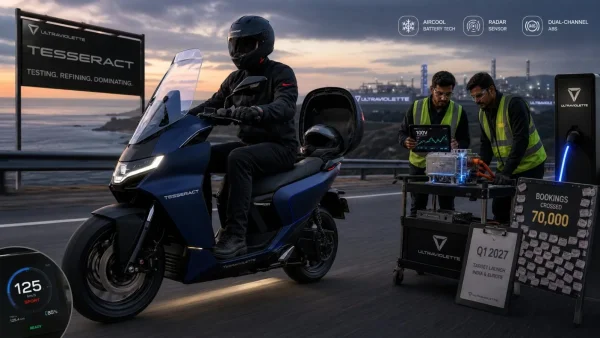
The one two-wheeler everyone was looking forward to from Ultraviolette has run into a bit of a snag. The Tesseract was supposed to be in your hands in Q1 or at the latest Q2 2026; now it’s a Q1 2027 affair. But here’s the good news: if you’ve put down a booking, you’re not paying more. And when it does come out, it will have been upped a notch for those who want to have their cake and eat it too, performance-wise.
How it will ride and charge
According to Ultraviolette, the time off has been put to good use. They are making a big engineering move to a higher voltage system for the Tesseract, which means more power and less time at the charger. They won’t give you the hard numbers just yet, but they make a point of how this puts them ahead of what’s on the market.
What you get out of it
For the most part, you’ll know what you’re getting. The 3.5kWh, 5kWh and 6kWh battery options are still on the table. So is the dual-channel ABS and traction control. A few of the models will have the on-board charger we saw with the X-47, and the focus is as much on safety for Indian roads as it is on the tech.
To put it in a nutshell, here’s what you’re looking at:
– A high-voltage system for quicker charging
– 125kph top speed
– 30 litres of boot room
– Standard ABS and traction control
– Your pick of 3.5, 5 or 6kWh batteries
Comfort, safety and the day-to-day
Then there is the feedback from 30 cities where they put the Tesseract on display. They’ve made the floorboard a bit slimmer so you can get on and off with ease, and put in a roomier seat for you and a pillion. The handlebars have been repositioned for a better fit. Even the windscreen has been raised for some extra utility, with a few minor bodywork changes to make it work.
They are putting 125kph on the table for top speed. In some of the test footage they’ve put out, the Tesseract leaves every home-grown scooter in the dust, whether it runs on petrol or juice. It even put some 150-200cc bikes to shame, pillion and all. We’ll have to see for ourselves once the production ones are out, of course.
That high-voltage setup is what makes the difference in the long run. The company touts it as a way to get more sustained power and charge in less time. The exact rates are being kept close to the chest, but the idea is to keep the heat down and the performance up on a long day in the saddle.
Ultraviolette will tell you they had a problem with packaging. At first, the thinking was to take the F77 and X-47 powertrain and make it work for a scooter. But you can only do so much with space and thermals. It was either lose the 30-litre boot they were touting or tone the 15kW output down to 10kW.
On the delay
They weren’t having any of it, so they started over. What you end up with is a new high-voltage build with a motor controller, BMS and vehicle control unit that have all been done from scratch. Put in the hours for that kind of work and you add about six months to the schedule, they say.
Under the hood
Most scooters these days are running 50 to 60 volts. Not the Tesseract. Ultraviolette says it is going to be the first in India with a 100V architecture, a far cry from their current EVs which don’t even hit 50.
You up the voltage and you can run less current for the same amount of power. It’s a way to keep things from running hot and hold your output steady, as any engineer will tell you.
The founders put it in plain terms: while the power you get is a function of the current, the heat you have to deal with goes up at an exponential rate. So with this new configuration, they’re after 15 kW out of a 4 kWh pack. That, by their count, is three times what you’ll find in a comparable scooter. The controller has been overhauled to make that happen. Where an older model would tip the scales at close to six kilos and do about 50 kW, the one we have now is much more compact and has a lot more in the way of power density. Most of the competition is putting 3-5 kW through a controller of this size; Ultraviolette is making 15 kW work.
There are some ergonomic tweaks on board, but also some hardware to stand up to the kind of roads you see in the city. You’ll be getting 14-inch wheels and a bit of long-travel suspension as part of the package. And no matter which variant you go for, dual-channel ABS and traction control are there. They’ve also put in some radar-based safety tech.
All in all, it’s a scooter made for when you want to put in some miles on the highway or just have a no-hassle ride in town. We’ve seen changes to the seat, the bars and the windscreen to make for a better experience on a long commute or a Saturday run. And for those who have already put down a booking, the price is not moving.
When you can get one
The Tesseract is being put through its paces right now, with a four-month road test to be had before they start building them. We’re told the first ones should be in customers’ hands in Q1 2027, if not earlier in the quarter.
People are still lining up for it. There are 70,000 bookings and counting. Some will be chuffed with the wait, but the company is standing behind the idea that you’re getting something better and more sensible than what was on paper.
What’s ahead
Ultraviolette is calling the Tesseract its heaviest volume seller to date, having made a name for itself in Europe and with 40 countries on the certification list. To keep up with that, they can put out 5,000 a month at the present plant, and there are talks of a bigger one down the line, with an MoU in place with the Karnataka government.
The Shockwave bike is also seeing a delay; they’ll have more to say on that in due course. For the moment, the plan is to bring the Tesseract to market in 2027 with a platform that doesn’t cut any corners.
If they pull it off, you could be looking at the most capable e-scooter in India, with the speed, the charge time and the storage to back it up. It comes down to whether you think the upgrade is worth the extra few months.