We’re going to see more Indian firms vying for space on American shelves as brand owners, not just as the service side of the equation. That’s the take from Oyo’s founder and PRISM’s CEO, Ritesh Agarwal. He makes the case that you’ll be seeing a lot more of these tech-savvy Indian consumer labels in the US, with Oyo at the forefront of that kind of expansion.
If you look at the numbers, the US is where Oyo is now making its most money, a change he put in place after some hard-charging growth beyond India’s borders. Put simply, with all the franchised and in-house properties it has put in place, Oyo is the top economy hotel brand in the country.
A soft power pivot, enabled by tech
Agarwal puts this in a wider context. India is home to the second largest concentration of FAANG talent, and he believes that kind of human capital is what’s allowing our companies to put together the sort of big-ticket consumer franchises that US customers want.
Indian brands eye US consumers
You can expect to see Indian brands being used by the American public in a big way before too long, and it will do more for India’s image than a bit of Bollywood or an IT contract ever could. Technology is what underpins that and makes it stick, in his opinion.
Agarwal put it in no uncertain terms when he laid out the strategic stakes:
– You’ll have Indian brands making a direct play for the US consumer
– Technology will do what it does best and shrink the time and cost to scale
– The line between a hotel and a home is going to get fuzzy with extended stay
The story is no longer about India as the back office; it’s about us building brands that have a name and a price tag in the US. You have to deliver on quality and consistency right out of the gate if you want to keep up with what’s expected here.
Oyo’s playbook: consolidation and extended stay
Then there was the 2024 deal to bring in G6 Hospitality for $525 million. It made Motel 6 – the biggest of its kind in North America – part of the Oyo family. In one stroke, you have a presence in every corner of the country, a name people know, and some serious clout in the budget end of the market.
Agarwal sees the housing crunch in the US as an opportunity. Oyo is getting into the nitty-gritty of extended stays, the grey area between a hotel room and a home, to fill a void that neither a standard rental nor a night’s accommodation can really cover.
It’s a head-on challenge for anyone else in the mid-market or budget lodging space.
Oyo’s premise is simple: with an asset-light model, a brand that offers value and distribution at speed, you can turn the friction of housing into steady occupancy.
Capital, timing and the US push
There’s been some buzz about Oyo’s parent, PRISM, getting the green light from SEBI to put 6,650 crore on the table in an IPO. The company put in its preliminary papers back in December 2025 through the confidential channel.
Then there’s Agarwal’s view on what’s to come. He sees a lot of Indian, consumer-facing companies putting money into the US, much like you’ve seen from Europe or Southeast Asia for years. "India's time is now,” he put it.
Signals from New York
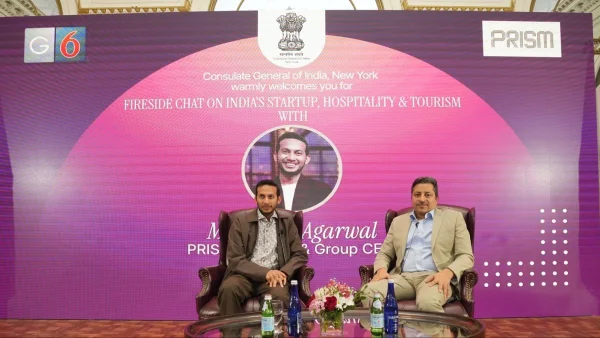
He was in New York on Tuesday for a fireside chat put on by the Consulate General of India and with Nitin Thakur, PRISM’s Group President, as his host. They got into the weeds on the startup scene and where the opportunities are in hospitality.
In talking up the US as central to Oyo’s figures and plans, Agarwal was trying to show this is more than a pilot. With Motel 6 you have the distribution; with extended stay you’re testing a hybrid that can be rolled out in any metro market under pressure.
When the subject of the SpaceX IPO came up, Agarwal told a story about running into Elon Musk at a launch last year that didn’t go well. The way Musk handled it was a case study in making failure part of the process – something any founder should try to copy.
Some leadership and policy to factor in
As for the policy side, he has little but good words for the government. He even called PM Modi the “startup Prime Minister” for the way he’s put the country behind its new ventures. We’re talking about $2 billion in capital for first-time founders.
He also made a point of mentioning his time with Donald Trump. There’s a certain openness to business that the former president is known for, and Agarwal sees that as having been good for the Indian-American relationship, making for a better climate for our kind of consumer business in the US.
What to keep an eye on
For now, it’s about the numbers: how Oyo’s extended stay units are doing in terms of RevPAR and occupancy, whether the Motel 6 network can be turned into some high-margin growth, and what PRISM does with its money after the IPO.
The real test is if other Indian companies can make the leap from being good at engineering to being a name Americans put their trust in. If they do, you won’t just see them in your code, but in the products and loyalty cards you use every day. Oyo is already making its move: be there with a strong brand and a fair price, and don’t let the window close.