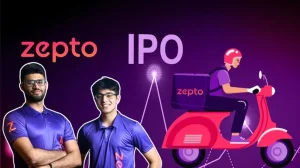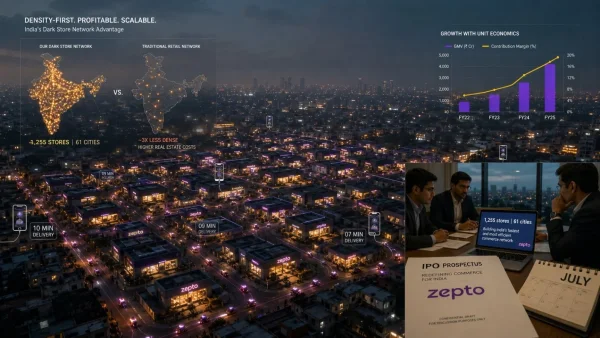
The Bengaluru firm is in a hurry to list before the end of the month, according to those in the know. It’s a move that will put its density-first model to the test in what is sure to be a close-watched market. With 1,255 dark stores in 61 cities under its belt, Zepto is looking to see if it can outmanoeuvre competitors with a wider but shallower presence.
IPO timeline and regulatory steps
On the regulatory front, Zepto has the nod from the SEBI for its first public issue and should be putting in an Updated Draft Red Herring Prospectus any time now. The process was quietly started in December 2025 via the confidential pre-filing route.
Competitive landscape and stakes
Come through with this and you’ll have another name on the exchange alongside Zomato and Swiggy. It’s well-timed, too, as the quick commerce story has moved on from the early days of growth at all costs.
Strategy: density over sprawl
There’s a case to be made that Zepto is doing things its own way. A report from Bernstein puts it plainly: while others are in a rush to open up new cities, Zepto is upping the operational intensity in the ones it has. They have the most concentrated footprint in the business, with about 21 stores to a city on average, compared to nine for the rest.
You can see the numbers. Zepto has 1,255 dark stores in 61 cities. Blinkit, for instance, has 2,222 but they are spread over 243 cities. Zepto’s store-to-pincode ratio is the best in class, which is exactly the point: they want to be where the customers are, not just have a national map to show off.
Bernstein says this means more of their network is in the metros, where you can get better delivery times and keep people ordering. It’s not about inflating GMV with new territory; it’s about getting more out of the markets you’re in.
Urban concentration and unit economics
In an industry where scale is usually measured in the number of cities you cover, it’s a bit of a contrarian play. But the thinking is that you can get better unit economics from a thick, high-density market than a thin one.
This listing is a statement of intent as much as it is a way to raise money. Everyone in quick commerce has been after the same customers with speed and choice. Now Zepto wants to prove that a tighter net is more profitable than a wide one.
If the market is in the mood for efficiency, it could change the rules for the segment. If not, the ones with the bigger reach will come out ahead.
Funding trail and founders
It doesn’t come out of nowhere. Zepto has had some solid support in private. In October 2025 they put together $450 million (roughly Rs 3,757.5 crore) with the California Public Employees’ Retirement System in the lead, at a $7 billion mark. Before that, in 2023, a $200 million Series E made them a unicorn at $1.4 billion. The whole thing was put in motion by Stanford dropouts Aadit Palicha and Kaivalya Vohra.
From here, it’s mostly formality: file the prospectus and talk to investors. But the real story is what happens in that July window. We’ll find out if a dense urban setup can be valued as highly as the kind of geographic sprawl the market is used to.
Here is what investors will watch most closely as July nears:
– Density-first model versus expansion-led growth
– Listing targeted before July 31
– 1,255 dark stores across 61 cities
– Nearly 21 stores per city on average