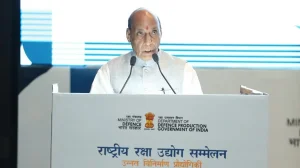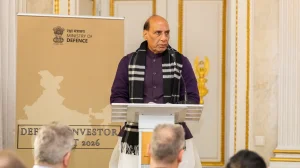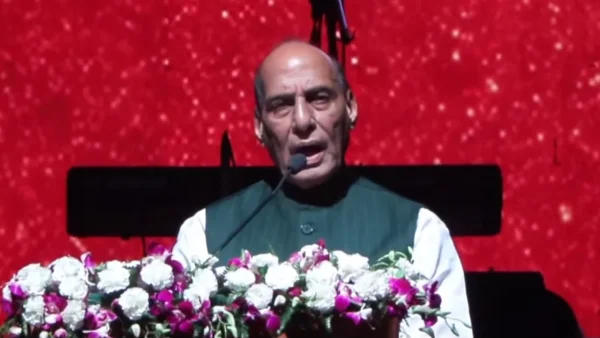
On Thursday in Jaipur, Defence Minister Rajnath Singh will lead a very important evaluation of the country’s security, a review of how prepared we are for anything. This is happening on the one year anniversary of Operation Sindoor. The plans for this meeting mix remembering what happened a year ago with some serious decisions about what dangers we might face in the future, and will very closely look at how well India’s military can fight and how quickly it’s adopting new technology.
Last year, Operation Sindoor fundamentally altered how security is viewed. On May 7th, in the very early morning, India used accurate missile strikes to destroy nine terrorist camps in Pakistan and the part of Kashmir that Pakistan controls. At least 100 terrorists were killed.
This was in response to the terrible attack in Pahalgam, where 26 civilians were killed. The Defence Ministry calls Operation Sindoor a hugely important mission involving all three parts of the military, and they say it showed India’s strong and unwavering political will and military determination, and that it was done with ‘surgical precision’.
Top brass meet in Jaipur for a two-day review
The second of these two-day Joint Commanders’ Conference will be the main part of this review. Rajnath Singh and the Chief of Defence Staff, General Anil Chauhan, along with the most important leaders in the military, will assess the forces’ current situation.
According to people with knowledge of the plans, the discussions will be thorough. They will cover all of the challenges to the country’s security and the military's ability to fight, considering that the security situation in the region is changing.
From past precision to future contests
A year later, the Ministry of Defence says that things are changing strategically: modern war is becoming complicated and increasingly reliant on technology. They point to the big impact of Artificial Intelligence, the increasing use of drones, and threats that go beyond traditional battlefields into areas that are not easily seen.
The conference is meant to be a place to assess new areas like cyber warfare, space, and cognitive warfare. It will create a plan for improving our abilities, to build a strong military that is ready for the future and has a strong advantage.
Indigenisation moves to the centre
Beyond just how the military carries out operations and its basic principles, what is being bought and made is also important. The Ministry says a key goal is to speed up the process of building things in India and becoming ‘self-reliant’ in making things for the defence forces, by encouraging innovation in the country and bringing together the civilian and military worlds.
To clarify the priorities shaping the agenda, officials have flagged these thrust areas:
– Speed up indigenisation across key platforms
– Deepen Aatmanirbharta in defence production
– Build a domestic innovation ecosystem
– Advance civil-military fusion initiatives
Why this anniversary matters now
The timing of this is important. Being on the anniversary of an operation that used multiple different areas of warfare, while at the same time discussing security in cyberspace and space, links the past’s strong commitment to being able to deter attacks with being prepared for the future, and shows that all three military branches are working together as the situation in the region changes.
For the armed forces, this review is about using what they learned from the accurate strike operation to make the military stronger in the long term. For industries, the focus on creating things in India and using drones sets expectations for when things will be ready, how advanced the technology will be, and how reliable the supply chains will be.
What to watch as deliberations proceed
Those at the conference will likely look at how to responsibly use AI to help with decisions and to deploy many unmanned platforms. They will also consider the weaknesses in protecting against cyber attacks and being able to continue functioning in space, as well as the training and principles of cognitive warfare.
Officials say they want to have a very clear and step-by-step plan. This means making sure the needs of those in operations, the way things are bought, and research and development within the country all work together to guarantee that we have strong military capabilities in situations where the enemy is present and technology is everywhere.
So the Jaipur conference isn’t simply about marking a date. It’s an attempt to connect a year of showing what the military can do with a plan for improving abilities, principles of operation, and the industry, and to base all decisions about national security on what has happened and how things are developing.