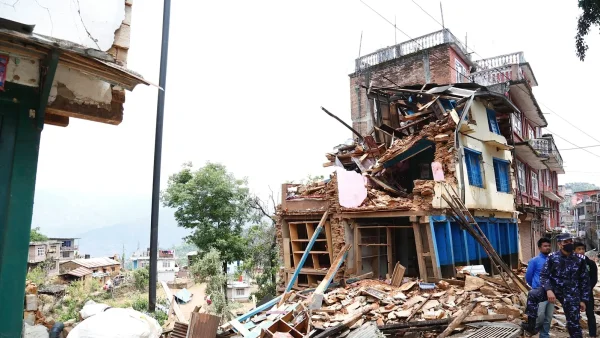
Over two days, the government of Nepal destroyed hundreds of illegal buildings by Thapathali and Gairegaun along Kathmandu’s Bagmati River. They say this will restore the riverbanks and make the capital look nicer, and that people who don’t own land will be taken to temporary shelters and will eventually be helped to get back on their feet.
Large-scale riverbank clearance in Kathmandu
Balendra Shah, leading Kathmandu Metropolitan City, carried out this work with the Federal Government. The Armed Police Force, Nepal Police and Kathmandu Metropolitan Police provided security. The people in charge said everything was done in a coordinated and mostly peaceful way.
Police and city officials say approximately 146 families had to leave Thapathali and almost 200 from Gairegaun. Some families went to shelters at Dasharath Stadium and in Kirtipur Municipality; they were told beforehand to collect their things and leave on their own.
Key figures and locations shared by authorities include:
– 146 families removed from Thapathali
– Nearly 200 families removed from Gairegaun
– Two dozen Thapathali families moved to shelters
– Temporary shelters at Dasharath Stadium, Kirtipur
– Two-day drive spans riverbank settlements
Government rationale and rehabilitation plan
Officials say this removal of homes is part of a city improvement plan to return the Bagmati Riverbanks to how they should be, and to improve Kathmandu in general. The government has said that people who don’t own land and are affected by the demolitions will be given other land and assistance to rebuild their lives.
The authorities also point out that many of the small houses and temporary buildings were in areas that flood easily, weren’t following any rules, were dangerous for those living in them and made it harder to make plans for the future. They said they gave people notice beforehand to avoid problems and to allow for people to move out gradually and of their own accord.
Relocation, reaction, and rights concerns
While many people did as they were asked and left their homes, others were very upset about being forced to move so quickly and not knowing what would happen with their resettlement. Police say about twenty-four families in Thapathali were immediately moved to temporary housing while the demolition crews worked.
Amnesty International is one of the human rights groups with concerns about people being forced to move. They caution that if people are evicted without being properly asked their opinion, having a guaranteed place to live, and support in the long run, things will get even harder for them. They are urging stronger protection and a system for those being relocated where those in charge are responsible for helping them to get back on their feet.
What comes next in the two-day drive
The authorities say they will continue to remove buildings in nearby areas as part of the same operation. During this two-day period, the government has also announced they will demolish illegal buildings in Shantinagar and Gaushala along the riverbank.
Officials outlined the immediate next steps:
– Continue advance notices and phased removal
– Provide alternative land and rehabilitation
– Prioritise restoring Bagmati riverbanks
– Maintain security presence for peaceful clearance
Why it matters for Kathmandu
Kathmandu has had problems with people building homes along the riverbanks for many years, because of people moving to the city, poverty and a lack of affordable places to live. Past governments have tried to clear these areas, but because of failures in enforcing the rules and not being able to help people find new homes equally, progress has been slow.
An earlier attempt to clear Thapathali, when Balen was the Mayor, didn’t work because the government led by K P Oli wouldn’t cooperate. This current effort, said to be one of the biggest in recent years, shows that the government is now determined to enforce the rules about what can be built where, and to completely change the way Kathmandu’s riverfront looks.