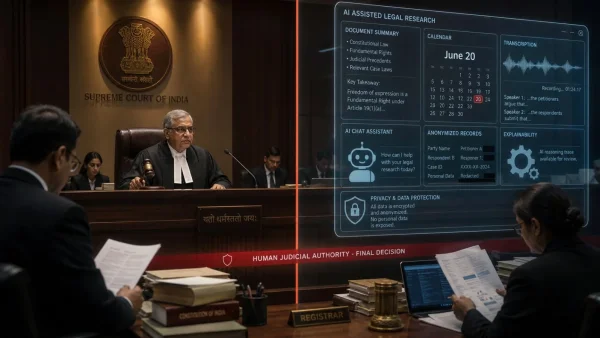
In a way, the top court is making room for Artificial Intelligence in its work, but it’s putting up some guardrails so that the final word is always human. This new framework tells you where AI can be of service and where it can’t, and is open for public comment until the 20th of June.
What changed today
We have a preliminary version of the Regulations for Use of Artificial Intelligence in Courts, 2026 from the Supreme Court. These are rules for every courtroom, tribunal and statutory commission, meant to let technology do its job in day-to-day matters without encroaching on judicial discretion.
According to the court’s AI Committee – led by Justice P S Narasimha and made up of Justices Sanjeev Sachdeva, Raja Vijayraghavan V, Anoop Chitkara and Suraj Govindaraj – the role of AI is to be an aide, not a decider. To quote the draft: ‘Every AI System shall function solely in an assistive capacity.’
Where AI fits in court work
You could see a lot of the back office and routine in the courtroom get a bit of a streamlining. The draft is fine with tools being put to use for things like legal research, putting together pleadings, or case management.
There’s also a green light for the kind of admin support that goes with cause lists, scheduling, filing and the like. Even a chatbot or two to show litigants the ropes, with some accessibility for those with disabilities or who don’t speak the language. And yes, anonymising records is part of it too.
Some of what the draft is on board with:
– A hand with research and drafting
– Translating and transcribing proceedings
– Managing cases and checking for defects
– Getting notices and summons ready
– Chatbots for litigants looking for court services
Red lines the draft draws
Then there is the matter of adjudication, and here the line is hard. The document will have none of AI deciding a case or setting a sentence. If an AI puts something forward on such a question, it is for advice only and a judge has to make the call. Human in the loop is a must.
Forget about risk scoring. The draft is against any system that tries to size up a flight risk, whether someone is likely to reoffend, or how credible a witness is. It won’t stand for ‘black-box’ logic when rights and liberty are on the table; it has to be explainable.
Surveillance is a no-go. Unless a law says otherwise, you can’t use AI to watch over judges, lawyers or litigants. And you can’t train or test an AI on personal data without the go-ahead from the proper authority.
Accountability and transparency for lawyers and courts
Don’t expect to put the onus on the machine. It is still up to the lawyer and the court to check the work, down to the citations and references. If an advocate has used an AI tool to build an argument, they have to come clean in court.
A court may even want to know which system was used and how the output was vetted. It’s all about using the speed and scale of AI without letting off the hook on professional responsibility.
Fairness, data safeguards and governance
Keeping bias in check is key. The systems have to be built and put in place in a way that is fair and doesn’t discriminate. Any AI that would stoke bias on the basis of race, caste, gender, disability or the like is out. There is to be extra care for the vulnerable.
When it comes to data, it has to be sound, representative and in order with the law. The Digital Personal Data Protection Act, 2023 will be the standard for privacy in this space.
As for how to run the show, the draft is for a full-time body at the Supreme Court to be the apex on AI policy and oversight. On top of that, an AI committee is to be set up at the top court and in every high court to make sure things are done to a uniform standard.
Why it matters and what comes next
You see courts around the world trying to figure out the limits of AI. This is India’s way of having it both ways: you get the benefits in research and admin, but you keep the opaque algorithms away from anyone’s liberty.
Before the framework is in stone, the Supreme Court wants to hear from the public and those with a stake in it. Get your comments in to the committee by June 20th.