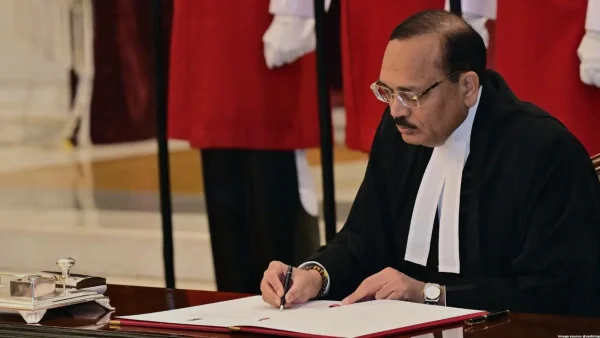
The Chief Justice was very clear about AI and the courts: don’t be afraid of it, but don’t just give up your job of deciding things to it. At a meeting of judges in Bengaluru, he described technology as something to make things work more smoothly, while human reasoning remains at the heart of justice.
A clear message from the CJI on AI and the courts
He wants judges to be balanced and careful, and to use AI tools without giving up their ability to make their own decisions. He says the courts should treat AI like a really complicated case – think it through thoroughly, take more time, and be careful and patient. The aim is to get better results, not to automatically accept what the computer says.
He stressed that the judge inside each person must still be independent. Programs can assist, but they can’t decide what’s right, understand the specifics of a situation, or understand the social and moral aspects of things. He said we should approach technology thoughtfully, not by blindly following it.
The conference, which was about how to completely rethink the court system in the age of AI, was attended by important judges and government leaders of the states. The fact that so many high-ranking officials were there shows how important the issue of AI is for courts that want to be quicker, fairer, and more open about what they’re doing.
Where AI can help the judiciary right now
The Chief Justice pointed to several areas where AI could be helpful. The most obvious is legal research. AI can find relevant past cases, summarize long and complicated files, and quickly find contradictions in the law much faster than a person looking through everything by hand. But this doesn’t mean we don’t need to read and think for ourselves, it just speeds up the parts that take a lot of time.
AI can also help with managing cases. It can assist with making schedules, pointing out when things are being delayed in the legal process, and organizing huge amounts of paperwork. This gives judges more time to actually hear the case and make a decision instead of dealing with administrative work, and can help to reduce the number of cases that are waiting to be heard.
AI can also make standard, repeated tasks uniform. Creating basic document outlines, sorting text into categories, or converting documents into another language can all be done by AI programs with someone checking the results. If people are given specific, focused training, they’ll learn when they can trust these tools and when they need to be more careful and verify the information.
And importantly, the Chief Justice connected all these improvements in efficiency to one goal: to allow more time and attention to be given to the actual job of being a judge. He believes AI should make it easier to have better hearings, clearer explanations of decisions, and faster rulings, particularly in courts that are already handling too much.
The limits of algorithms in the act of judging
However, he gave equally strong warnings. AI works based on trends, formulas, and information that already exists. It doesn’t have human judgment. It can’t balance different rights against each other, decide if someone is telling the truth, or bring the law up to date with current standards. When judges make decisions, they think about things carefully and consider the situation; their decisions are based on the values in the constitution and what people have experienced.
Relying too much on AI runs the risk of turning careful judgment into something mechanical. This would reduce the thoroughness, independence, and honesty of the system. The Chief Justice mentioned a growing concern: AI "hallucinations” where it creates fake past cases, wrong references, or completely made-up legal ideas.
These aren’t small errors. They go to the very core of what courts are about, and that is being accurate and genuine. If not caught, they can change the arguments, lead to the wrong result, and destroy the public’s faith in the courts. For a system that’s already overloaded, mistakes like these are expensive and dangerous.
The danger of misuse goes further than just errors. AI tools can be used to create misleading documents presented to the court, or arguments that sound good but are actually weak and without substance. Using AI in the courts adds confusion to cases, takes attention from the actual problems in disputes, and makes things take longer. He said that being careful and watching things closely is simply part of what a judge is supposed to do.
Verification, ethics, and guardrails for responsible AI use
The Chief Justice of India was very clear about who is responsible for things. Anything created by AI must be checked by someone else. Judges and lawyers should check where information comes from, make sure facts are right, and be sure the original sources are real. You can’t give the responsibility for being correct and fair to a computer.
Good safety measures can make using AI less risky. Courts could make people say when they’ve used AI to write or look at information. They can decide what programs are acceptable, insist on a record of what the AI did, and require that the AI’s results are checked against reliable sources. Benchbooks and standard ways of doing things could be helpful.
Issues of fairness and keeping private information safe are central to the discussion. AI systems that have been taught with biased information can repeat or even worsen existing inequalities. Courts should demand testing for bias, a variety of information used to “train” the AI, and independent reviews. They should also have very strong rules about how long data is kept and who can see it, to protect private details.
How an AI reaches a conclusion is also important. AI that is a “black box” (where you can’t see how it works) destroys trust. If the AI is being used for anything the public sees in court, it should, as much as possible, provide the reasons for its answer, where it found the information, and how sure it is of its answer. If it’s hard to see how the AI works, then a person must oversee it even more carefully to make up for this lack of transparency.
The way AI is purchased and overseen is also part of the answer. Checking AI tools in a central location, ethics groups, and a way for people who use it to give feedback can find problems early on. “Red teaming” and really testing the AI, especially for research and summarizing documents, can reveal the AI making things up before those fabrications end up in official court documents.
Training, culture, and the human core of justice
Although the technology will continue to change, the core values of the court system should not. The Chief Justice of India emphasized that people need to keep learning, thinking about what they are doing, and striving for excellence. Training should cover not just how to use the tools, but also understanding the dangers, recognizing bias, handling data properly, and checking information.
A person should always be involved. Judges are still the authors of their rulings. Clerks and assistants are still important for reviewing things. The court environment should reward careful checking, not just going fast. Ways to measure success that focus on quality, being understandable, and fairness can balance the desire for speed.
Starting with small test projects can help decide how to use AI widely. Courts can begin with limited uses, collect information about how accurate and efficient it is, and improve the procedures before using it in more cases. Input from judges, lawyers, and people involved in the cases can help make the design, the training, and the safeguards better.
The public’s belief in the court is its most important asset. Being open and clear about how AI is used, what it can’t do, and how mistakes are prevented can reassure people who are using the courts. Being open about the way AI is helping with court work (within what is morally acceptable) can help maintain confidence.
A balanced roadmap for AI in the Indian judiciary
The Chief Justice of India spoke at a time when Indian courts are trying out AI to make processes faster and reduce the number of cases waiting to be heard. Along with the possibility of improvement, there are real questions about privacy, bias, and whether everyone will have equal access. The Supreme Court is looking at rules for using AI in a way that is ethical and responsible.
A useful plan is starting to take shape: Use AI to make administrative tasks easier, speed up research, and help with translating and writing. Make people say when AI has been used to create or work on something submitted to the court and then check it. Review the AI programs, check for bias, and protect the data. Always have a person in charge of all decisions and important analyses.
Most importantly, we must protect the human element of justice. The legal system gets its authority from thinking about things with values as a guide, being helped by experience, and being based on what the Constitution says. No tool can take the place of the natural understanding and moral decisions that result in a fair outcome.
As the Chief Justice of India said, the courts are at a turning point. The choices made now will affect the court system for many years to come. Technology should help the court system achieve its goals, not change them. We need to provide justice that is fair, available to everyone, and kind, and use AI as a careful helper, never as a replacement.