The research is a warning. It shows a spike in visits to these services, which make non-consensual explicit images, coming from the very platforms you would expect to be on top of things. It is an open question how well they are holding up.
According to ISD, these are not just places where people talk about the tools; they are being used to point users in their direction. You end up with a level of scale and ease of access that is hard to ignore, and one that does a number on the victims and the trust we have in the web.
What the ISD study uncovered
When ISD put out its report on July 13, it was to see how the top 10 or so apps and sites for making non-consensual deepfakes are being found. They wanted to know what is being searched for, what comes up, and how creators are moving their audience along.
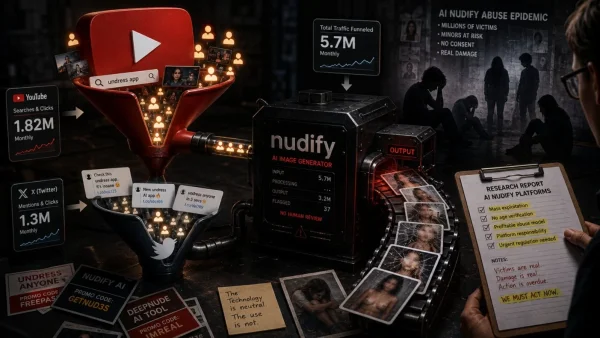
They put in for ‘undress app’ and ‘nudify app’ on the various social networks. What they came across were videos touting certain services, some with a promo code to make it a no-brainer to give the tool a go with some free credits.
Mainstream platforms as gatekeepers
The numbers are telling. From December 2025 to March 2026, the report puts the total of nudify site visits from social media at over 5.7 million. YouTube is the head of the class here, with more than 30 per cent of that, or 1.82 million visits to be exact.
Then there is X, with 1.3 million and change. It is a case against the old way of thinking that this kind of content is the province of poorly policed corners of the internet. The big players are in the mix.
Why this threatens everyday users
It is not just a matter of the technology. ISD points to who is on the receiving end: exes, current partners, even family members like a sister or cousin are fair game for these apps.
There is a vengeful streak to it, the authors say. Some of the requests are aimed at getting someone’s job or livelihood in jeopardy. It is one way to wield a tool for harassment and make it stick.
And for the price of entry, the harm can be done. A lot of these will let you have an image for $1 (Rs 96). When it is that cheap, the abuse can get ahead of any moderation in place.
On the flip side, some of the operators are doing well. Wired has a figure of $36 million in a year for some of them. There is money to be made, and that keeps the promotion and the product development moving.
Some of the key figures from the study:
– 5.7 million+ in visits from the social side
– YouTube with 1.82 million (30%+)
– 1.3 million from X
– $1 (Rs 96) is the going rate for an image
Enforcement gaps and contested policies
In the view of ISD, YouTube’s own rules on the sexually explicit should be enough to put a stop to non-consensual imagery. But in practice, the researchers had little trouble finding material that ran afoul of those very rules, making the site a de facto portal to the problem.
“YouTube wasn’t a passive party in this,” Melanie Smith of ISD put it to Wired. “We saw them making it easy to use these tools.” She was not seeing the kind of comprehensive follow-through on the no-ads or no-links to explicit sites that one would want.
YouTube’s official response
Boot Bullwinkle, for YouTube, has been clear on the stance. The company has “strict policies” when it comes to unwanted sexualisation, whether it is on the site or in an external link. That means anything synthetic that is a realistic stand-in for nudity is off limits.
How people are finding these tools
If you type in something as plain as ‘undress app’, the results are right there. ISD’s work shows there is not much in the way of a roadblock. The videos don’t just name-drop; they show you where to go.
With a link or a code in the video, you can be in and out with a free trial. It is the same playbook you see with any popular app, only in this case it is for something you should not be using.
What comes next
The bottom line of the report is that the guardrails are not where they need to be. With the volume of referrals we are seeing, the system is too slow for the people left in the lurch.
Now it is on to the enforcers. The study makes it clear that YouTube and X have to do better than have a policy in writing. They have to prove their systems aren’t standing by while this kind of thing is put on a mass scale.