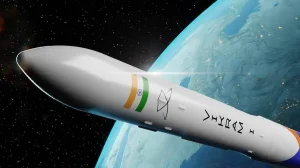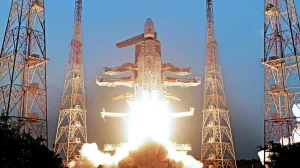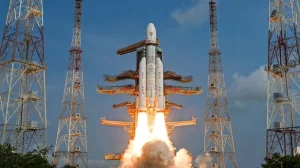
On 18 July 2026, India entered a new era in space exploration as Skyroot Aerospace successfully launched Vikram-1, the country’s first privately developed orbital-class rocket, from the Satish Dhawan Space Centre, Sriharikota. The mission, named Mission Aagaman, marks a historic milestone comparable to the launch of ISRO’s SLV-3 in 1980, but this time led by the private sector.
Why is Vikram-1 Significant?
For decades, India’s space programme was almost entirely driven by ISRO. While ISRO earned global recognition through missions such as Chandrayaan, Mangalyaan, and PSLV, commercial participation remained limited.
The space sector changed dramatically after the Government of India opened it to private companies through policy reforms beginning in 2020. These reforms allowed startups to design rockets, build satellites, and use ISRO’s launch infrastructure under the supervision of IN-SPACe.
Vikram-1 is the first major outcome of those reforms. It demonstrates that India is no longer dependent solely on government agencies for launching satellites into orbit.
The Journey So Far
Skyroot Aerospace was founded in 2018 by former ISRO engineers Pawan Kumar Chandana and Naga Bharath Daka with the vision of making space launches affordable and frequent.
The company’s first breakthrough came in 2022 with Vikram-S, India’s first privately built sub-orbital rocket. Although it did not reach orbit, it successfully validated propulsion, avionics, and flight systems.
Much of the technology tested during Vikram-S was refined for Vikram-1, reducing technical risks before attempting an orbital mission.
Why Was Vikram-1 Developed?
The global satellite industry has changed significantly over the last decade.
Instead of launching a few large satellites, companies are now deploying hundreds of smaller satellites for:
Broadband internet
Earth observation
Climate monitoring
Agriculture
Disaster management
Defence
Navigation
Internet of Things (IoT)
These satellites require dedicated, cost-effective launch vehicles.
Vikram-1 has been designed specifically for this rapidly growing small-satellite market, enabling India to compete with global launch providers.
What Makes Vikram-1 Different?
Vikram-1 incorporates several modern technologies:
Lightweight carbon-composite structures
Three solid-fuel stages with a restartable liquid upper stage
Modular design for faster production
Capability to deploy multiple satellites into Low Earth Orbit
Designed for rapid turnaround between launches
These features aim to reduce launch costs while increasing flexibility for commercial customers.
Why This Launch Matters for India
The success of Vikram-1 represents more than a technological achievement.
It demonstrates that India’s private aerospace ecosystem has matured enough to undertake complex orbital missions.
This could:
attract global commercial satellite customers,
create thousands of high-skilled jobs,
encourage investment in Indian space startups,
strengthen domestic manufacturing,
reduce dependence on foreign launch providers, and
contribute to India’s ambition of becoming a major player in the global space economy.
Challenges Ahead
Despite the historic achievement, significant challenges remain.
The commercial launch market is highly competitive, with established players such as SpaceX, Rocket Lab, Arianespace, and several Chinese launch providers already serving customers worldwide.
To compete successfully, Skyroot must demonstrate:
consistent launch reliability,
competitive pricing,
rapid launch schedules,
high mission success rates, and
the ability to scale manufacturing.
One successful launch is a beginning, not the finish line.
The Future of Skyroot
Vikram-1 is only the first step in Skyroot’s long-term roadmap.
The company plans to:
conduct additional developmental launches,
transition to regular commercial missions,
develop heavier launch vehicles,
build reusable rocket technologies,
support India’s growing satellite ecosystem.
India has also set ambitious goals for expanding its space economy over the next decade, and private companies like Skyroot are expected to play a central role in achieving them.
A New Chapter in India’s Space Story
Forty-six years after ISRO’s pioneering SLV-3 launch, Vikram-1 symbolizes the next phase of India’s journey into space—one where government expertise and private innovation work together.
If Skyroot and other emerging companies continue to succeed, India could transform from being primarily a satellite-launching nation into one of the world’s leading commercial space powers.
Vikram-1 is therefore more than a rocket. It is a signal that India’s space ambitions are no longer confined to government laboratories—they now extend to a vibrant ecosystem of startups capable of competing on the global stage.