The advance tax calendar is in full swing in India. With the first instalment for FY 2026-27 coming up on June 15, 2026, there’s no room for error if your post-TDS/TCS estimate is over Rs 10,000. A short or late payment means 1% a month in interest, so this is one compliance issue to put on your radar.
This is all about the pay-as-you-earn system: you spread the cost out over the year instead of facing it at filing. For salaried folks, any side income from the markets, a rental property or a deposit can be enough to tip you over the line, even with TDS on your salary.
There is an exception for senior citizens 60 and older, but only if they don’t have any business or professional income to report. Otherwise, the rule applies.
Who has to be on top of things by June 15
As it stands, you’re in the advance tax camp if your year-end estimate is north of Rs 10,000 after TDS and TCS. We’re talking a wide range of people here – from the salaried to freelancers, consultants and businesses – as long as their numbers add up to that figure.
Your salary might be fully covered by TDS, but if you have some capital gains, rent or interest on top of it, you may still have an obligation. The same goes for senior citizens with business or professional earnings.
Not sure if you need to file? See if any of these ring true for you this quarter:
– You are on a salary but have capital gains that put you over the limit.
– You work as a freelancer or independent consultant.
– You own property and have taxable rent coming in.
– You have a lot of interest piling up on fixed deposits.
– You are a senior citizen with some form of business or professional income.
Paying online in a jiffy
Head to the Income Tax Department’s e-filing portal to make a payment; it will take you through a few options. You’ll want to use the e-Pay Tax function for Advance Tax. You can get to the portal at https://www.incometax.gov.in/iec/foportal/
Here is a quick way to do it on the site:
– Log in to e-filing.
– Go to e-File and click on e-Pay Tax.
– Put in a New Payment.
– Make sure to select Income Tax and then Advance Tax.
– Choose Minor Head 100 and the right assessment year.
– Fill in the figures for tax, surcharge, cess and any interest, then pay with your method of choice.
Just be sure you have all the components in there: the tax itself, plus surcharge, health and education cess, and interest where it is due. Hold on to your acknowledgements for the record; you’ll need them to square off payments with what you actually owe.
Penalties for missing or underpaying
There are two ways you can be put in the penalty box for a late or short payment. For one, if you haven’t put down at least 90% of your total tax by March 31, Section 424 (the new face of old Section 234B) will have you down for 1% a month in simple interest from April 1 until you make it right.
Then there is Section 425, which is in line with the former 234C. If you don’t hit the mark on an instalment as the quarterly calendar has it, you’re looking at 1% per month on whatever you came up short.
All told, these add up. The best way to handle it is to be on top of your numbers, factor in every bit of income and stick to the schedule so you don’t end up with a mountain of interest.
Payment schedule and presumptive taxation
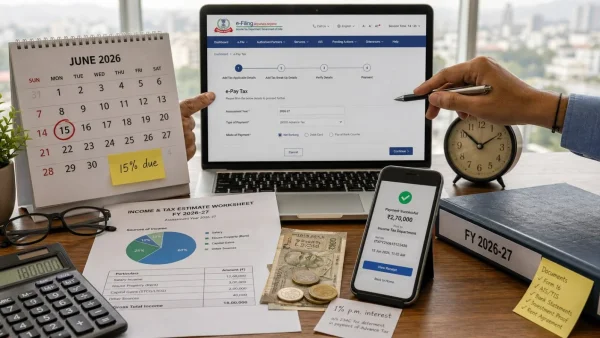
For FY 2026-27, advance tax is broken into four parts. You want to have 15% of the total in by June 15, 2026. After that, 45% is due mid-September, 75% in mid-December and the rest by March 15, 2027.
If you’re a freelancer or run a small business and are on a presumptive scheme, you have a different set of rules. You can do it all in one go: 100% of your advance tax is due no later than March 15, 2027, though you have until the 31st if you prefer.
It’s a simpler way to comply, but you lose the benefit of spreading it out. Make sure you have your gross receipts in order and some money put away so you don’t have to rush at year-end.
Why this deadline matters now
The June 15, 2026 date is where it all begins. Getting that first 15% in not only sets you up for the quarter ahead but also keeps you from being hit with 1% monthly interest. It’s a good way to make sure you don’t have to come up with a large sum in March.
Don’t be fooled if you have a lot of TDS on your salary. Check your capital gains, rent and the like. If those push you over Rs 10,000 in tax, you still have to pay advance tax even with the TDS.
What you need to do is review your income for 2026-27, take out any TDS or TCS you’re owed, figure out what’s left and pay it. Have your papers in order in case something changes – a bonus here, a sale of an asset there.
In the end, it’s about as much planning as it is writing a cheque. Hitting the June 15 mark gives you some peace of mind for the year, and you won’t be in a bind to settle up under pressure when the year is done.