While India is dealing with the fallout of a paper leak, China is putting on display a Gaokao process that doesn’t miss a beat. It’s a security model made for a country of this size. For the students, there is no room for error; this is the score that will open or close doors to their future. As for the universities, the point is made: if you want people to have faith in your high-stakes testing, you have to be unyielding on oversight and run a tight ship.
Why Gaokao shapes futures
Then there is the National Higher Education Entrance Examination, the Gaokao. It is the one and only way into a college or university in China, and it happens every year.
Your grade is everything. At most schools, it is the final word on whether you get in. You can see why it’s so cut-throat and tense, but for many it is also the only way up the ladder to a better life and a more comfortable bank account.
It is not a matter of just passing or failing. Think of it as a placement test of sorts. Some 12 million put in an appearance for it annually, yet the big names like Peking and Tsinghua will only let in about 0.1 per cent of those who try.
How the exam actually works
Most students face the Gaokao in their last year of high school. You are looking at a two- to four-day stretch, which can vary by where you are in the country and what you’ve put down for subjects.
Chinese, math and a foreign language are on the table for everyone. From there, you add on whatever fits your academic track, so while it is standardised, there is some give and take between the different regions.
The 2026 edition was a smooth operation, if you ask the officials in Beijing. The Ministry of Education has the numbers: 12.9 million signed up this time around.
Security architecture behind the smooth run
Prevention is the name of the game in China’s system. The question papers are moved under watchful eyes and put away in places you can’t get to, with a chain of custody that is hard to break.
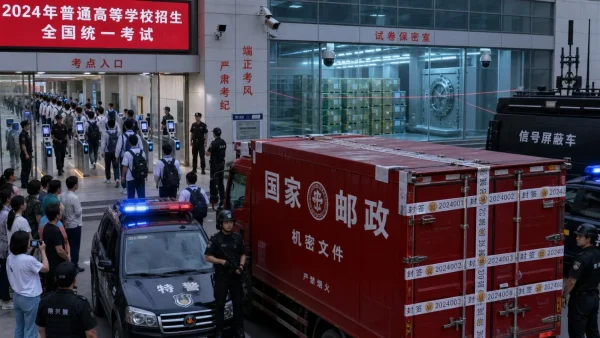
Walk into an exam centre and you’ll find biometrics, metal detectors, cameras, and even signal jammers. AI is on hand in some places to flag anything odd. And don’t think about cheating; the government has no patience for it and will press criminal charges when it matters. They are also on top of the internet to put a stop to any leaks or noise.
Inside paper setting and printing
If you talk to one content maker in the education space, he’ll tell you the controls in place are on a par with state secrets. The people writing the questions are put in a room with no outside contact and no devices. Nothing goes in or out, and the cameras never blink. In a way, they are in for a month of it.
There is also a check on any conflict of interest. The department makes sure the teachers they pick don’t have kids or kin in the running for the Gaokao, and they aren’t the ones in the classroom with the students either. By all accounts, the printing is done at a ministry-sanctioned location or within a prison that has been put through its paces by the States Secrets Bureau and the Ministry of Education.
You have to be a model inmate to be trusted with the work – you need to pass a background check and some confidentiality training. And don’t think for a second the place is unguarded; it’s a 24/7 operation with infrared, motion and vibration sensors on high alert.
Locked logistics from press to desk
Then there are the China Post trucks. They’re used to move the papers because they are, after all, 100 per cent in the hands of the state. You’ll see police up front and armed special forces in tow, with GPS and satellites keeping an eye on every move.
There are video monitors on every side of the truck. Stray from the route or the speed limit and you set off an alarm. Once they get to their destination, the papers are put in a vault where they stay under the watch of armed police.
A nation on pause, and the student experience
When exam time comes around, it puts a stop to the usual way of life. You’ll hear of factories idling and roads being made clear so as not to disturb the teenagers in the test halls. Outside, you can find parents in symbolic attire, there to put in a good word for their kids.
But the strain is there well in advance. Years of prep, after-hours tutoring and rigid timetables add up. It’s no small thing: the score is your ticket to a top university and a better life.
India’s debate and what can be adapted
With the talk of paper leaks in India, there is more of a push for things to be above board. Some will have you believe that if you look at the Gaokao in China, you can see how hard-nosed enforcement and tech can handle an exam of that size. Then there are those who say you can’t make an apples-to-apples comparison given the differences in how the two countries are run.
The consensus among experts is that India can pick and choose. But any reform has to make sense for the ground reality and put trust and accountability first, rather than just copying a system.
Policymakers tend to zero in on a few things:
– Transport that is tracked from start to finish
– Stiffer consequences for the kind of cheating that is premeditated
– AI for surveillance, but with a human in the loop
– A tight chain of custody
– Being open with the public
Why the optics matter for institutions
An exam body needs to look like it has its act together. The way Chinese officials are touting a smooth 2026 is as much about setting a standard for large-scale, mistake-free operations as it is for show.
They do still have to put out the odd fire. In 2022, some photos of math papers made the rounds online and people started to wonder. The Ministry of Education had to step in and say it was students trying to be clever, not a leak.
What comes next
For the foreseeable future, with millions vying for a spot at university, this is going to be a hot button issue. India has to figure out how to be secure without losing the confidence of the students.
China’s approach is a case study in what you can do with enough control. But in the end, the question for any system is how to have your cake and eat it too: to be secure, fair and humane, and to let learning be as important as the rank.