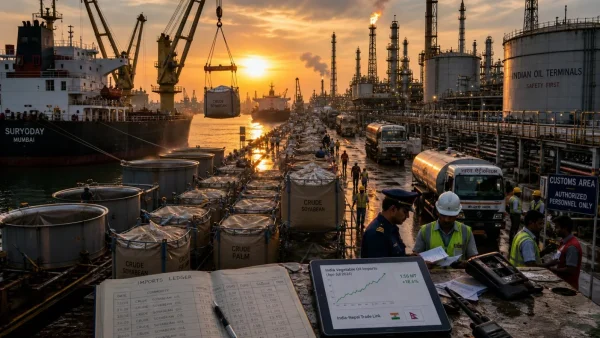
The market made no bones about it in May: it was all about the crude, and that alone was enough to nudge total edible oil arrivals up 6.7% to 1,338,936 tonnes. The Solvent Extractors’ Association of India (SEA) put the increase down to the appeal of crude soyabean oil; as the premium over palm has thinned, refiners have been quick to make the most of it.
Refiners gain as policy tilts to crude
You can see the results of policy in the numbers from SEA: not a single tonne of RBD Palmolein was imported in May 2026, and the share of refined oil has tumbled. For the first seven months of this oil year, the ratio of refined to crude has gone from 16% to 3%, with the latter now making up 97% of the mix, up from 84%.
SEA says it is what you would expect given the government’s approach to the duty differential. It has been an effective way of getting crude palm oil into Indian refineries and, in turn, putting some life into local value addition and employment.
Soyabean steps on palm’s toes
Nowhere is the change in the wind more evident than with soyabean oil. We saw 4,93,854 tonnes of the crude come in during May, up from 3,98,585 a year back. With the edge over palm oil narrowing, buyers were on it, and it helped bring the overall figure for edible oil to 13.39 lakh tonnes.
There was also a lot of movement in non-edible oils, which more than doubled to 26,202 tonnes in May 2025 from 12,040. Put them together and you have 13.65 lakh tonnes of total vegetable oil for May 2026, an 8% step up from 12.67 lakh in 2025.
Seven-month trend shows sustained build
What happened in May is part of a larger story. From November 2025 through May 2026, we have seen a 13% climb in edible oil imports to 92.17 lakh tonnes. If you look at total vegetable oil for the first half of the 2025-26 year, it is up 12% to 93.65 lakh tonnes.
Non-edibles, on the other hand, have been left behind in that period, with shipments down to 1,47,710 tonnes from 2,07,505. It is another sign of where the focus is: on edibles and on doing the work in India.
Tariff signals reshape the playbook
Starting 1 June, the government put a value of USD 1,218 on a tonne of crude palm oil and USD 1,222 for the RBD version, with a small cut for crude soyabean. SEA says between that and the duty structure, the message is clear: buy the crude, not the finished product.
You can see it in the RBD Palmolein numbers. In the last seven months, imports have been 47,270 tonnes, a far cry from the 8,26,800 in the same run last year. That kind of drop means more volume is being put through our own refineries.
Regional dynamics and duty-free corridors
Then there is the matter of Nepal. Refined oil from there is still coming in in force, thanks to the zero-duty provision in the SAFTA Agreement for anything bound for India. It is a bit of a regional exception in a market that is otherwise very much focused on what can be refined at home.
To put it in perspective, 1,338,936 tonnes in May is a good deal more than the 1,254,883 we had this time last year. It is the scale of the switch to soyabean, even as the rules on palm keep the value on this side of the border.
Key takeaways for market watchers
This is what is moving the needle on trade and refining right now:
– Crude is king; refined is down to 3%
– Soyabean is the one to have as its premium eases
– RBD Palmolein has all but vanished due to the duty gap
– Tariffs are a nudge in the right direction for crude
– Nepal’s duty-free route is still open for business
Why it matters and what to track
Going with the crude means we don’t have to cede any of the refining margin to someone else, and it keeps our plants running. But it does put us at the mercy of raw material costs, so the spread between soyabean and palm is what will make or break a deal.
Worth watching are two things: how long soyabean can hold its own on cost, and whether the duty differential will stand. For the moment, with 13.65 lakh tonnes of vegetable oil in the books, the writing is on the wall for India’s refiners.