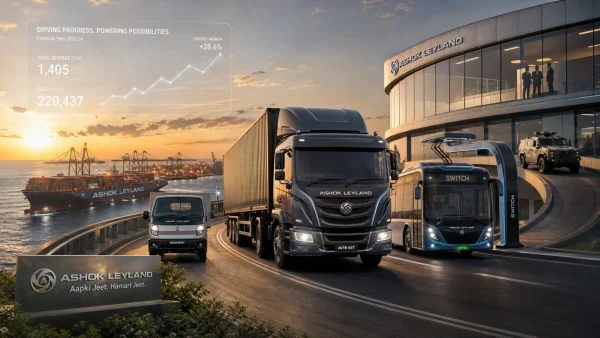
With a March quarter to put in the books and record volumes for FY26, Ashok Leyland has made its intentions known to the competition. The Q4 standalone PAT came in at Rs 1,405 crore, a 13% rise on Rs 14,160 crore in revenue. For the full year, commercial vehicle volumes have never been higher, hitting 220,437 units.
Why this quarter matters
There is more to it than the headline figures. Management has pointed to a defence order book that is at an all-time high and a toehold in Indonesia as part of a wider global strategy. It’s a mix of better products, more pull from overseas and a ramp-up in electric mobility that should ratchet up the pressure on rivals in FY27.
You can see the momentum in the numbers too. Profit after tax was 76% higher than the December quarter’s Rs 796 crore, a sign of operating leverage and demand holding firm as we close out the year.
Earnings snapshot and margins
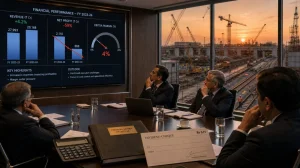
On the operations side, Q4 revenue was up 19% to Rs 14,160 crore. EBITDA was 15% higher at Rs 2,066 crore, with pre-tax operating profit of Rs 1,909 crore. And with Rs 3,280 crore in cash generated over the quarter, the balance sheet is in good shape.
Looking at FY26 as a whole, revenue was up 14% to Rs 44,007 crore and operating PBT 22% to Rs 5,163 crore. PAT was 8% up at Rs 3,566 crore even with a one-off Rs 308 crore charge for the new labour code. EBITDA for the year was Rs 5,732 crore – a 13% margin compared to 12.7% last time around. We’re sitting on Rs 5,899 crore in net cash, up from Rs 4,242 crore.
Key numbers at a glance
Here are the standouts from the quarter:
– Q4 PAT: Rs 1,405 crore (13% up YoY)
– Q4 revenue: Rs 14,160 crore (19% up YoY)
– Q4 EBITDA: Rs 2,066 crore (15% up YoY)
– Sequential PAT: 76% growth from Rs 796 crore
– Cash in hand for the quarter: Rs 3,280 crore
Volume leadership and product mix
Ashok Leyland put 220,437 CVs on the road in FY26, well past the 197,366 unit mark set in FY19. Light CVs were a hit with 74,322 sold. On the export front, they moved 18,082 units, an 18.5% increase, which goes some way to spreading the risk.
The management team is touting the strength in Power Solutions, the Aftermarket and EVs as a way to underpin the core CV business. In an industry where you have to spend to compete, that kind of resilience and better realisations is what sets you apart.
Electric mobility shift
Then there is Switch Mobility. Their revenue more than doubled to Rs 1,807 crore in FY26. They’ve seen e-bus volumes go up 238% and e-LCV sales 56%, with 1,530 of the former and 1,606 of the latter delivered. Switch is now in the black with a PAT of Rs 104 crore.
It’s a case in point for the premiumisation angle. Getting to scale with zero-emission buses and LCVs not only helps the bottom line but also cements ties with municipalities and logistics operators, putting a bit of a tech halo on the rest of the portfolio.
Cash, dividend and deployment
With Rs 5,899 crore in the bank, there is room to manoeuvre. The plan is to put the surplus into new products and tech, and to keep the customer experience up to standard across the board.
As for the shareholders, the board has put forward a second interim dividend of Rs 2.50, making it Rs 3.50 for FY26. You’ll be able to claim it on or before 26 June 2026; the record date is 3 June. Don’t expect a final dividend for 2025-26, though.
What to watch next
Chairman Dheeraj Hinduja has the defence pipeline and the foray into Indonesia in his sights. CEO Shenu Agarwal is banking on premiumisation and a steady hand on the tiller to widen margins and win back some share with a more varied offering.
All in all, with the kind of volume and profitability they’ve put on the table, Ashok Leyland has upped the ante. Add in the export side, a money-making EV division and a solid balance sheet, and it should be a stiffer fight in FY27, with fleet and infrastructure needs on their side.