You could call it one of the more important things to come out of India’s Chandrayaan-2 so far. In a May 27 statement, ISRO put it plainly: there is solid proof of ice down near the south pole, and it may well dictate how we run our next forays to the Moon.
The work was done by the Physical Research Laboratory in Ahmedabad, which put the microwave radar numbers from the polar region’s chillest craters under a microscope. What they are seeing is an indication of ice put away in the shadows, well below the surface.
Why this matters for future missions
It is not just an interesting bit of science. You can turn water-ice into fuel, oxygen and something to drink, so it is at the core of any long-term plan for the Moon. If you can put your finger on where it is, you can make for a more thorough and extended stay up there.
ISRO is saying the implications for where and how we land are considerable. When you know where the ice is, you can lower the risk and have a better handle on the tech you’ll need to get at it.
Here is what you should know from ISRO’s update:
– The evidence is in the cold craters of the poles
– All from the DFSAR on board Chandrayaan-2
– It paves the way for ISRU in the years to come
What the Chandrayaan-2 radar saw
The story is in the Dual Frequency Synthetic Aperture Radar, or DFSAR, on the orbiter. Built as a microwave imager to look under the regolith, it is made for the job of unearthing hidden ice.
It is the first of its kind to be fully polarimetric, covering both L-band and S-band. Ever since it went into orbit back in 2019, the craft has been putting out thousands of datasets with a fine-toothed view of the polar terrain.
A standout crater inside Faustini
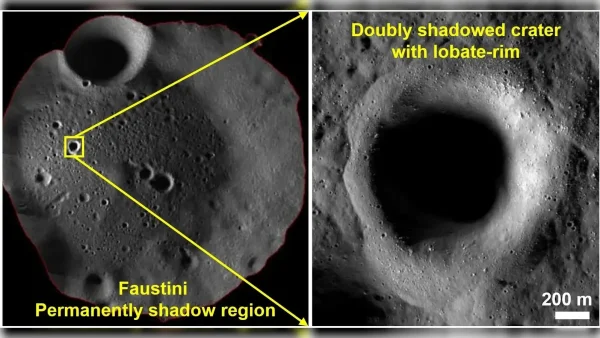
If you look at the 1.1-km-wide crater in the Faustini, for instance, the researchers have a lot to say about it. ISRO says the radar is picking up some of the best signs of subsurface ice right there.
There is also a flow-like, lobate rim to the crater. The thinking is that the impact may have broken through a layer of ice and left a mark that DFSAR can still read today.
Building a clearer polar map
We have seen before that Chandrayaan-2 can spot water and hydroxyl on the lunar surface. Now, with the latest from the orbiter, we have some high-res maps to tell us exactly where the ice is.
In the agency’s view, this gives us a better picture of how volatiles are spread out in the poles. It is a way of zeroing in on good spots for the next mission to put some new tech to the test.
What ISRO said on May 27
The credit for the find goes to the scientists at the Physical Research Laboratory, who have made a case for the presence of ice in the harshest craters of the south pole. These are the kind of results that will inform where we put down a lander and how we go about using local resources (ISRU).
The bottom line is that with the hard evidence from the radar, the Chandrayaan-2 is doing more than charting the Moon. It is showing us where we can go and what we can work with when we get there.