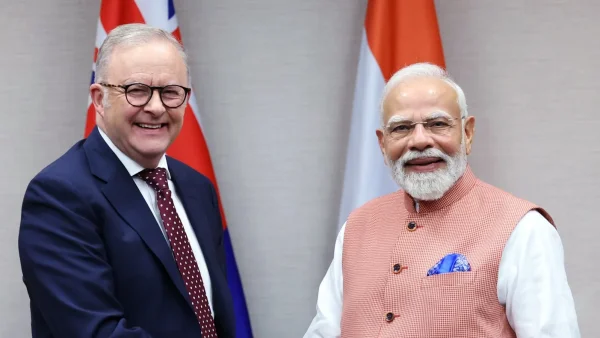
In the run-up to Prime Minister Narendra Modi’s arrival, Anthony Albanese has been making sure the message is clear: this is a sign of deeper alignment and some good old economic momentum. The Australian leader has been effusive in his praise of the bilateral relationship, pointing to India as one of the world’s top-growth stories and putting the two nations at the heart of what makes for a stable, opportunity-rich neighbourhood.
Why this matters for the Indo-Pacific
It is fitting that the visit is on the horizon as both sides put stock in a free and prosperous Indo-Pacific. When he was in New Delhi with Foreign Minister Penny Wong, PM Modi made it plain where the head is at: defence, trade, technology and a supply chain you can count on are the bedrock of the Comprehensive Strategic Partnership.
Canberra is not viewing this as mere window-dressing. Albanese has been quick to point out that we are a nation of two oceans – as much an Indian Ocean country as a Pacific one. In his view, you can’t have that kind of outlook without being in step with India.
Parliament push and people power
Albanese made his case before the Parliament, calling the partnership something of a once-in-a-lifetime chance for the region. He put a fine point on the ECTA and how it has upped the ante on trade, but also on the things that hold us together: common culture, education and, of course, the universal language of cricket.
He put in a plug for his own time in India and said he’ll be glad to put on the host for the Prime Minister again – a privilege he is looking forward to. And then there is the million or so of us in the Indian Australian community. As the fastest-growing migrant group in the country, they are what will make the occasion stand out.
Diplomacy meets diaspora
Of course, the action is not just in the chancelleries. Philip Green, our High Commissioner in India, has been vocal in his support for Albanese’s line on India, saying it gives his work more meaning. They are ready to have PM Modi over. You could say the mix of official overtures and community spirit is setting the mood for the visit.
Signals from New Delhi
The talking points were put in order this week in New Delhi. PM Modi was pleased to see Penny Wong and, in a post, laid out the intent to put some steel in the Comprehensive Strategic Partnership. You had the usual suspects in the conversation: defence, more trade, better tech links and the need for supply chains that can take a hit.
Nothing new under the sun here, really. Both capitals have been saying as much for a while. Whether it’s giving business a leg up or making sure your logistics don’t fall apart, the agenda is as much about hard-nosed practicality as it is diplomacy.
What to watch next
Now it’s a question of follow-through. With the kind of political cover these two are providing, officials will have to show results that companies and the public can put their hands on. There is a sense from both leaders that this is about staying the course, not just making headlines for a day.
If you read between the lines of the statements, here is what you get:
– A date with PM Modi is coming up in Australia
– India is moving at pace as an economy
– The ECTA has done its job for trade
– Defence, trade and tech are the order of the day
– We are in this on supply chain resilience too
– An Indo-Pacific that is open and secure is the goal
But it is more than the numbers on a balance sheet. When you look at the way Albanese talks up our geography and the way Modi is on about regional openness, you see two strategies coming into focus. That is where the sectoral work is heading.
Don’t let the communiques fool you; culture and education are doing some of the real work. Albanese has been at pains to credit the shared past, the schools and the sport for bringing communities in line. It is the kind of foundation that builds trust when times are tough and does wonders for business.
All in all, the visit should be a case study in that dual approach: firm strategy from the top and a bit of human energy from the ground up. If the pace is anything to go by, the next chapter of this partnership will be defined by how fast we can put words into action on the field.