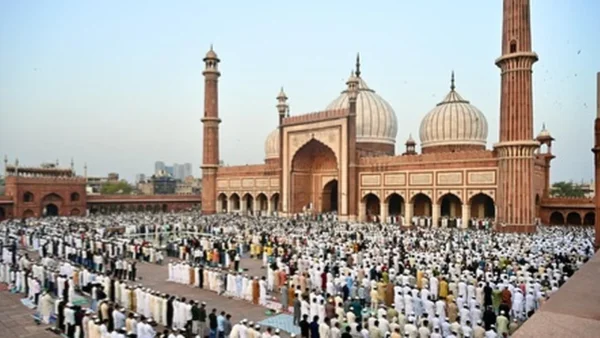
It was a Thursday of pre-dawn prayers and busy Eidgahs, with law enforcement in several states vouching for the calm. Whether you were at a national monument or a local mosque, you could see the size of the congregation and the authorities’ focus on keeping things moving and making sure the ritual sacrifice was done indoors.
How they got ready
You could tell from the scenes in Old Delhi, Moradabad, Jaipur and Guwahati: the courtyards were full and the lines for prayer were long, but there was an air of discipline to it all. It was a quiet morning, one that was in line with the work the officials had put in beforehand.
Delhi sees orderly dawn prayers
Old Delhi was up and about early. The Jama Masjid and Fatehpuri Masjid were packed with people for their special prayers. ‘We are here to put across a message of brotherhood and to have some joy in the festival,’ said one man at the Jama Masjid. ‘Our prayers to Allah are for the country’s progress and for peace.’
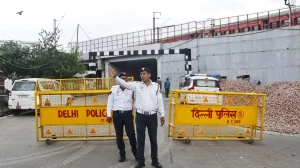
‘The morning has been uneventful,’ is how the Delhi Police put it. Madhur Verma, the Joint Commissioner of Police, said they had put in place a solid plan for the Central District, which included some marches in the more mixed-up neighbourhoods. ‘We have had zero trouble so far and we will keep it that way,’ he said.
Verma was also quick to point out the rules for the day. ‘The qurbani is to be done inside your home, and only there.’ You would hear the same kind of thing in other parts of the country.
Uttar Pradesh focuses on coordination and traffic
In Sambhal, the top two S.P.s were on hand to make sure the prayers went off without a hitch. According to those in charge, the police at the various mosques and Eidgahs were there to see to it that the roads were clear and the peace was kept.
Then there were the signs of how the different communities live side by side. Om Prakash, who works at a temple, told us, ‘For as long as I can remember, we have had no problems. We do our puja, they do their namaz at the Eidgah next door – we even share a wall with them.’
Bablu Kumar, the JCP, says the groundwork for this was laid well in advance, with SHOs and ACPs in the field having their say. ‘We have 46 Additional SPs and around 14 Deputy SPs out there today,’ he says when asked about the numbers.
Here is what you need to know:
– Some route and flag marches in mixed neighbourhoods.
– We’ve been in touch with peace committees in every zone.
– 46 Additional SPs and 14 Deputy SPs have been put in place.
– A force of 1,500, plus the RAF, EFR and 12 CRPF companies.
– No open-air qurbani or meat handouts.
– Traffic is to be left alone as much as possible.
On top of that, we have put in the field a police contingent of some 1,500.
Kumar was at pains to point out that his teams had been to the more sensitive spots to iron out any old issues, so there would be no hiccups or crossed wires once the public showed up.
States are reporting calm; crowd control is in effect
The Jannati Darwaza at the Khwaja Garib Nawaz Dargah in Rajasthan let people in from the early hours and saw its share of footfall. It was much the same story in Maharashtra, West Bengal and Bihar, where the morning has been uneventful.
In West Bengal, they’ve put a multi-layered security plan in motion. “We’ve had 22 or so sit-downs with community heads,” said Sunil Kumar Yadav, the Chandannagar Police Commissioner. “We’re following government orders to the letter. All qurbani will be in enclosed areas, and so will the distribution of meat.”
Yadav also made it clear that traffic won’t be affected. “You’ll have the RAF, EFR and district RAF for law and order, and 12 CRPF companies on top of that,” he said. The idea is to let the crowds move on in an orderly way after they are done.
And for the most part, the numbers haven’t put a dent on the day-to-day in the big cities. You can see it in the footage from the Jama Masjid in Old Delhi, the main grounds in Moradabad, Jaipur’s Eidgah on Delhi Road and Sijubari in Guwahati – all showing a smooth flow in and out.
What it means and where we go from here
It’s a case study in how to handle a big religious event without any trouble. There’s been a lot of unity on display, and the police have been firm on keeping the rituals and the like indoors to avoid any kind of flashpoint.
For now, the authorities are out and about but in good spirits. Madhur Verma in Delhi called the morning incident-free and is banking on that being the case for the rest of the festival. It’s all about a safe time, no traffic jams and a bit of neighbourly good sense.