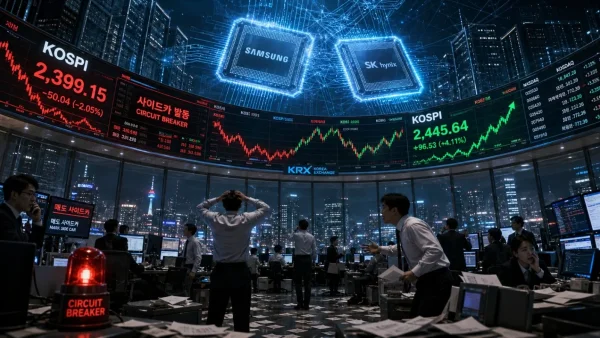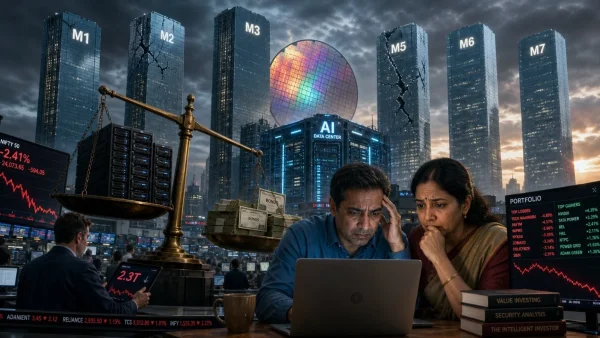
June was a rough month for the Magnificent 7 story. Some $2.3 trillion has been written off the books of the likes of Microsoft, Nvidia, Alphabet, Apple, Meta, Tesla and Amazon. The index for the group is down 10% as of now, with investors wanting to see hard evidence that the big money they’re putting into AI is coming back in the form of revenue. For Indians with a hand in US tech, that kind of concentration is top of mind again.
AI capex shock: from asset-light to asset-heavy
There was a time when Big Tech was lauded for being lean and having plenty of free cash. Not anymore. They are shelling out hundreds of billions for the latest chips and data centres, and if you listen to the market, some of it is even debt-funded. The talk these days is less about the promise and more about the payback.
Not everyone bled the same. You had Apple and Amazon down in the 8% range, while Nvidia was off by 13 or so. Then there’s Microsoft, which saw a 20% tumble. It shows how picky investors have become: they like the ones making money with AI right now and they don’t let up on the rest.
A tense July: earnings as the verdict
Dan Ives of Wedbush Securities, one of the more vocal bulls in the room, says we’re in for a high-stress period. He put it to his clients this way: ‘We are going through another ‘gut check’ in the coming weeks for the tech trade as we wait for a very important 2Q earnings season in July to put some teeth to the AI Revolution buildout.’
He also noted that ‘jitters will continue as worries around the costs of this once-in-a-generation tech buildout hit its next gear of growth.’ When you have trillions on the line, the quarterly figures have to show that AI is good for sales and margins, not just for the headlines.
Then you have Tom Lee over at Fundstrat Global Advisors, who says there’s a new narrative to get your head around. The Magnificent 7 are no longer the asset-light operations they used to be; they’re running balance sheet intensive businesses. In his view, as AI does the work of humans and the capital put in starts to come to fruition, it could be a solid moat.
Follow the money: selective AI winners emerge
The numbers on the page don’t tell the whole story. Sidharth Sogani, who runs Blue Aster Capital and CREBACO Global, has seen semiconductors and memory makers do well this year even as some of the Mag 7 have had a hard time. His read on it is that the money isn’t walking away from AI, it’s just being more of a snob about it, going where the near-term gains are.
Viram Shah, the man behind Vested Finance, would have it both ways. ‘The number is real. The Mag 7 have lost something like $2.3 trillion in June and this is definitely a big drop. But, tech isn’t actually falling apart. You have to wonder if all that money put into AI – we’re talking close to a trillion dollars – is going to be worth it in the end. That’s the question on everyone’s mind.
Until the numbers come in and prove who is making their outlays work, you can expect to see the top spot in AI change hands. It’s a steeper hill for stock pickers to climb these days. And if your portfolio is heavy on the index, you have more to worry about with concentration than with when to make a move.
For those in India: time to trim or just rebalance?
A lot of Indian investors have been in US markets via the same seven stocks, under the impression they were well-diversified. But in truth, you’re putting all your eggs in one thematic basket. “If June’s whipsaw put you on edge, it’s probably because you are overconcentrated,” says Shah. “It’s no reason to walk away from global equities.”
He puts the brakes on yes-or-no thinking. “Should I sell now?” is the wrong way to put it. You should be asking, “Am I as concentrated as I thought?” It changes the whole dynamic, and lets you build a portfolio with some staying power.
Here is what the experts are putting on the table given the current risks:
– See how your mega-caps stack up to the other 490 in the index
– Go with a broader or equal-weight fund
– Remind yourself why you are in US equities in the first place
– Let your SIPs do their thing and buy the dip
– Pare back on the over-extended ones and look at AI infra
– Hold some cash until the earnings dust settles
*
The valuation talk and what’s next
There are two sides to this. The bulls will tell you these are the engines of the index and AI is only picking up, so you should be adding. The bears will say the price is in there already and if monetisation lags, you could see more pain.
Sogani thinks having some cash on the side is prudent. If the coming quarter shows AI is actually putting money in the bank, then this pullback is a good thing, maybe even a chance to get in.
Shah is more about what you can put your hand on. “It is hard to be sure of the next move,” he says. “But you can control your exposure so you don’t have to be the one selling at the worst moment. Rebalance and spread out.”
July has a few things to offer**
Sentiment will be driven by three things. One, do the revenues and guidance tie back to what they’ve been building in AI? Two, what are they saying about the cost and margins of doing so? And three, will we see some leadership outside the Magnificent 7?
If the results hold up, the premium stays. If not, capital will drift to where it can be repaid quickest. The takeaway from June is plain: the price tag on AI is the issue of the day.
The big seven are still the backbone of the AI story, but the market wants to see the work. Volatility is the order of the business until then. For an Indian investor, it is more important to be diversified and not have all your chips in one theme than to try and time the bottom of a stock.