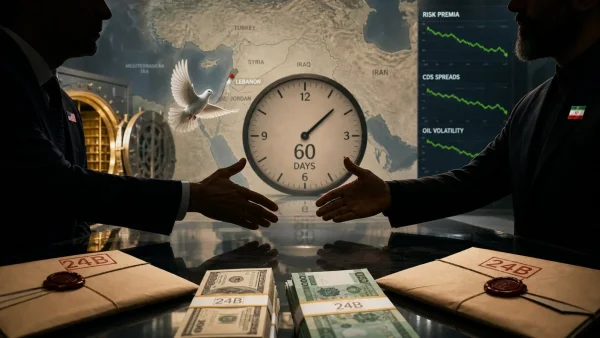
You could say this reported understanding with the United States has the potential to re-draw the map for any Middle East or sanctions-heavy position you have. Mehr news agency in Iran says the idea is to pair a way out from under sanctions and a broader truce with the gradual unblocking of $24 billion in Iranian money, all within 60 days.
Investor lens: relief rally or policy whiplash?
The message to the market is plain, but with strings attached. Put in place as it stands, the plan would put some much-needed liquidity in Iran, take down the threat of war in a few places and put a process in motion for the nuclear file. But you can only count on these gains if the plan is actually put to work and the short, hard timetable is respected.
A source near the negotiating table in Iran tells Mehr that the memo calls for an end to hostilities right away and for good, even in Lebanon. If that de-escalation is for real, it will do something to the risk premium. Then again, how long it lasts will be as much of a talking point as the sanctions side of things.
What the draft outlines
When it comes to getting the economy back to normal, the framework is said to make the lifting of broad sanctions contingent on how the nuclear talks in Tehran go. Mehr has it that 60 days of haggling should be enough to see off both the US primary and secondary sanctions and to settle the nukes.
Financing is handled in that same 60-day span. The $24 billion in blocked funds would be let go in stages. To get some early momentum, the agency says Iran would be given half of it before the first round of talks even begins.
The 60-day clock and contingent flows
That 60-day period is where the action is, according to Mehr, and it’s the one you need to have in mind when you’re sizing up your exposure. You get some near-term cash from the first half of the $24 billion; the rest seems to be on the line for how the negotiations fare.
Mind you, it is a draft. Whether it gets the nod to set these wheels in motion is another matter. That gap is a risk in itself.
Why it matters for capital and risk pricing
Should this go ahead, you are looking at a change in three areas at once: the risk of conflict, of sanctions, and of being able to fund operations. All have a price. A firm truce, say in Lebanon, puts a lid on some of the tail risks. The nuclear talks are a road to some regulatory sense. And the fund releases mean better ability to pay.
Then there is the execution. Sixty days is not a lot of time for this kind of diplomacy. One hiccup and you could see asset releases put on hold, the outlook on sanctions muddle, and old questions about stability in the region come back to the fore.
Attribution and verification
We are going by what Mehr has put out, with a source in the know on the Iranian side. You won’t find an official word from the US or Iran in this report. Consider it a guide until you see the formal statements and the paperwork to back it up.
What to watch next
It’s a matter of reading the room in the next few days and seeing if there is any real movement. Those in the market will be waiting for the kind of proof that shows the money can move and the fighting can stop as planned. How clearly this plays out will tell you where the risk appetite is.
Some of the main things to keep an eye on:
– A sign-off from the parties on the framework
– When the 60-day timer is set to start
– Some hard evidence of the early fund release pre-talks
– What is being put on the table for the nuclear scope
– Any tangible moves to call off hostilities
Mehr’s version of events is a mix of carrot and stick. You have the early liquidity, a 60-day run to get the US to drop its sanctions, and the goal of a permanent halt to the fighting.
We’ll see if this is a pivot or just a close call. For the moment, the proposal – assuming it is taken up – is a blueprint for having capital, statecraft and security all on the same page for 60 days, with $24 billion as the means to do it and the measure of it.