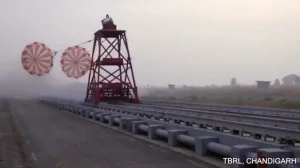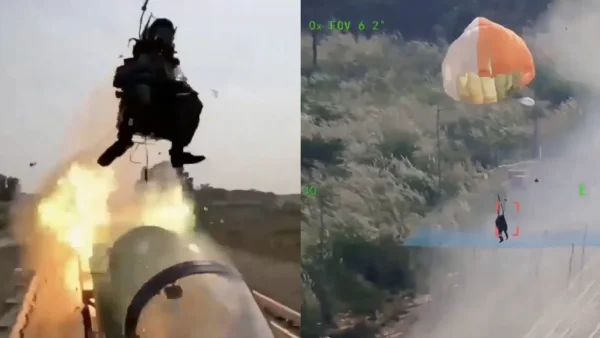
India has reached a new level of safety for its fighter pilots. The DRDO proved at the Rail Track Rocket Sled facility in Chandigarh that the high-speed escape system is safe and works exactly as it should in very difficult situations.
High-speed ejection test hits 800 km/h
During the actual test, three things that are absolutely vital to a pilot surviving were confirmed: the canopy breaking away, the ejection seat working in the correct order, and the pilot being recovered completely. Essentially, a dummy pilot was blasted out of the front part of a fighter cockpit in a carefully planned test, just as would happen in a dangerous emergency while flying.
The Ministry of Defence explained the speed during the test was very accurately controlled, so the results are useful for real fighter plane flying. People in the government said this puts India in the relatively few countries that can test and officially approve escape systems on a large scale, all within the country.
How DRDO executed the rocket-sled trial
The engineers used two sleds connected to the front section of the Light Combat Aircraft. Several small rocket engines were fired in stages to get the exact speed needed for the test, and this could be repeated to get clear and reliable information.
A testing dummy made to resemble a human body had sensors to measure the forces, turning movements and acceleration a pilot would feel during a quick escape. Cameras both on the sled and on the ground recorded how the canopy shattered, the path of the seat, and when the parachute opened, all to make sure the timing and safety levels were correct.
These tests with the seat actually moving are much more complicated than the static tests with nets, or “zero-zero” tests. They are the best way to judge how well an ejection seat will work, because they recreate the effects of the air rushing past, the shock of the speed, and the sequence of events happening together, and these only occur when the plane is moving.
Collaboration and capability building
The DRDO did the test at the Terminal Ballistics Research Laboratory, and got help from the Aeronautical Development Agency and Hindustan Aeronautics Limited. People from the Indian Air Force and the Institute of Aerospace Medicine were there to observe the test. re
People throughout the defence field have said this outcome is a major step forward for India’s own abilities in aerospace and a definite help to India becoming more self-sufficient. It’s not just that the test worked, but it also makes our knowledge about how to design, put together and officially approve these life-saving systems much stronger.
Why this matters for pilots and platforms
Ejection systems are the final thing a fighter pilot relies on. Proving the canopy and seat separation works at 800 km/h means pilots have a better chance of surviving if something goes wrong at high speed, when flying low to the ground, or while doing difficult turns. It also gives people more confidence in improvements being made to planes and future aircraft projects.
If escape systems are trustworthy, fewer pilots will be lost, the risk during test flights will be reduced, and it will be quicker to determine if a plane is safe to fly. As India makes and improves more fighter planes, having an ejection system that we have tested and know works is a big advantage.
Part of a broader indigenous push
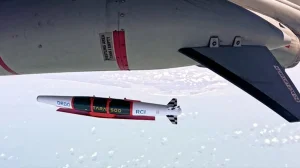
This test is in line with the expansion of India’s defence technology. We’ve recently seen how useful systems made in India have been, including Akash surface-to-air missiles, BrahMos cruise missiles, the D4 anti-drone system, airborne early-warning planes, and the Akashteer air-defence control system.
The progress on these things has been supported by colleges and institutions that focus on advanced defence learning and research and development, and they have helped create the equipment, methods and skilled people needed for complicated aerospace projects.
What comes next
We can expect more of these types of tests at different speeds, heights, positions of the plane, and with different canopies and seats. Each of these will provide more proof for approval, and will help with the design of the cockpit, how the structure is put together and how pilots are trained.
Because India now has a proven method of testing with a rail system, we can do things more quickly, rely less on facilities in other countries and possibly even offer testing to other countries. For the Indian Air Force and companies that make planes in India, this means they can learn faster and have more control over the important technology that keeps pilots safe.
Key takeaway
By successfully testing an ejection system for Indian fighter jets at 800 km/h on a rocket sled, the DRDO has made a major improvement in pilot safety and given India the ability to do this on its own. This result helps India’s goals in aerospace, increases faith in future fighter planes, and shows we are steadily becoming more self-reliant in defence.