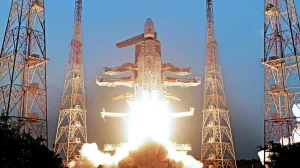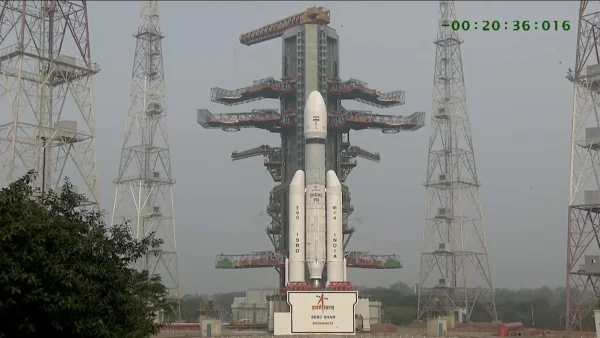
The heavy-lift rocket LVM3-M6 from India has made a historic success by launching the BlueBird Block-2 communications satellite, which was also a great commercial mission for ISRO and a very important step for space direct-to-mobile connectivity. The process of the launch happened at 08:55:30 IST from the second launch pad at SDSC SHAR, Sriharikota.
It is the biggest satellite of its kind, as it weighs 6,100 kg and is the most heaviest of all the satellites ever put by the LVM3 into the Low Earth Orbit. In the 16th minute, after the liftoff that was scheduled, the spacecraft was placed into an orbit that was near circular, about 518.5 km away, with an inclination of 53 degrees.
ISRO LVM3-M6 FORUM UPDATES
– POV: LVM3-M6/BlueBird Block-2 mission, a dedicated commercial flight operated under the joint NSIL-US-based AST SpaceMobile agreement.
– Cargo: BlueBird Block-2 – a satellite for a new generation communication system, the satellite’s goal being to make 4G and 5G broadband readily accessible on the standard smartphones.
– The orbit: The then almost round LEO at an altitude of around 520 km and inclination 53 degrees was attained in just about 16 minutes after the rocket was launched.
– The record: At the rate of 6,100 kg, LVM3 took the heaviest payload to the LEO out of any launch that has been made from India.
– The cadence: It is revealed here that two back-to-back LVM3 launches were made within a time span of 52 days, which underscores increased launch readiness.
– The cumulative reach: ISRO, with this mission, has so far put in place satellites for 34 countries amounting to 434 satellites.
What is BlueBird Block-2 and why it matters
BlueBird Block-2 belongs to AST SpaceMobile’s worldwide constellation in the LEO realm that is going to provide cellular satellite connectivity, a service that mobile phones, as a main consumer device in the world, will greatly benefit from. The satellite has a 223 square meter phased array antenna which is considered the largest ever communication antenna in the commercial space sector at low Earth orbit.
Its goal is to be very obvious and remarkable; deliver round-the-clock support for 4G and 5G voice and video calls, text messaging, streaming, and data services on unaltered smart mobile gadgets. The very same constellation if the procedures are to be faithfully conformed to could extend the spotty coverage of the established networks to distant zones which are totally or partially out of reach .
LVM3 at a glance
The ISRO's heaviest operating launcher LVM3 has a height of 43.5 meters and a take-off mass of close to 640 tonnes. It is made up of three stages which are two S200 solid rocket booster strap-ons, an L110 liquid core stage, and a C25 powered by cryogenic fuel upper stage.
The cargo capacity of the launcher is about 4,200 kg to the geosynchronous transfer orbit (GTO) and the system has already been to the kind of missions that bring glory. Th e V.experience in this regard would be of c0urse with the GSLV Mk II which isp being retired soon and the PSLV. A perfect mission is that of Chandrayaan-2, Chandrayaan-3, and two OneWeb missions. Plus, the first and the second parts of one of the OneWeb missions. A lot of cumulative stirring of emotions with all these over the substantial duration from the beginning to the peak and the very last minute of the involved operations. Although here and there little poking in to get it done has been definitely a factor. The flight that among the attendees of the last decades of rocketry will be most remembered for its grandeur among all…. The sixth flight of LVM3-M6, but the third time meant only for commercial use.
How to watch the ISRO LVM3-M6 live stream and replay
– ISRO live-streamed the countdown and launch on its official website and YouTube channel.
– The full video replay is still available, with the mission highlights and post-launch updates taking place on ISRO’s digital platforms.
– To keep up with the launch events well in advance, look for the Launches or Updates section on isro.gov.in and become a subscriber of ISRO’s official video channel for getting further information through notifications.
What will be the next move in the orbit
The satellite is handed off, and it will go into an initial checkpoint phase as per the custom. The first normal restoration procedures consist of power and health check-ups, solar array and antenna deployments, and stabilisation. Subsequently, BlueBird Block-2 will have the process-time for payload calibration and network integration before the indications of the progressive service demonstrations are finally out.
With more BlueBird satellites being added to the constellation, the service of the mobile network partners is expected to be even better, thus slowly making possible a broader and more reliable direct-to-device connectivity.
Strategic and commercial value
The completion of this mission is not only a solid proof of the robustness of the Indian space industry in the market of the world but also a complete exhibition of the LVM3’s capability to carry and deliver the heaviest and most valuable commercial payloads to highly specific slots of LEO. This was also a significant indication that in the space of global business, NSIL was playing an increasingly important role to make ISRO’s launch capacity available.
On the one hand, the regularity of LVM3 launches in the Indian space economy is an aspect that certainly increases the overall income of the LVM3 or strengthens the provider network within India. On the other hand, with architecture directly linked to mobile technology, the benefits that users and operators will have include provision of service for emergency response, maritime and aviation connectivity, and broadband connectivity to the rural areas with a high level of up-time and last-mile delivery.
Bottom line
The BlueBird Block-2 satellite launch by ISRO’s LVM3-M6 duo had the amazing character of merging pure technicality with market forces, obliterating the border between the two. Not only did the mission place the heaviest payload ever in the LEO orbit, but it did so in a matter of days and with such a certainty of the future that it was impossible not to recognize the flight as the harbinger of heavy-lift India’s transition to the next era of space-enabled international connectivity.