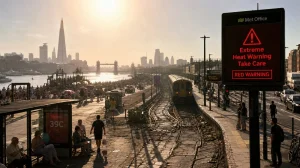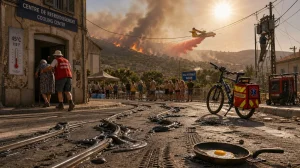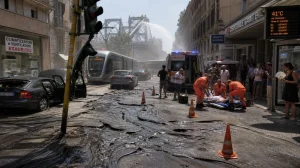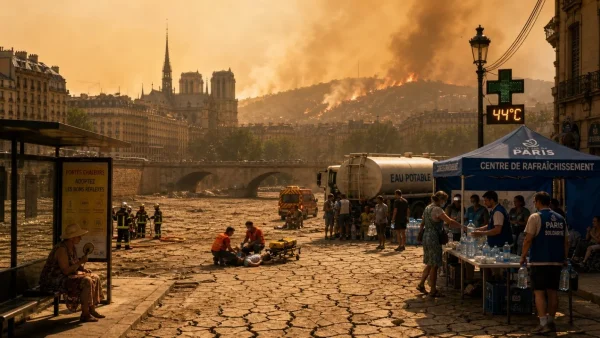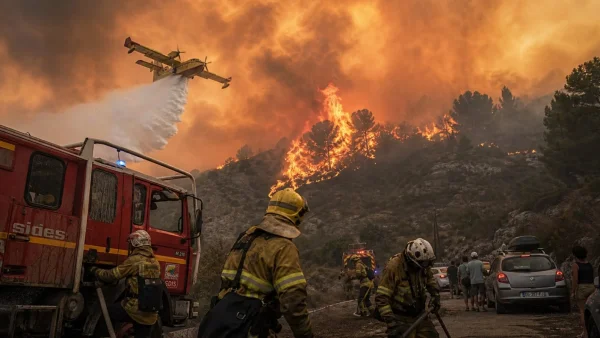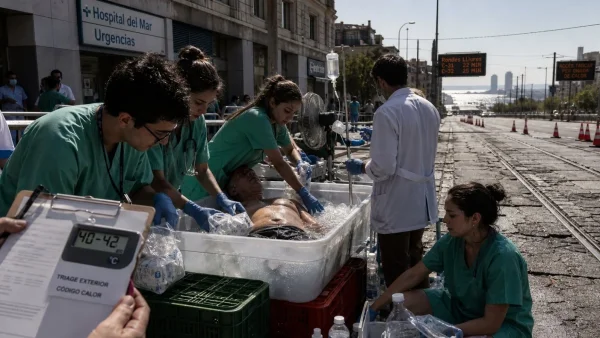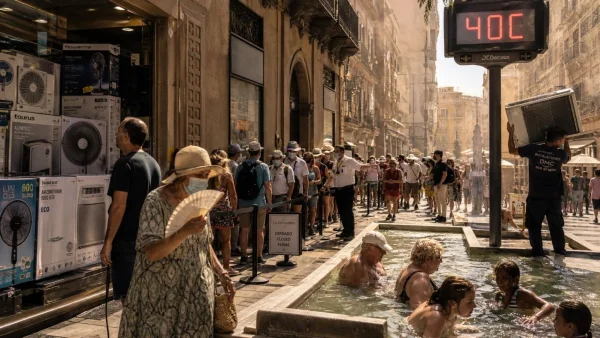
What was once an annoyance has become a full-blown disruption in Europe. You can see it in the run on coolers, the curbs on transport and the early shutters at some of the more famous tourist spots. We have red alerts in several nations and 40C weather for which the infrastructure isn’t built. Without the hand of climate change, we’d be 2 to 4C cooler, according to the experts.
Public services bend under the heat
You’ll find transport and city officials having to make do as they can. The central and southern Netherlands, for instance, will be on code orange from Wednesday through at least Friday. NS, the national rail, is scaling back on a number of lines.
In Amsterdam, the city is making room for some relief in the water. If you have a city pass, you can use one of the six outdoor pools at no cost. It’s a way to take some of the edge off for those in hot homes or out in the thick of it.
Over in the UK, schools are changing up their day-to-day to keep students out of the harshest of the sun. ‘Every school in the country is going to have to put in some kind of adjustment this week,’ says James Bowen. ‘We’re not well set up for this sort of thing.’
The tourism side is being retooled as well. The Louvre and the Eiffel Tower have put a cap on hours, and over in Brussels, the Atomium is going to be done with visitors earlier than usual from Wednesday to Friday, to give its staff and guests a break.
France becomes the flashpoint
It is in France where you feel it most. The national average of 30 stations hit 29.8C on Tuesday – a figure you won’t see in the books since 1947.
It’s a country-wide issue. As four more departments go into the top tier of heat alert on Wednesday, we’re looking at 44 million people in the mix. Toss in the 31 on an orange alert and you have over 90 percent of the population in the line of fire. Expect 39 to 41C from Brittany to the south-west and around Paris.
Everyone wants to be cool. Carrefour was at 30,000 in sales by 6:30 on Monday, ‘a thousand times what you’d normally see,’ according to CEO Alexandre Bompard. Amazon has seen numbers almost double on last week, and Fnac Darty is up in double digits.
There’s a queue for installers, in some cases right in your own neighbourhood. In the south-west, electrician Thierry is fielding a lot of ’emergency’ work. ‘On paper you put in a request to the owners’ association, but nobody is in a mood to wait,’ he says.
Then there is the matter of the vulnerable. ‘It’s hard to get by’ on your own with no AC, is how 62-year-old Martine Belloc of Bordeaux puts it. She made her way to La ManuCo, a coworking spot put to use as a haven for the elderly to get some respite.
For some, the postcard moment has become a test of wills. ‘Paris in this is no fun,’ says John Beeler, an American engineer, with a fan in one hand and a hat on his head. ‘You’re in the streets, the subway, even in our place, and you can’t breathe.’
He and his wife have made for an air-conditioned hotel room.
Immediate action is being taken
With the heat ramping up, you’ll see authorities and operators put in some stopgaps to keep people from coming to any harm:
– Cuts to Dutch train service on the harshest lines
– Some of Amsterdam’s outdoor pools are open for a free swim
– The Louvre and the Eiffel Tower are reining in their hours
– You won’t be able to make it to the Atomium in Brussels as late as usual, at least Wednesday through Friday
– A run on fans and AC units by homeowners
– Some changes in the way UK schools are running things
Europe under warning
It’s a red alert in 16 Italian cities, from Milan to Rome, says the health ministry. In those concrete-heavy urban areas, the risk of heat illness is at its peak.
The hot front is moving east. Over in Poland, the weather service has put out high-level warnings for the west of the country this Thursday to Saturday; they’re looking at numbers that could top the 40.2C mark from 1921.
Even the Adriatic is in the crosshairs. Croatia’s coast is on red for the weekend. And in Hungary, where they were already on a second-level watch, they’re going to the maximum from Saturday to Tuesday as the thermometer keeps rising.
Then there’s Spain. For once, the national weather service is calling for a lull. Most of the country will see a drop, with only bits of the Basque country still in the red by Wednesday. Come Thursday, you won’t find a spot in Spain with a red or orange rating.
In the rest of Western Europe, though, it’s not so easy to get some respite. With the Netherlands on high alert and public services feeling the strain, we’re in for a long few days.
What makes this one stand out
You have to look at the way the atmosphere is holding the hot air over the region for days. There’s no let-up at night, so the daytime highs just build on themselves, putting a strain on everyone and everything from the power grid to the railways.
A paper put out this week puts it down to us: “significantly exacerbated by human-induced climate change.” They figure if it weren’t for that, we’d be 2 to 4C cooler. It’s a stark reminder of how a little extra warmth in the baseline can become a health crisis.
And then there are the buildings. A lot of what you see in Europe was put up to hold in the cold, not to stand up to this kind of searing heat. That’s why you see the rush for new ACs and the like.
It’s enough to make institutions put aside the passive warnings and do something about it. Whether it’s a school or a museum, they’re having to alter course because this is more than you can just muddle through.
Keep an eye on these for the week:
– France: 39C to 41C on Wednesday
– The Netherlands: code orange through Friday
– Poland: high-level from Thursday to Saturday
– Croatia’s coast: red on Friday and Saturday
– Hungary: max alert from Saturday to Tuesday
– Spain: all clear by Thursday
When the heat is at its worst, it comes down to the basics: look after your health and the services you need. The demand for cooling, the changed schedules, the alerts – it’s a continent making do with a new, hotter normal.