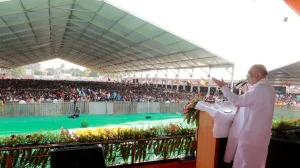
Modi makes his way to the state on June 20 for the occasion. It’s a mix of the symbolic and the substantive, with a good measure of welfare and infrastructure on the table for those in the countryside. As officials put it, he hasn’t been back since the BJP’s win in the Assembly.
Farmer payouts and who they are for
You can’t have this kind of visit without the 23rd round of PM-KISAN. The government says in its press release that we are looking at over Rs 8,880 crore being put in the hands of 9.44 crore farmers across the country.
Then there is an official note on the two-day trip that gives you a different number for the very same thing: in excess of Rs 18,880 crore for those 9.44 crore. For West Bengal alone, it is more than Rs 900 crore for 45 lakh or so people.
Put it all together and the state has seen over Rs 15,000 crore in PM-KISAN help, with the national total since 2019 going past Rs 4.46 lakh crore. You won’t find any explanation for the discrepancy in what was put in front of the press, though.
What’s new in agriculture and insurance
The Prime Minister is set to put some Central schemes in motion here. We are talking about the Pradhan Mantri Fasal Bima Yojana, the Agri Stack, the National Mission on Natural Farming and the Dhan-Dhaanya Krishi Yojana, to name a few.
Take the crop insurance for 2026-27: it should be covering close to 50 lakh of the state’s farmers on 14 lakh hectares. With the premium subsidies and an insured value of some Rs 28,140 crore, it’s a big deal for them.
An infrastructure drive for the rural and coastal belts
In the government’s telling, this is about development in railways, farming, fisheries and the like. The goal is to put some steel and concrete in place to give livelihoods and the local economy a nudge forward.
They are pointing to a few things: the bettered fishing harbour at Fraserganj in South 24 Parganas, a new fish market in Sainthia, and a semen lab for goats in Haringhata. There are also railway works in the offing to the tune of nearly Rs 590 crore.
For those in Bengal, here is what is on the docket:
– Paschimbanga Divas in Tarakeswar with the PM
– Upgrading the harbour at Fraserganj
– A modern fish market in Sainthia
– The new goat semen facility in Haringhata
– Some Rs 590 crore in railway projects
– Over Rs 900 crore in PM-KISAN for the state
Some symbolism in Tarakeswar, and Mookerjee
The West Bengal part of the tour is centred on Paschimbanga Divas in Tarakeswar, Hooghly. It is a place with ties to Dr Syama Prasad Mookerjee, and the officials are not shy about making the cultural and political point of that.
It seems the Centre is using Tarakeswar to have it both ways: a bit of heritage and a day to deliver on policy for the small-time producer and the fisherman alike.
Defence, a bit of culture and Yoga
Over the course of the two days, the PM will be in West Bengal and then Odisha. In Kolkata he is to head up the 12th International Yoga Day. He has been doing that for the UN observance since 2015, from here and overseas.
After that, he will be at the port in Kolkata to commission three home-grown ships: the INS Dunagiri, the Sanshodhak and the Agray, the PMO says.
What is in store in Odisha
He will be with President Droupadi Murmu in Mayurbhanj to see the Santhali Jahera and Ho Jahera groves in Pahadpur, a school and a centre for skills. It is all part of an outreach on education and putting power in the hands of the rural population.
Rairangpur will be the scene of a programme to mark the BJP’s second year in charge in Odisha. The PM will be inaugurating and laying the first stones for energy and road projects running to over Rs 47,600 crore.
So after the 20th, you have a run of commissions and schemes with people in the fields and on the rails to show for it, and some longer-term moves on defence and the region.