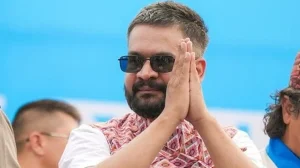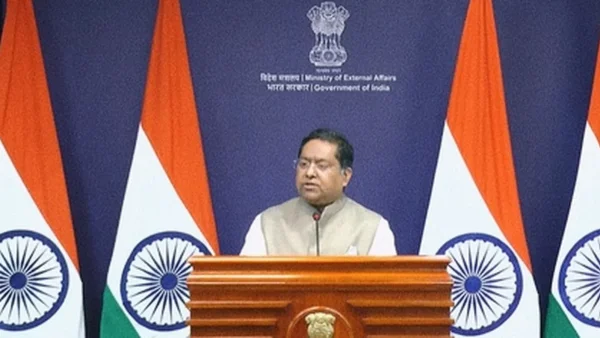
It was a clear message from India on Tuesday: there is no room for outsiders in the India-Nepal boundary conversation. The Ministry of External Affairs made that plain after Prime Minister Balendra Shah of Nepal made his latest pronouncements, noting that the vast majority of the border is demarcated and the rest will be dealt with through our own channels.
You could see New Delhi’s position as a direct answer to Shah’s words, which have a way of stirring up old history and politics. By pointing to the work already in progress, India is making it known that it is the process, not some outside hand, that will chart the way forward.
India’s message and the unresolved stretches
Randhir Jaiswal of the MEA said they have been following the PM’s remarks and the foreign ministry’s follow-up. He put it at nearly 98 per cent for the demarcated part of the India-Nepal border, with the open questions being a matter of where rivers have moved or localised encroachments have occurred.
Take the Gandak, for instance; its changing course is one reason some segments are still up in the air. Jaiswal also noted they are in the middle of mapping cross-border occupation of no-man’s land in areas that are otherwise defined. In a Delhi briefing he was unambiguous: these are things we handle between us, no third party needed.
What sparked the exchange
Shah had some strong words in his first speech to Parliament since he was sworn in. He put it out there that each side has made inroads into the other’s territory and called for a resolution based on facts. The Lipulekh, Limpiyadhura and Kalapani file, for one, has been an open book for a while.
He was open to the idea of having historians and surveyors have a look at it, and mentioned that Kathmandu has put the question to China and the U.K. as well. It was all framed as an appeal for good neighbourly dialogue.
Clarifications in Kathmandu
There was some noise back home in Nepal, so the foreign ministry put out a word to say the PM was referring to no-man’s land and the like, not making formal claims. A way of reining in the debate to the nitty-gritty of it.
Not everyone in the Parliament was on board. You had opposition voices like Basana Thapa and Ramesh Malla asking for proof and, if necessary, for the PM to walk the talk or take it back.
Stakes for the border and diplomacy
When you have 98 per cent of a border marked out, you have your footing. But the bits that aren’t can put a strain on the people living there and make for some awkward political posturing. India’s call for joint mapping is a sign they want to take it one step at a time.
If you boil down what has been said by both sides, it comes to this:
– No third parties, says India
– 98 per cent is done, says India
– We’ve all encroached, says the Nepal PM
– It’s about no-man’s land, says the MOFA
– Let’s talk and work together, says both
On the ground, for the officials and those who live there, it is about the day-to-day: put a pin in the encroachments, get the maps right and don’t let new trouble start while the talking heads are at it.
What comes next
In a way, India has set the table. The boundary will be mopped up in the forums we already have. That means more of the kind of technical legwork you do when you are dealing with a river or verifying a piece of no-man’s land.
And while Shah has shown he is amenable to an approach with some hard data behind it, the clarification from Kathmandu has made the playing field a bit easier to navigate diplomatically. We are looking at encroachments, not grand claims.
All signs are to the effect that we will see more of the same: joint mapping and the usual bilateral discourse. The trick will be to turn what the technicians find into something both can live with, without letting the politics get in the way.