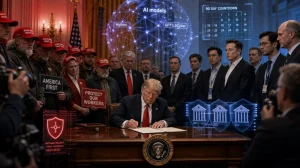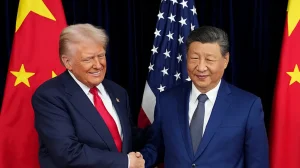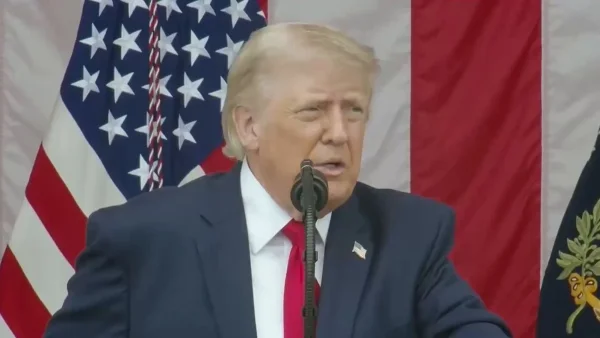
Then there is the reality that Donald Trump’s hard-charging approach to artificial intelligence is running up against some unease in his own camp. Conservative types are sounding the alarm that the tech could be a threat to social order and local livelihoods. You have a rare kind of division in the MAGA fold with AI policy right in the middle of it, and it has the potential to make 2026 an interesting year.
A surprise rift inside MAGA over AI
Trump will tell you we have to put our foot down on AI to keep up with China, and that if you over-regulate, you stifle progress. But some of his old friends in the movement think he is moving too fast and without enough oversight. It is unsettling for people in communities that don’t trust the sort of top-down change the elites like to bring.
Take Amy Kremer, for instance. She is a long-time Trump ally and heads up the group Humans First. She says the law hasn’t been able to catch up with the technology and she has her doubts about the sway big money in tech has on the rules of the road. “There are more regulations on a ham sandwich I can pick up on a street corner in New York or D.C. than there is on AI,” is how she puts it.
Kremer sees it as a moment of clarity for conservatives on the flip side of AI as it comes out of the lab and into the real world. For her it isn’t a theoretical issue; it is a question of whether we are looking out for the workers and the towns as these new systems come online.
Activists’ letter urges guardrails before rollout
With the worry that AI is being let loose without any checks, a number of activists, many of them from the right, have put their names to a letter to the president. Put together by Humans First and made public, it is a reminder that you can’t have one without the other: you need progress but also some form of protection and answerability.
“America did not become the greatest nation in the world by allowing unelected elites to experiment on the public without safeguards or accountability,” the letter makes clear. You will find the likes of Kremer and ex-White House aide Steve Bannon among those who signed it – the latter has no time for AI, which he has called the most perilous invention we have ever seen.
They are making the case for the government to put some teeth in its testing of any system before it is handed over to the public. The idea is that you need a safety floor for any innovation that is to be of use to society and not a nuisance. To put it in a nutshell, they want to make sure the brakes are in place before you step on the gas.
If you boil down what the signatories are after, it comes to three things:
– Make sure advanced models are put through their paces before they are released
– Have some way to hold people to account and protect the public
– Don’t let innovation run over safety
Policy pause fuels scrutiny of Silicon Valley ties
Things got a bit more pointed when Trump, at the 11th hour, decided not to put his name to an executive order on high-powered AI on May 21. Those in the know say the version on the table would have nudged the industry to set some standards of its own.
So now all eyes are on the billionaire’s connections in the tech world, who are not for having the feds look over their shoulder. At 79, he has made it plain he is for moving fast on AI and has cautioned that if you put up roadblocks, you let the competition pass you by. The ones behind the letter would have you believe that a voluntary code is no substitute for an outside check.
In Trump’s view, it is a numbers game with the rest of the world: if you hold back on AI, you cede ground to China. There are those in the movement who will tell you that to be a strong nation, you have to hold your communities together, put some certainty in people’s jobs and make sure they can count on their basic resources. You have one side and then you have the other, both of them saying they’re looking out for the public, but they can’t agree on how or when to do it.
Rural costs and political risk
It’s not just a matter of code. There is a physical side to AI, and you see it in the way these data centres are spreading across the country. They are power-hungry, using up a lot of electricity and water, and for all that, they don’t put many local people to work.
Megan Mullin, a political scientist at UCLA, puts it down to the kind of pushback you get with any mega-project, only there’s an edge to it this time. A lot of the new facilities are going in where folks already feel like no one is listening. “You have to understand, for some of these places, it stirs up old feelings about being left out of the room when decisions are made,” she says.
Put simply, the inroads of these centres are making some hard-line rural types feel like they’re under siege. And that is of a piece with why Trump has done so well with them; the Economic Innovation Group has him at 90 percent of rural counties over the last three election cycles.
Voting trends and AI anxiety
The numbers from Pew back that up: his share of the rural vote has been on the up, from 59 percent in 2016 to 69 in 2024. So any new ruffle in those parts is worth noting.
But even among his most ardent supporters, there are some who are starting to ask what an AI-first approach is really going to cost them. It’s not an ideological thing for them. They want to know if the projects are going to hit their power bills or deplete the water table. Will the benefits they’ve been told to expect actually show up in their own backyards?
If you talk to the naysayers in the country, their case is straightforward:
– The toll on water and power
– Not much in the way of new employment
– Hardly any say in where these things are put
Support is there, but tech is in the crosshairs
You won’t find them turning on Trump for it. “His leadership is absolutely amazing,” Kremer will have it, and he is in step with the rest of us. She has her issues with the tech industry and its hangers-on, not with the president.
“They’ve put up a moat around the White House,” she says, meaning that some very well-connected people have walled off the decision-makers from how the rest of us feel about AI. It’s a convenient way for activists to make their point without tearing apart a movement held together by loyalty to one man.
For the moment, the plan is to put some distance between Trump and the industry and have him put in some guardrails. We’ll have to see if he can be swayed by the pressure from the ground up.
What to watch next
Some in the know would say it’s premature to think this is going to change the electoral map. Mullin sees the makings of an AI backlash, but nothing with the force to move the needle yet. It’s a bit of a patchwork.
Then you have the younger crowd. Alex Dray, 23, of the Young People’s Alliance, was among those who put their name to the letter to the president. He says AI is coming to the fore for young people, right up there with the cost of living and mental health. “I’d say we’re in for a reckoning in the next few months,” he says.
In the end, it comes down to what comes out of the White House and how fast the data centres keep growing. Some kind of federal line in the sand might put minds at ease, or it could be the spark for more calls for hard rules. For the conservatives sounding the alarm, the equation is easy: you make sure it’s safe before you worry about the innovation.